


Content


Copywriter at Promodo
Over nearly three years as a copywriter, I’ve written for US and European startups and companies, including SE Ranking. I enjoy working with words—finding the right phrasing, organizing ideas, and turning them into clear and useful content that shows real value and helps businesses grow.

KPIs in Google Ads should follow business goals, not the other way around. In this article, we’ll go over the main KPIs for Google Ads in eCommerce, explain when they make sense to use, and how to choose the ones that actually support business growth.
ROAS shows how much revenue you generate for every dollar spent. It helps you quickly see whether your advertising is paying off in terms of revenue.
However, ROAS is more of an ad account metric than a business metric. It doesn’t take the cost, shipping, returns, operational expenses, or fees into account. This means that even with a high ROAS, your profit can be very small or even negative.
When is this KPI useful?
When should you not use ROAS?
Goal example: reach a 300% ROAS in a Shopping campaign to scale products with stable margins.
ROAS works well for quick evaluation and ad management. But if you want to scale a campaign, you should also rely on other indicators.
CPA is the cost of one order or target action. As a KPI, it should be tied to financial results.
To get a more realistic number, you can add other expenses to your ad account costs. For example, taxes, the salary of the person packing orders, delivery costs, and so on. This way, the picture is more accurate, and you don’t overlook hidden expenses.
When you set CPA as a KPI, think about what the maximum CPA is acceptable for you. For example, you may calculate that if acquiring one purchase costs 300 UAH, it already becomes unprofitable and inefficient for your business.
When should you use CPA?
When is CPA not suitable?
Goal example: reduce CPA by 20% to reach an acceptable cost per order.
.png)
CAC is the cost of acquiring one new customer. Unlike CPA, which shows the cost of an order, CAC shows the cost of a customer. So if one person makes three purchases, CPA counts three orders. CAC counts only one customer.
A business grows thanks to its customer base. If you acquire customers at a cost lower than CAC, the business can scale.
When is this metric useful?
When should you not use it?
Customer Acquisition Cost makes sense when you’re thinking about the future of your business, not just the current moment.
Goal example: by the end of the quarter, reduce CAC by 20% and keep it at no more than 30% of the average LTV.
LTV is the total value a customer brings to a business over the entire period of interaction or over a specific time frame.
LTV does not show the effectiveness of a specific ad campaign. It shows the customer’s potential — how much money they will bring if we retain them and they come back.
“We worked with a business that was somehow losing customers and not growing year over year. Marketing was evaluated every month: if there were transactions or purchases, the campaign was effective; if not, it was turned off. Some channels were stopped because they didn’t bring quick results. Technically, the optimization was correct, but there was no growth.
When we analyzed longer periods and calculated LTV, we found that user acquisition pays off, on average, after 3 months. At the same time, the iOS segment becomes profitable after three months, and Android after four.
This is critical for businesses with repeat purchases: payment systems, FMCG, eCommerce, subscriptions, and seasonal products. Without considering LTV, you make decisions that can prevent growth.”
— Anna Tarasova, PPC Specialist
Analyzing the full payback period helps you see the real economics of marketing and make decisions that support long-term growth.
That’s why LTV is important for:
If you track only ROAS or CPA and hit a plateau, you need to analyze longer periods. Optimizing based on a short time frame can lead to losing users who don’t pay off immediately but become profitable over time.
You should not use LTV when:
Goal example: increase LTV by 20% through repeat purchases within 6 months.
ROI answers the main question: Is the business actually making money? If ROAS shows revenue from advertising, ROI shows the overall profitability of your investments. And when we talk about investments, we don’t mean only ad budgets, but all business expenses — operational, marketing, team, and infrastructure.
ROI directly answers the question: how much the business actually earned and whether it earned anything at all.
When do you need ROI?
Not everyone has a full set of data or tracks all expenses. In that case, you can include additional costs, calculate ROI, and then set ROAS goals based on it.
If ROI is high, it means the business is profitable, and you can invest more in scaling. In this case, you can even intentionally lower ROAS targets in ad campaigns. This creates a financial buffer to expand your audience, attract more users, and work with them further through retention or remarketing in Google Ads.
There may be another situation: ROI looks good, but the margin is, for example, 45%. In that case, it makes sense to increase ROAS. By analyzing campaigns over a longer period, you may see that some of them don’t deliver enough return. Then it’s logical to reduce the budget for less effective directions. As a result, ROAS in the ad account will grow, and overall business ROI will improve as well.
At the same time, there are situations where ROI is not the main reference point:
Goal example: achieve 25% ROI across all paid channels before increasing the budget by 30%.
CPM shows how much you pay for 1,000 ad impressions. It reflects the cost of reaching an audience, not sales effectiveness. It’s useful when your goal is to build brand awareness.
When should you use it as a KPI?
When should it not be your main KPI?
Goal example: reach 70% of the target audience with a CPM no higher than $4 to test demand in a new category.
Impressions are the number of times your ad is shown. This metric reflects how visible your ads are in the auction, but it does not guarantee attention, clicks, or actions.
When should you use it as a KPI?
When should Impressions not be your main KPI?
Goal example: get at least 500,000 impressions in a search campaign with an 80% impression share for key commercial queries.
Conversions are recorded target actions a user takes after interacting with an ad. For example, a purchase, a submitted request, a phone call, a registration, a subscription, or any other action the business defines as a result.
Conversions can be at different levels, and all of them matter:
When do conversions work as a KPI?
Not all conversions have the same value. A sale for $50 and a sale for $500 are very different financially, even though in analytics they are both counted as one “conversion.” That’s why it’s important to understand not just the number of actions, but their contribution to revenue and margin.
The number of conversions also doesn’t automatically mean profitability. An increase in conversions without controlling CPA or margin may mean costs are growing faster than profit.
Lead quality also matters. In B2B, some leads never turn into deals, so you need to evaluate the close rate and actual revenue, not just the number of submitted requests.
When don’t conversions work as a KPI on their own?
Goal example: increase transactions by 25% while maintaining the current CPA.
CTR is the percentage of users who clicked on an ad after seeing it. In PPC, it primarily indicates relevance. It shows how well your ad matches the user’s query, interest, or intent. A high CTR indicates that the message, offer, and ad context align with the user’s expectations.
When does CTR work well as a KPI?
When is CTR not an effective KPI?
Goal example: increase CTR in a search campaign from 6% to 9% by optimizing headlines and aligning them with keywords.
Read more about CR, ROAS, LTV, and CAC in our article on key KPIs for eCommerce.
The set of KPIs always depends on your business model, growth stage, funnel stage, and your goals. Below, we explain how to determine which KPIs make sense for your specific situation.
The simpler your business model, the simpler your KPI can be. But if you want to grow and scale, then as your business becomes more complex, basic performance metrics are no longer enough.
At the beginning, when you have limited data, ROAS or CPA is usually enough. You don’t need complex setups or large amounts of data to track them. If you can see costs, revenue, and the number of purchases, you already have something to work with. Then you choose ROAS or CPA based on the product, account type, and purchase cycle. For most businesses, this is enough at the early stage.
But in larger companies, even if the technical team is given a ROAS target, it is based on LTV and ROI. The owner or CMO sees the full profitability picture and sets the target ROAS for the PPC team accordingly. So simple KPIs for specialists are often based on more complex calculations at the business level.
If you want to grow further, basic metrics are no longer enough — you need to add new ones. For example, Customer Acquisition Cost can be critical for B2B. In B2B, the deal cycle is longer: a purchase may be completed via a call with a manager, rather than directly in the ad account. Especially in cases where decisions take longer and involve the sales team. In such situations, failing to consider the real cost of acquiring a customer makes performance evaluation incomplete.

That’s why KPIs should match your stage of business development: if you’re just starting, work with basic Google Ad metrics. As you scale, add deeper ones. And always align the complexity of your KPIs with your data, resources, and real growth goals.
You need to understand what goals your business has right now and what specific tasks your ad campaigns are solving. KPIs should follow goals, not the other way around.
For example, your goal is to scale sales without losing margin. In that case, you should define an acceptable CPA or target ROAS that keeps you profitable, and then make budget decisions based on that.
If the focus is on increasing profit from your existing customer base, then LTV and repeat transactions are the key metrics. A clearly defined business goal immediately narrows down the list of relevant KPIs and makes performance evaluation more transparent.
Next, you link campaigns to funnel stages, which also affects KPI selection.
At each level of customer interaction, we can choose the campaign that best suits the specific stage and select the right KPIs to measure its effectiveness. For this, you can use the See–Think–Do–Care model.
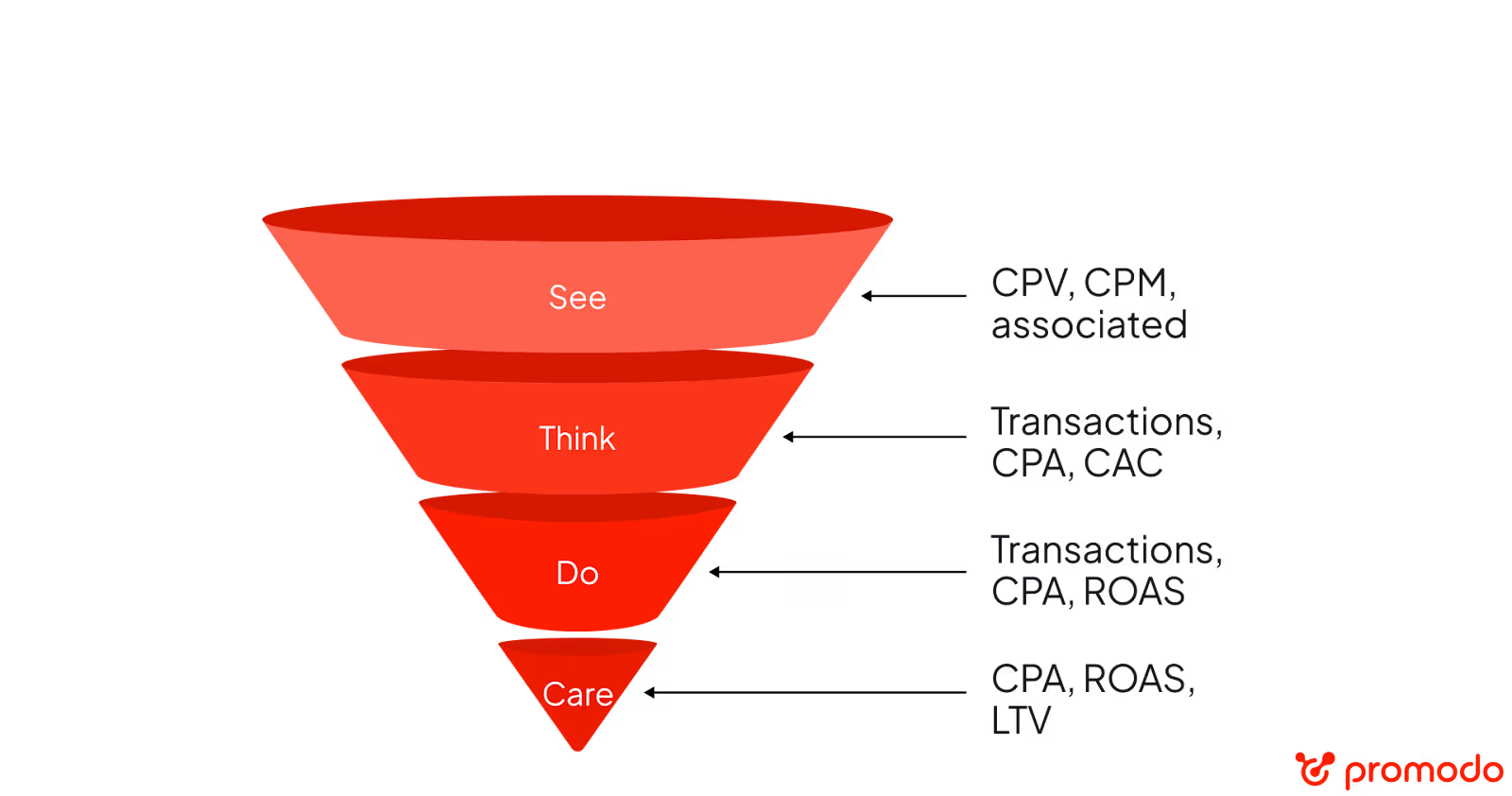
At the See stage, the audience is quite broad. People are interested in the category but don’t have a direct intent to buy. Here, media campaigns are used to introduce the product, so it makes sense to track:
At this level, we evaluate the quality and cost of contact with a new audience and its further impact on the funnel.
At the Think stage, the user is more interested in the product but is not ready to buy yet. The goal is to get into the customer’s consideration set, capture their interest, and push them to the next step.
Relevant KPIs in this case are:
Micro conversions indicate whether traffic is high-quality and whether users are moving toward a decision. Macro conversions and transactions confirm the actual result.
CPA and CAC help you understand how much this movement toward purchase costs and how much the customer costs. At this stage, it’s important not only to increase the volume of actions but also to control their cost, because this is where the channel starts becoming efficient.
At the Do stage, the user is ready to buy and is looking for where to complete the purchase. The goal here is to capture the user and complete the transaction.
You should track:
At this stage, you are working with direct intent, so you measure specific results. Transactions show sales volume. CPA shows how much each purchase costs and whether you stay within your acceptable margin. ROAS shows whether the ad budget pays off and whether you can scale campaigns without losing profitability.
Care is the stage where the client has already made at least one purchase. The goal is to retain the customer and encourage repeat purchases.
KPIs at this stage:
Here, LTV is added to the Google Ads metrics list because you are not evaluating a single purchase, but the total value of the customer over the entire period of interaction. LTV shows whether your acquisition costs were justified and whether retention generates long-term profit.

Copywriter at Promodo
Over nearly three years as a copywriter, I’ve written for US and European startups and companies, including SE Ranking. I enjoy working with words—finding the right phrasing, organizing ideas, and turning them into clear and useful content that shows real value and helps businesses grow.
You may also like
Choose quality and trusted services to improve the presence of your company on the Internet, and feel free to contact our UK team if you have any questions.
.avif)
In this article, we'll explore the current marketing trends around selling online courses.
.avif)
Our team has gathered practical AI use cases that help online stores sell more.

Remarketing is one of the most efficient forms of display advertising.
We at Promodo are ready to help you improve your performance across all digital marketing channels.
Get started



.avif)

.svg)


