



Content



Journalist at Promodo
For over 6 years, I have been working as a journalist in the communications and marketing industry. I help brands communicate effectively through written content, engage with market experts, and create professional materials on topics related to business and marketing, sharing insights on working with marketing tools.

In 2024, Meta officially rolled out a new ad algorithm, Meta Andromeda, which has fundamentally changed how ads are selected and delivered to users. That’s why now is the right moment to understand how your business can adapt to these changes and avoid losing performance in paid channels.
In the new article, the Promodo team explains how the Meta Andromeda algorithm works and why creatives are becoming the central component of advertising.
Meta Andromeda is a new machine-learning model that decides which ad to show to a specific user.
Before Andromeda, the system worked something like this:
This approach was slow, hard to scale, and often inaccurate. That’s because, in the early stages, the system treated very different ads almost the same way.
Andromeda changed the selection logic. Instead of evaluating all available ads at once, the system quickly filters out what’s irrelevant from the start. When a user opens their feed, the algorithm already understands their behavioral context, not just from the last 30 days, but from a long history of actions, interactions, and patterns.

For example, on Instagram, some users see a short in-app questionnaire where they can choose which ad categories interest them most. These answers serve as direct signals to the algorithm. If a user skips the questionnaire, the system learns on its own by tracking which ads they respond to best.
It works like this: if fashion is relevant to a user right now, ads from other categories are filtered out immediately. From there, the system goes deeper and selects between subcategories, formats, scenarios, and creative types.
The main reason is scale. The number of ad creatives is growing faster than traditional models can process them well. Generative AI has made ad production cheap and easy and feeds flooded with similar-looking content.
This shift also reflects how users behave. People adapt quickly to visual patterns. Creatives that performed well a year ago often fail to catch attention today. In this situation, small tweaks, such as a new background, a different color block, or minor copy edits, rarely send a new signal to the algorithm. The system thinks it’s still the same creative that has already been tested.
As a result, optimization slowed down. Advertisers often ended up fighting the system, trying to push creatives manually that they believed should perform better.
When creatives differ only in product or price, the algorithm has nothing new to learn. In practice, you’re working against the system instead of letting it work for you.
Andromeda was built as a response to this shift. The new model is based on a simple idea: the creative carries the meaning and the context. For mid-size and large businesses, this often comes down to internal processes: being ready to scale production, test non-standard formats, and, in some cases, move away from rigid brand guidelines in performance advertising.
The system first groups all creatives into broad thematic clusters: fashion, fitness, tech, finance, and more. If a user shows interest in a certain category, ads from other categories are filtered out right away.
At every stage, multiple neural models run in parallel. Not one after another, as in the past.
Next, the system looks at early performance signals: interactions, clicks, views, and initial conversions. Most ads are excluded here if they don’t trigger a meaningful response. Only the strongest creatives move on to the final auction.
After this pre-selection, the classic ad auction takes place. The system decides which ad is most relevant to a specific user at a specific moment. This is where the actual CPM and cost per click are formed.

In early March 2026, Meta updated its attribution system, splitting conversions into two types: click-through (which now counts only link clicks) and engage-through (likes, saves, shares, and other social interactions).

Previously, all of these actions were grouped under “clicks”, which often caused discrepancies between data in Meta Ads Manager and Google Analytics. This update should help reduce those differences.
Meta also changed the engaged-view window for video ads, reducing it from 10 seconds to 5 seconds. This is especially relevant for Reels, where Meta reports that nearly half of purchase conversions happen within the first two seconds of viewing.
The changes will take effect starting in March 2026 for campaigns optimized for web conversions. Meta is also integrating the new attribution model with third-party platforms Northbeam and Triple Whale.
From an advertiser’s perspective, the biggest shift is the widespread expansion of Advantage+. It’s now on almost every level of ad setup: audiences, budgets, placements, and ads.
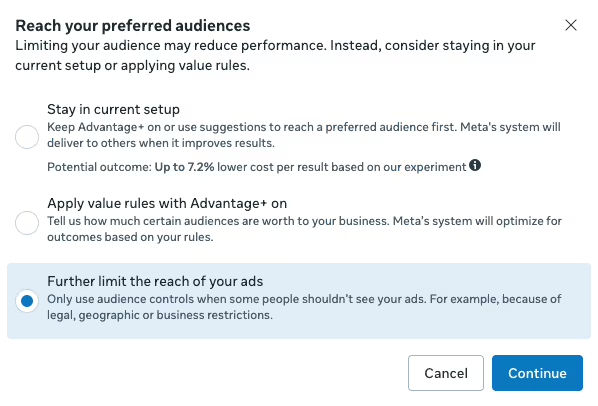
Manual settings haven’t disappeared, but without additional constraints, they now act more like signals to the algorithm. For example, age and gender limits can still be set as hard targeting rules. Interest targeting, however, works as a recommendation. This way, you tell Meta which audience you believe is more important to your business. The only setting that hasn’t changed is location targeting: geography is a strict rule.
[[SLIDER-START]]


[[SLIDER-END]]
Placements are a separate topic. Handing them over fully to automation can be risky. User behavior differs significantly across feeds, Stories, and Reels, and so does format performance. In practice, manual placement control often delivers more stable results than full automation.
Recently, Meta added a new AI-powered feature to Advantage+ called “Describe Your Audience”. Instead of manually searching for interests one by one, advertisers can now describe their target audience in plain text — who these people are, what they’re interested in, and what they tend to buy.
The system analyzes this description and automatically suggests relevant interests for targeting, while also explaining the logic behind its recommendations.
For example, if you describe your audience as “women aged 21–45 in the U.S. who are into fashion and shop for clothes online,” the system may suggest interests like Clothing, Fashion Brands, or Fashion Media. This doesn’t change how Advantage+ works overall.
Interests still act as signals for the algorithm rather than strict targeting limits, but the feature significantly speeds up campaign setup.
Andromeda uses early user reactions to determine whether an ad has a chance of reaching the final auction. That’s why small, cosmetic variations of the same format rarely create a new signal and are filtered out quickly.
What this means in practice:
Businesses that move away from old templates faster and start experimenting will gain an advantage over competitors who stick to past strategies.
For campaigns with longer purchase cycles or higher-priced products, ads need to generate early engagement signals.
What you should do:
From our experience, Andromeda identifies a few top-performing creatives within 1–2 days and directs most impressions to them. To prevent the algorithm from pushing all traffic to them, we isolate the remaining creatives. We duplicate the ad set, move all non-performing creatives there, and assign them a separate budget. This approach gives the system space to reassess those creatives without competing against obvious favorites and generates additional signals for optimization.
Another key change is scale. With one of our clients, we used to launch five creatives every two weeks. After we explained how Andromeda works, they increased production to 15–20 creatives, and it worked.
Andromeda performs best when it has enough data and isn’t limited by heavy segmentation.
What to do:
Meta doesn’t automatically see what users do after they click an ad. The system only uses the actions you send through Pixel or the Conversions API. That means data quality directly affects optimization.
What’s worth checking:
For mid-size and large businesses, adapting to Andromeda is often less about the PPC team and more about internal limitations. The algorithm expects a steady flow of fresh signals, and that’s hard to deliver without fast internal decision-making.
At the process level, this usually means:

Journalist at Promodo
For over 6 years, I have been working as a journalist in the communications and marketing industry. I help brands communicate effectively through written content, engage with market experts, and create professional materials on topics related to business and marketing, sharing insights on working with marketing tools.
You may also like
Choose quality and trusted services to improve the presence of your company on the Internet, and feel free to contact our UK team if you have any questions.

With a global shift to digital marketing, travel industry businesses are extremely focused on attracting potential clients, boosting online presence, and drivin

Sometimes, ecommerce business owners give shopping behaviour analysis a miss, examining only separate indicators such as conversion rate or bounce rate.

Email marketing is a powerful tool for reaching the target audience and expanding the client base.
We at Promodo are ready to help you improve your performance across all digital marketing channels.
Get started




.svg)


