


Content



Journalist at Promodo
For over 6 years, I have been working as a journalist in the communications and marketing industry. I help brands communicate effectively through written content, engage with market experts, and create professional materials on topics related to business and marketing, sharing insights on working with marketing tools.
.avif)
Google is gradually embedding advertisements into its AI-powered search experience and developing new protocols to enable seamless in-interface purchases. Below, we break down the latest features announced and currently in testing in the U.S.
Last year, users began experiencing a new way to search: Google AI Mode. Instead of the traditional list of links, this interface provides AI-generated responses that let users ask follow-up questions, compare products, or request detailed explanations—all within a single window. Given its convenience, the introduction of direct advertising into AI Mode was only a matter of time.
Google plans to display promotional offers directly within these AI responses, reaching users when they shift from general research to specific product selection. These offers will be clearly labeled as "Sponsored" and integrated naturally into the conversation flow rather than appearing as isolated ad blocks.

It is likely that Google won’t require creators to build entirely new ads for AI Mode. Instead, commercial offers will be pulled from existing Google Ads campaigns—specifically Search and Shopping ads that sync with Merchant Center and product feeds. In short, AI Mode will tap into the same advertising database but serve it in a new format: embedded directly within the AI’s response.
For businesses, this means the focus isn't on a new "ad type," but rather on the quality of product feeds, structured data, and offer relevance. If a product is already correctly optimized within Google Ads, it is technically positioned to appear in AI responses as the format scales to new markets. For now, however, this remains a strategic projection.
As a standalone feature within AI Mode, Google is launching Direct Offers. This format allows advertisers to present a targeted promotion at the exact moment a user is on the verge of making a purchase.
Direct Offers function through Google Ads, where advertisers can attach a specific incentive to their campaign—such as a 20% discount. From there, Google’s system autonomously determines the optimal moment to serve that offer within the AI Mode interface.
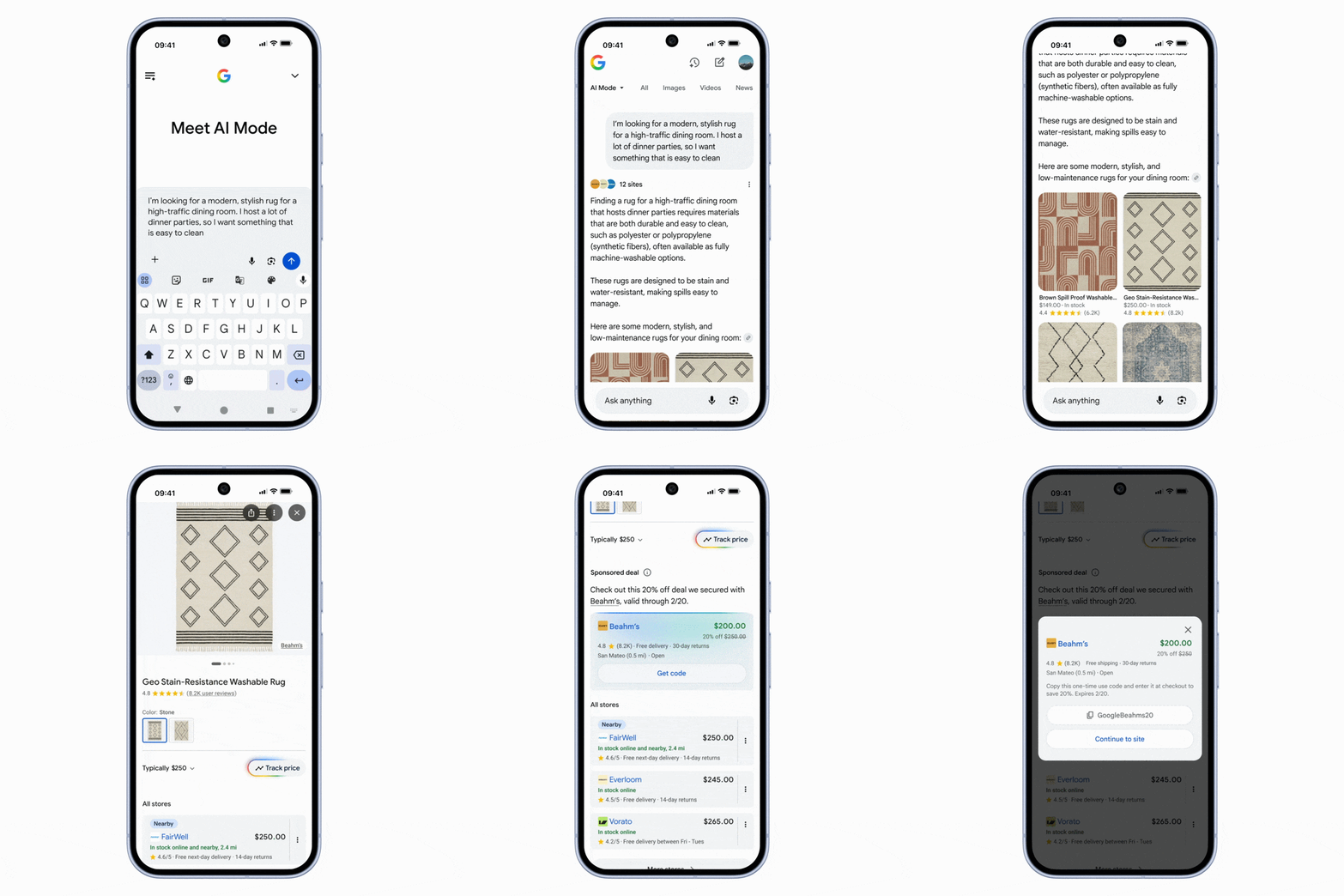
This new mechanic is already being piloted by major brands like Petco, e.l.f. Cosmetics, Samsonite, and Rugs USA, as well as various Shopify merchants. While Google’s current focus is on discounts, the roadmap includes expanding to other offer types that help shoppers prioritize value over price alone—think product bundles or free shipping incentives.
Finally, it’s worth noting the Agent Payments Protocol (AP2). This is a technical framework Google is launching to facilitate seamless purchases within AI environments. As AI Mode evolves from a recommendation engine into a full-service shopping hub, Google is building this standardized mechanism to ensure secure, frictionless payment processing directly within the interface.

AP2 defines the architecture for how AI interfaces interact with payment infrastructures—governing data transmission, identity verification, and transaction logging.
In tandem, Google has launched the Universal Commerce Protocol (UCP), a broader standard designed to regulate how businesses engage with AI agents throughout every stage of the customer journey. This goes beyond simple payments; it encompasses product data, real-time availability, shipping terms, and digital identification.
Through UCP, "in-app" ordering is already being rolled out in the U.S., allowing users to purchase items from Etsy and Wayfair directly within Google Search's AI Mode and the Gemini app. Support for Shopify, Target, and Walmart is expected to follow in the near future.
In December 2025, reports surfaced suggesting that Google planned to introduce advertisements directly into the Gemini chatbot. These claims were swiftly refuted by Dan Taylor, Google’s Vice President of Global Ads. Taylor clarified that there are currently no ads within the Gemini app and that the company has no immediate plans for a rollout. For now, Gemini’s role remains instrumental, serving as a tool to streamline AI-powered features used within Google Ads.

At the same time, OpenAI was the first to publicly acknowledge the possibility of introducing ads into ChatGPT—and as of February 2026, they have officially begun testing advertisements for users on their Free and 'Go' subscription tiers in the U.S.
A standout development is AI Max, an extension for Google Ads search campaigns powered by Gemini’s advanced capabilities. Its primary objective is to interpret user intent with much greater depth. Rather than being restricted to a fixed list of keywords, the system analyzes the full context of a query. This allows it to surface ads for related or broader search terms that an advertiser might not have initially anticipated.
In effect, Google is gradually shifting the heavy lifting—such as expanding semantics and testing new queries—to the AI model. The advertiser provides the strategic direction and objectives, while the system autonomously identifies new growth opportunities and optimizes ad delivery based on the likelihood of conversion.
For a deep dive into the technical nuances of AI Max, you can explore the full breakdown in our feature on Promodo.
Journalist at Promodo
For over 6 years, I have been working as a journalist in the communications and marketing industry. I help brands communicate effectively through written content, engage with market experts, and create professional materials on topics related to business and marketing, sharing insights on working with marketing tools.
You may also like
Choose quality and trusted services to improve the presence of your company on the Internet, and feel free to contact our UK team if you have any questions.

Together with a top Promodo expert, we break down the most common strategic SEO mistakes businesses make.
.avif)
Understanding the key metrics for each channel is crucial to set realistic goals for your marketing team or agency, and evaluate whether those goals are met.

With 92.96% of online traffic coming from Google, we have reached the point when there is no need for trend hunting: it is now when trends are hunting us.
We at Promodo are ready to help you improve your performance across all digital marketing channels.
Get started


.svg)


