


Content


Copywriter at Promodo
Over nearly three years as a copywriter, I’ve written for US and European startups and companies, including SE Ranking. I enjoy working with words—finding the right phrasing, organizing ideas, and turning them into clear and useful content that shows real value and helps businesses grow.

Team Lead of PPC Department at Promodo
Yuliia has been working in internet marketing for more than 15 years. She worked with different leading clients in varied industries. Now she leads her own team.

AI Max was introduced last year and has become one of the most significant updates to Google Search campaigns. However, there are important aspects businesses need to consider before enabling it.
In this article, together with Yuliia Beresnieva, PPC Team Lead at Promodo, we’ll explain what AI Max for Search in Google Ads is, whether it’s the right fit for your business, and share practical tips for working with it.
Dynamic Search Ads (DSA) campaigns will automatically upgrade to AI Max in February 2027. As of June 15, 2026, Google has also restored the ability to create new DSA campaigns.
AI Max is a set of features in Google Ads that expands the capabilities of search campaigns using Google’s AI.
These features automatically optimize ad relevance and ad content. As a result, ads better match user search intent, which increases the potential for conversions.
The main goal of AI Max is to expand semantic reach and generate more impressions and traffic. It may not lower traffic costs, but it will seek additional audiences likely to convert. The value lies in identifying relevant demand that would be difficult or nearly impossible to capture manually.
AI Max can also handle longer, more conversational search queries that users typically enter into LLMs.
In practice, instead of relying strictly on predefined keywords, audience, and scenarios, the system analyzes the user’s query, context, account signals, and website content. Based on that data, it determines which search queries to target, which ad to deliver, and which landing page to direct the user to.
Google is testing AI Max in standard Shopping campaigns in the US. It can potentially make Shopping with AI Max almost comparable to Performance Max.
AI Max includes two core features: search term matching and asset optimization.
Search term matching allows your ads to appear for queries that are not included in your keyword list as users don’t always search using the exact keywords you target. AI Max analyzes your existing keywords, ad copy, and website pages to identify additional relevant queries that have conversion potential.
Asset optimization automatically adapts your ads to match a user’s search query better.
This includes two main capabilities:
When AI Max for Google Ads is enabled at the campaign level, these features are activated by default. However, each function can be turned off separately if needed.
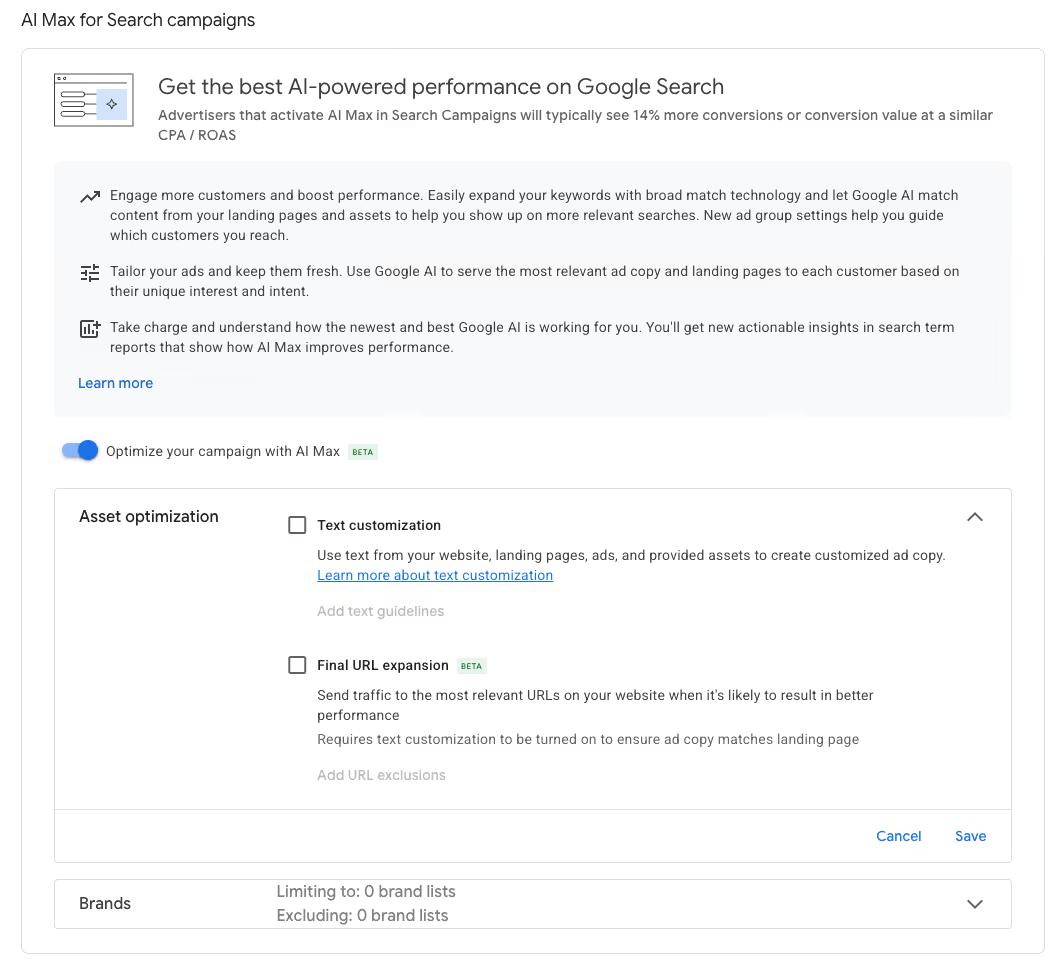
As a result, users see more relevant ad messaging and land on a more appropriate page, which improves campaign performance and increases the likelihood of conversion.
According to Google, advertisers that activate AI Max in Search campaigns achieve, on average, 14% more conversions or conversion value at a similar CPA/ROAS. For campaigns that are still mostly using exact and phrase keywords, the uplift can reach 27%.
AI Max for Search campaigns in Google Ads works only if your account and website are properly prepared.
Before enabling AI Max, you need to define what outcome matters most for your business. The search campaign should be aligned with a specific objective.
Your website must comply with Google policies, include clear CTAs, clearly presented benefits, and other elements that the algorithm can use to optimize your ads.
For AI Max to work effectively, each ad group should receive at least 3,000 impressions over the past 7 days.
That’s why it’s recommended to group keywords around landing pages rather than keeping segmented ad groups built around individual product models.
Before enabling AI Max, your campaign shouldn’t be limited in budget. Spending limits can negatively impact performance.
The recommended minimum budget for a campaign using AI Max is $50 per day.
AI Max can scale demand effectively, but it also reduces category control. The system may start capturing search queries that don’t always align with the business’s priorities.
It doesn’t mean the feature is ineffective or that you should avoid it. It simply means you need to take this pattern into account.
We had a case where a search campaign was launched for one specific product category, but part of the traffic started to come from queries related to a different category.
This becomes critical when a business needs to strengthen or scale a particular category. If demand expands in a different direction, the campaign may not achieve the intended business goal, even if it shows overall growth.
The algorithm’s learning phase may cause this behavior. The other reason can be that the campaign is set for some categories rather than across the entire account. However, irrelevant queries like that remain a real challenge.
For PPC teams, this often creates internal resistance. Traditional search campaign logic is built around a clear structure: category → query → ad → landing page. When this connection becomes less predictable, it is harder to ensure that increasing the budget will drive growth in the exact category the business wants to scale.
That is why teams don’t roll out AI Max without careful evaluation. Many of them test it on selected projects. If it doesn’t deliver the expected outcome, they turn it off. This shows that AI Max does not fit every scenario and requires clear boundaries and control.
— Yuliia Beresnieva, PPC Team Lead at Promodo
AI Max may perform well in single-category or highly focused niches, where there is less category variation and a lower risk of traffic dilution.
No, you shouldn’t do it right away. Wait six weeks to give the algorithm time to learn. You can’t make any changes during the first 14 days. Actually, changes are not recommended during the remaining 4 weeks as well. The only exception is a budget adjustment of up to 20%.
It’s important to understand that campaign performance depends on the quality of setup and the strategy. Also, the extension may not deliver immediate results; it takes time.
Under the right conditions, the main advantages include:
AI Max identifies search queries beyond your predefined keyword list. This allows you to capture additional search demand without manually expanding your keyword coverage.
Because the system adapts ad text and selects landing pages based on a specific query, users see more relevant messaging and land on a page that is more relevant to them.
AI Max operates within defined constraints, so you can maintain control and precision even with automation enabled.
Automatic adjustment of queries, text, and landing pages reduces the need for constant manual testing and scaling. The campaign can respond to changes in demand more quickly.
Reporting in Google Ads shows how AI influences search queries, ads, and landing pages.
Before enabling AI Max, you should assess if this approach aligns with your business conditions. In some cases, it may underperform or create additional risks.
AI Max can adjust wording and tone in ads. If your brand cannot allow any deviation from approved messaging, this may not work for you.
In industries with strict wording requirements, automatically generated or modified content may not comply with regulations.
Because AI Max dynamically selects landing pages, it may not be suitable if you need to promote only one fixed page or if your website is still growing and doesn’t have that many quality and relevant pages for the system to choose from.
AI Max can help capture additional demand beyond your keyword list and improve how queries, ads, and landing pages align. At the same time, it doesn’t always deliver results immediately and requires careful setup and monitoring.
Before you launch it, make sure AI Max fits your case. The extension can be effective, but it works best when tested thoughtfully and evaluated against your specific business priorities.

Copywriter at Promodo
Over nearly three years as a copywriter, I’ve written for US and European startups and companies, including SE Ranking. I enjoy working with words—finding the right phrasing, organizing ideas, and turning them into clear and useful content that shows real value and helps businesses grow.
Team Lead of PPC Department at Promodo
Yuliia has been working in internet marketing for more than 15 years. She worked with different leading clients in varied industries. Now she leads her own team.
You may also like
Choose quality and trusted services to improve the presence of your company on the Internet, and feel free to contact our UK team if you have any questions.

Since 2018, breadcrumbs are part of SERPs. Today, Promodo’s digital marketers will cover what marketers need to know about breadcrumbs and their implementation

US retail eCommerce reached $340.2 billion in the second quarter of 2026, up 12.2% year over year, and now accounts for 17.1% of all retail sales.

The key elements of a brand are branding, brand identity, and logo that serve multiple purposes. Our new blog post reflects on the main concepts of branding.
We at Promodo are ready to help you improve your performance across all digital marketing channels.
Get started




.svg)


