


Content


Copywriter at Promodo
Over nearly three years as a copywriter, I’ve written for US and European startups and companies, including SE Ranking. I enjoy working with words—finding the right phrasing, organizing ideas, and turning them into clear and useful content that shows real value and helps businesses grow.

If you’re deciding how to split the budget between PPC and SEO, you’re likely facing a challenge: you need results but are scared to choose the wrong strategy.
In this article, you’ll read about the difference between PPC and SEO from a startup perspective. We look at these channels as tools that behave differently depending on timing and intent.
We’ll break down how PPC and SEO work at each stage of growth, what risks they introduce, and how teams combine them without wasting budget or time.
There is no universal PPC vs SEO split that works for every startup. The ideal solution is a combination of both: start with PPC and support with SEO. But the right mix depends on your marketing strategy.
In the first 3 months, PPC is the fastest way to find out what gets clicks and sign-ups. SEO is more efficient after 6+ months. It will lower the CAC and create a steady source of organic traffic.
“Every strategy is unique. What works depends on the startup’s niche, brand awareness, target audience, stage, and many other factors. There’s no universal approach that works for everyone.”
— Yuliia Beresnieva, Team Leader of the PPC Department at Promodo.
PPC (Pay-Per-Click) means posting an ad and paying a fee only when someone clicks. PPC can be used to drive conversions (leads, sign-ups, sales) and to test demand and messaging quickly.
SEO (Search Engine Optimization) means improving your website and content so it appears in organic search results. SEO doesn’t bring instant traffic, but over time, it can generate steady visits without paying for each click and reduce acquisition costs.
The key difference for startups is how quickly each channel delivers usable results.
PPC works faster. Within 2-3 weeks, you can see whether people click, sign up, or request a demo. That’s why PPC is often used when early-stage teams need to prove traction and show progress quickly.
SEO works on a longer timeline. In fact, research from Ahrefs shows that only 1.74% of new pages reach the top 10 within their first year, while 72.9% of pages ranking in Google’s top 10 are over 3 years old. It means SEO usually takes time to deliver meaningful results.
This timing gap matters when resources are limited. If you need fast answers, PPC gives you feedback sooner. SEO requires patience and is less forgiving when results are expected quickly.
“In some cases, I had to say no to a customer because SEO wouldn’t work within the required timeframe.”
— Vladyslav Trishkin, SEO Team Leader at Promodo.
Let’s take a look at what makes the most difference when you compare SEO and PPC and choose what to prioritize.
Here you see a general comparison, but real decisions are easier to make with professional help.
My best advice would be to ask specialists to analyze your case and develop the most appropriate and effective marketing strategy.
— Vladyslav Trishkin, SEO Team Leader at Promodo.

PPC is the best option to start with if you’re an early-stage startup. Search ads bring first customers faster and show what people actually look for, which messages resonate, and which offers fail.
Does it mean you don’t need SEO at the start? No, it doesn’t. If you’re launching the PPC campaign, you should have your website prepared.
Another thing to remember: at the very beginning, the conversion rate can be lower and more expensive as you have fewer traffic channels.
“If it’s a new project that’s still building its brand and has no organic traffic yet, PPC won’t be very cost-effective at the beginning.”
— Yuliia Beresnieva, Team Leader of the PPC Department at Promodo.
Key takeaway:
Use PPC to start fast. Start SEO to prepare your site for PPC campaigns.
At the seed stage, you want to improve messaging, control costs, and avoid channels that don’t scale.
Here, PPC works best as a testing tool. You can use smaller budgets to compare value propositions, ad copy, and landing pages.
SEO should stay focused. Teams usually start with expert- or founder-led articles that target specific high-intent searches. This way, you build early credibility and organic visibility without spending too much.
This approach fits the current market reality. Data from Gartner shows that marketing budgets remain flat, while generative AI improves productivity through time savings (49%) and cost efficiency (40%). Content is cheaper to produce, but paid traffic isn't getting more affordable.
Because of this, Seed-stage teams usually rely more on organic traffic and use paid ads selectively.
Key takeaway:
Use PPC to learn what converts. Use SEO to grow traffic without increasing ad spend.
At Series A and beyond, growth is driven as much by existing customers as by new ones.
Benchmarkit tells that about 40% of new SaaS revenue comes from expansion, and for companies over $50M in revenue, it’s more than half. That means growth comes from helping current customers use the product more.
PPC is still valid at this stage. It works well for branded search, high-value keywords, product launches, and retargeting. But PPC is rarely effective for retention or upsell.
Then, SEO, including educational content, use-case pages, and product explanations, helps customers adopt more features and stay longer.
Key takeaway:
At Series A and beyond, PPC is best used to capture and protect high-intent demand, while SEO is used for retention and expansion revenue.
At Promodo, we help with both SEO and PPC. We’ve gathered a few use cases to demonstrate how SEO and PPC can help bring new customers, outperform competitors, and efficiently launch new concepts.
Claspo is a pop-up form and notification builder to boost website sales. When we started working with them, their goal was to attract relevant organic traffic and outrank competitors in organic search.
The point was that in the US SaaS market, most organic demand comes from informational searches, and competition is high. That meant SEO content had to show real expertise and be useful on its own.
We started with competitor and keyword analysis to understand where demand already existed, how fast competitors were growing, and which topics showed clear conversion potential. We also reviewed Claspo’s existing content to identify pages that were already driving traffic or leads and could be improved.
Based on this, we built a content strategy. We involved the copywriters in writing 10 new content pieces and optimizing 10 existing blog posts each month. We targeted keywords with sufficient search demand and integrated CTAs that encouraged users to explore the product without breaking the informational flow.
To support trust and EEAT, all content was tied to real authors with relevant expertise and transparent profiles.
Result:
From August 2023 to July 2024, we created and optimized 285 articles. It led to 59,278 organic clicks in Google Search Console, an 81.3% increase over the year.

The Place Group is a provider of premium office spaces, co-working areas, and meeting rooms in Dubai and across the UAE. They wanted us to help them launch a brand within the commercial real estate market in Dubai.
The initial goal was to attract relevant traffic and leads within a fixed marketing budget. The expected audience was freelancers and real estate agents, but we also saw an opportunity to reach larger companies.
At the start of the project, we launched paid campaigns across Facebook Ads, LinkedIn Ads, and Google Ads. Facebook and LinkedIn were used to target professions, interests, and business roles, while Google Ads focused on users actively searching for office space.
Early results showed that social platforms did not deliver enough qualified demand. Based on performance data, we shifted the majority of the budget to Google Ads. The intent was higher, and the conversion potential was clearer.
We ran multiple Google Ads formats, including English- and Arabic-language search campaigns, dynamic search ads, and remarketing. Search campaigns performed best, as users were actively looking for office space when they needed it. Arabic-language ads helped reach local audiences with higher budgets for premium rentals.
Ad messaging highlighted the client’s key advantages, such as location, transport access, amenities, and available discounts. We included these elements directly in ad texts and extensions to improve relevance and click-through rates.
Result:
Within roughly 16 months, this PPC-focused approach helped The Place Group establish a strong market position. By the end of the project, all vacant offices at their The One Tower location were rented, and demand exceeded initial expectations.
We worked with Monobank, a fully digital bank that offers all banking services through its app. The main goals were to attract new users, encourage them to install an app, and activate the card.
We also aimed to increase brand awareness, as people were more familiar with traditional banks, and Monobank was a new concept.
We focused on following the classic consumer behavior model AIDA — awareness, interest, desire, and action — to guide our promotion strategy.
Before the app launched, we promoted the landing page through social media and display ads to generate early interest and email sign-ups. This included Facebook campaigns that highlighted the bank’s features and benefits.
Once the app was released in the App Store and Google Play, we added ASO (App Store Optimization) to improve visibility and make the app easier to find and download. At the same time, we ran campaigns across Google Ads, Facebook, Instagram, and other channels to drive users directly to the app.
In the next stage, we used video ads across platforms to broaden reach and reinforce the brand message. To increase the relevance of these ads, they were customized to seasonal behavior, for example, around holidays.
We also set up remarketing campaigns to re-engage people who had interacted with the landing page, installed the app, but did not activate the card, or installed the app but did not complete key actions. These campaigns helped capture users at different points in the funnel.
Result:
The initial target for Monobank card issuance was reached three months earlier than projected. The customer base grew to about 400,000 at that time.

PPC is best for speed. It helps startups capture high-intent traffic quickly. SEO works on a longer timeline and helps build stable organic visibility and lower CAC once demand and positioning are clearer.
The PPC/SEO balance varies as a startup grows. Early on, PPC is the safest option that helps you learn fast, while SEO stays lightweight. At the Seed stage, PPC is used selectively, and SEO starts driving organic traffic. At Series A and beyond, SEO and PPC work together.
The right approach depends on your stage, goals, and time constraints. Contact us to balance pay-per-click vs. SEO correctly and avoid wasted spend and misaligned expectations.
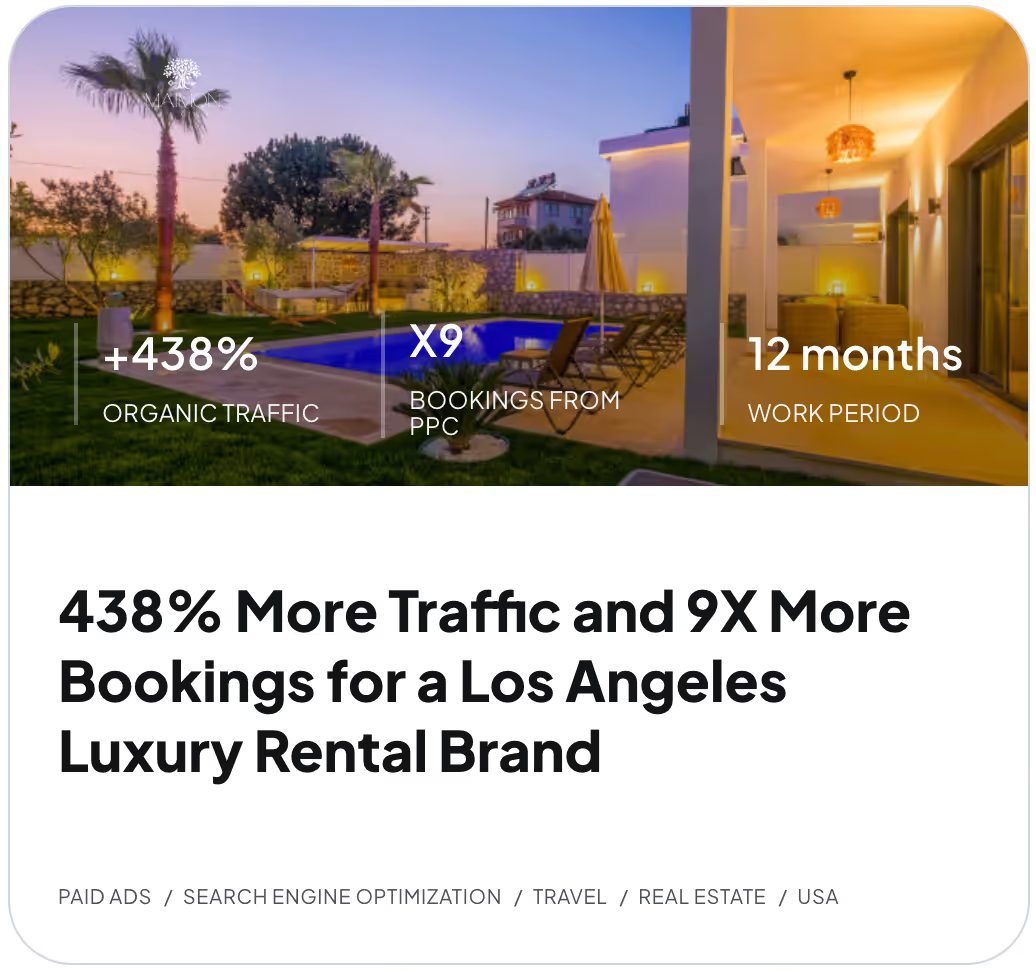
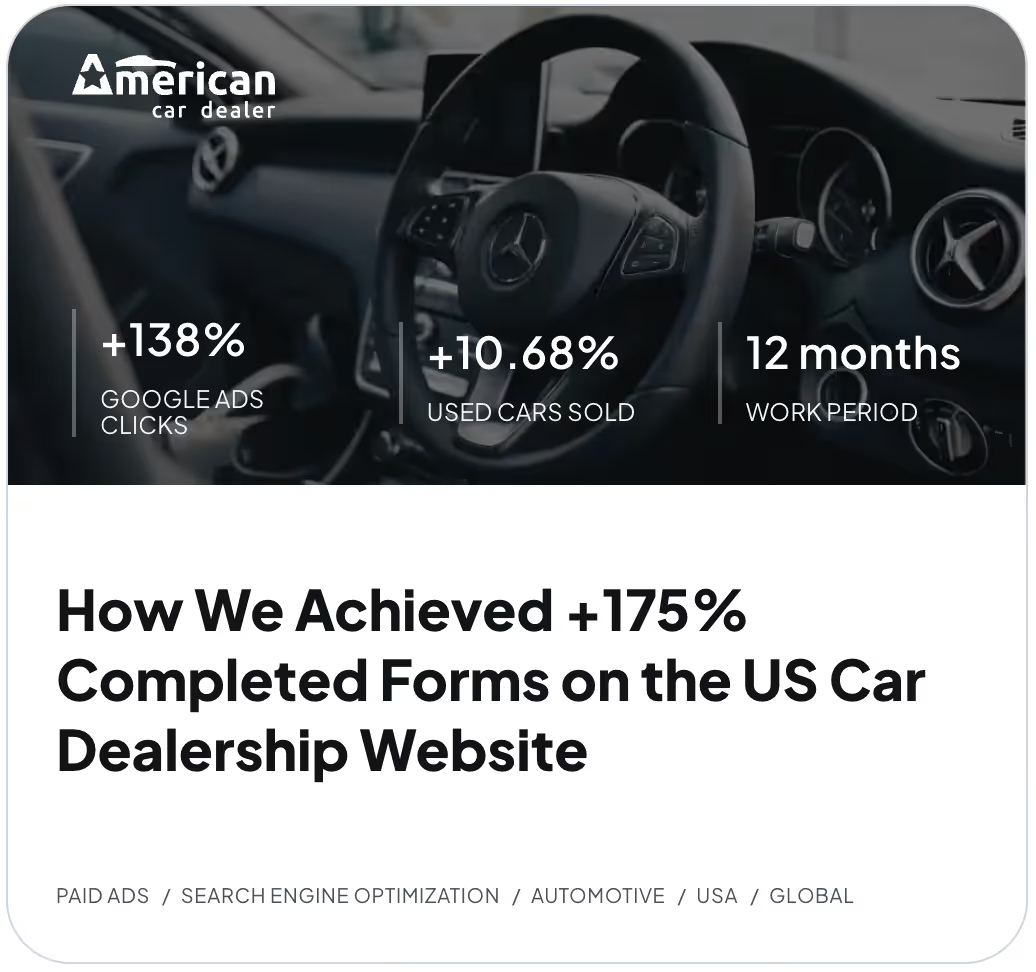
SEO and PPC work well together, and Promodo successfully combines them for many brands.
[[ROW-START]]
[[ROW-END]]
[[FAQ-START]]
It all depends on your case and strategy. Unfortunately, there’s no universal answer.
Yes, but not immediately. SEO lowers customer acquisition costs over time as content starts ranking and brings consistent traffic without paying for every click.
Not necessarily. These two channels can work very well together. SEO can reduce reliance on paid traffic, but PPC is still useful for branded search, high-intent keywords, launches, and retargeting. You can adjust spending rather than switch channels off.
Yes, they can, if they are not coordinated.
Usually, it can take 2-3 weeks. It’s the average time when you can see stable results. If it doesn’t work, you should try changing the approach.
[[FAQ-END]]
Copywriter at Promodo
Over nearly three years as a copywriter, I’ve written for US and European startups and companies, including SE Ranking. I enjoy working with words—finding the right phrasing, organizing ideas, and turning them into clear and useful content that shows real value and helps businesses grow.
You may also like
Choose quality and trusted services to improve the presence of your company on the Internet, and feel free to contact our UK team if you have any questions.

There are many analytics systems and auditors for media advertising: Gemius, Kochava, Kantar CMeter, Singular. \

In this article, Promodo experts will explain how outreach works, why it is important for online commerce, and how to build an effective strategy in 2025.
.avif)
Last year’s CEE eCommerce report showed that 69% of shopping sessions take place on mobile and generate 44% of revenue and 41% of transactions.
We at Promodo are ready to help you improve your performance across all digital marketing channels.
Get started





.svg)


