


Content



Team Lead of Content for promodo.com
Experienced in working with data, expert recommendations, and real business cases to create clear and valuable content that delivers real business impact. Passionate about discovering new insights, exploring industry trends, and turning complex topics into practical, easy-to-understand content.

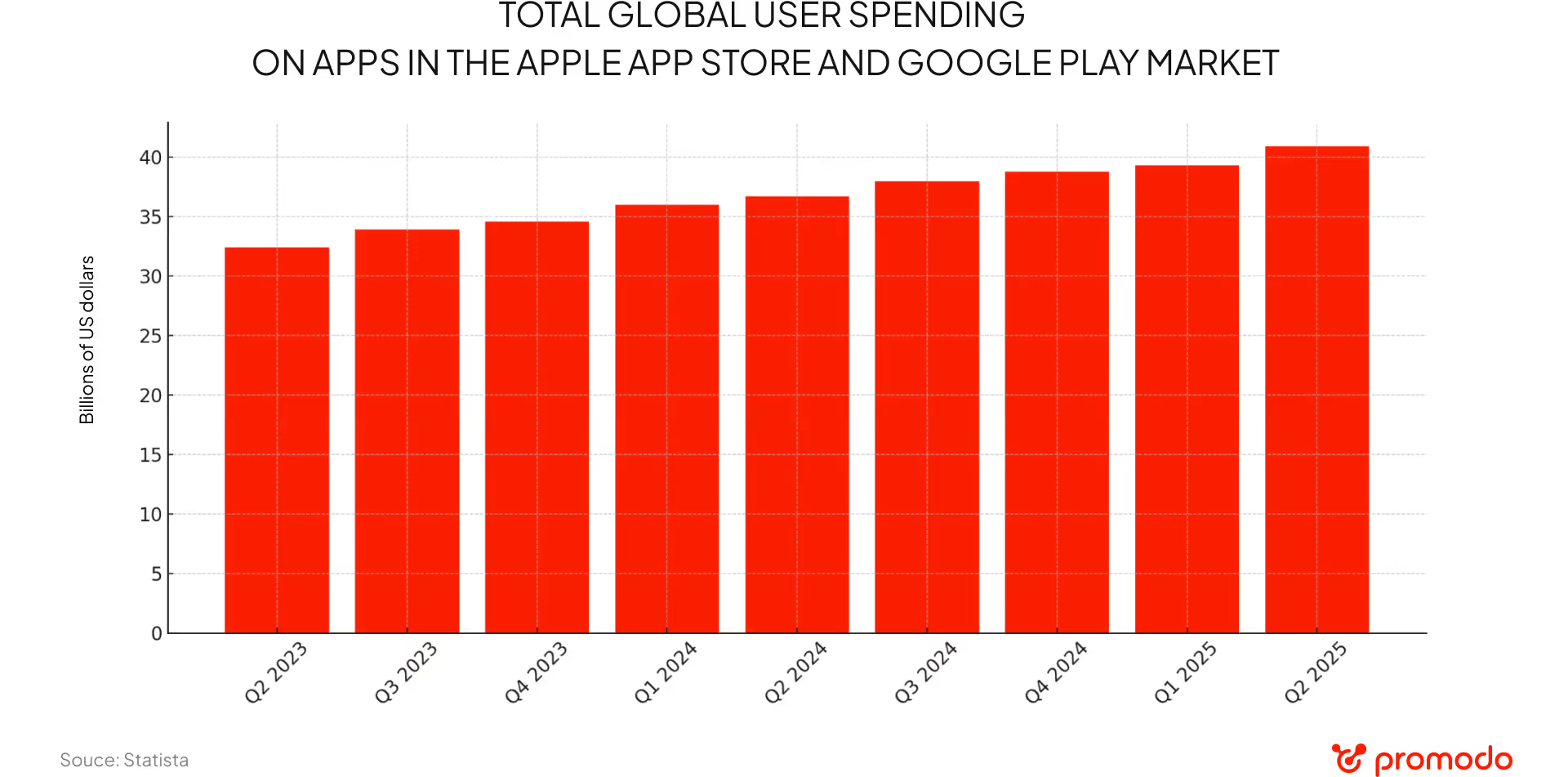
Users increase their spending on mobile apps every year — but competition in the market grows even faster. In this landscape, App Store Optimization remains a core component of mobile marketing. ASO helps apps gain visibility, lower CPI (Cost Per Install) in advertising campaigns, and consistently outperform competitors.
In this article, we’ll explore the key ASO trends in 2026 that are worth adopting right now. We’ll also share practical recommendations and tools to help you promote your app more effectively on the App Store and Google Play — and achieve consistent organic growth.
App Store Optimization (ASO) is a set of actions aimed at improving a mobile app’s visibility in the App Store and Google Play, increasing downloads, and boosting user conversion. ASO includes working with keywords, titles, descriptions, icons, screenshots, reviews, and other elements that influence app discovery and appeal.
In 2026, the mobile app and ASO landscape will be even more competitive — and here’s why:
Undoubtedly, one of the top ASO trends this year is AI because ASO is increasingly powered by artificial intelligence. Instead of manually analyzing keywords, marketers now rely on AI tools to optimize metadata and visual elements. With well-crafted prompts, AI can independently generate metadata, icon variations, as well as ideas and hypotheses for app screenshot design.
Artificial intelligence has integrated into every stage of ASO optimization — from semantic core and metadata analysis to generating visual elements and A/B testing hypotheses. Of course, AI still has limitations; for example, when working with large datasets, there’s a high risk of homogenization.
Vlad Skakovskyi, Senior Mobile App Marketing Specialist
User intent is also on the list the latest trends in app store optimization 2026. App store algorithms analyze not just individual keywords but also the full context and user intent. Instead of stuffing generic keywords, a modern ASO strategy requires naturally written titles, subtitles, and descriptions that score high on Google Natural Language (GNL).
This means your app description should reflect proper latent semantic indexing, the right text sentiment, and relevant keyword entities.
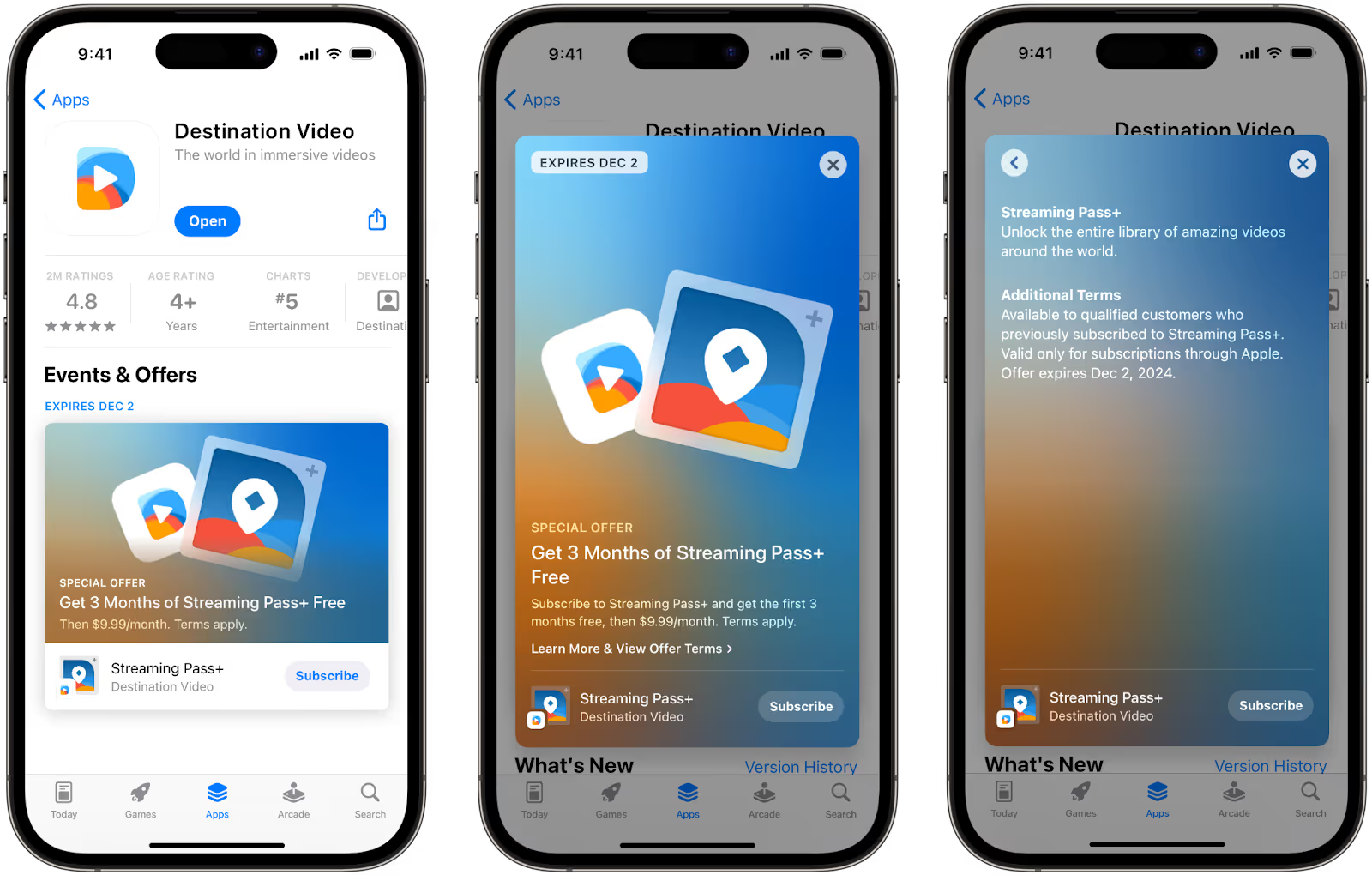
App Store and Google Play now rely heavily on user behavioral signals such as subscription status, activity, and app deletions. For different user segments, you can create tailored pages — Custom Product Pages (CPP) and Custom Store Listings (CSL) — and launch In-App Events or Promotional Content. Additionally, the App Store offers a powerful tool called Win-back Offers, which helps bring back churned subscribers through special, segment-specific deals."
Vlad Skakovskyi, Senior Mobile App Growth Specialist
The global market growth forces developers to “speak the language” of each target country. In 2026, marketers are increasingly localizing descriptions, keywords, screenshots, and icons for each region separately.
During localization, it’s important to consider linguistic nuances — from slang to cultural interpretations.
Vladyslav Skakovskyi, Senior Mobile App Marketing Specialist
According to AppTweak, more than 75% of top apps already localize their metadata for different countries (in the gaming category — 96%). This has a direct impact on visibility: users can find and understand an app in their native language faster, which increases conversion to installs.
Thanks to careful localization performed by the Promodo team, the Dine4Fit app increased the number of keywords ranking in Top-2–Top-5 by 88%, and the total number of indexed keywords by 76%.
Creatives (screenshots, videos, icons) matter just as much as keywords.
In 2026, it’s important to update your visual assets regularly and compare your app’s conversion rate with category benchmarks. Research shows that top apps refresh their screenshots 2–4 times a year, while leading games on Google Play update them up to 8 times annually.
For example, in November most retailers update their app icon for Black Friday to capture user attention and boost installs during the high season.
To run successful A/B tests for visual elements, it’s essential to systematize and prioritize your creative hypotheses. The RICE model works perfectly for prioritization, while the PET model helps structure and evaluate ideas more effectively.
Vlad Skakovskyi, Senior Mobile App Marketing Specialist
In-app events—such as seasonal promotions or new feature releases—are becoming an important visibility tool.
In-App Events and Promotional Content are visual features in the App Store and Google Play that highlight key updates, special offers, important changes, and events inside an app. Each card includes an image or video, a title, and a short description; when tapped, users can view full details and immediately join the event or take advantage of the offer.
The Promodo team was among the first to introduce an in-app event as part of the marketing strategy for monobank — previously, Ukrainian companies in the Fintech & Banking niche had not used this tool at all.
Creative assets play a crucial role in launching In-App Events, as both videos and static visuals can be used. In practice, a mixed approach works best — for example, using animation on the cover and static visuals in the event description.
Vlad Skakovskyi, Senior Mobile App Marketing Specialist
.png)
CPP (Custom Product Pages) are alternative versions of an app’s App Store page that can be tailored to specific audiences, keywords, ad campaigns, or seasonal events.
The main advantage of CPP is the ability to direct users to a more relevant version of your app page, which increases conversion rates, boosts downloads, and improves search visibility. When used in Apple Search Ads (ASA) campaigns, CPPs allow marketers to create highly targeted pages that match user intent.
Studies show that only about 30% of developers use CPPs — but those who do typically see an 8–9% increase in conversion rates.
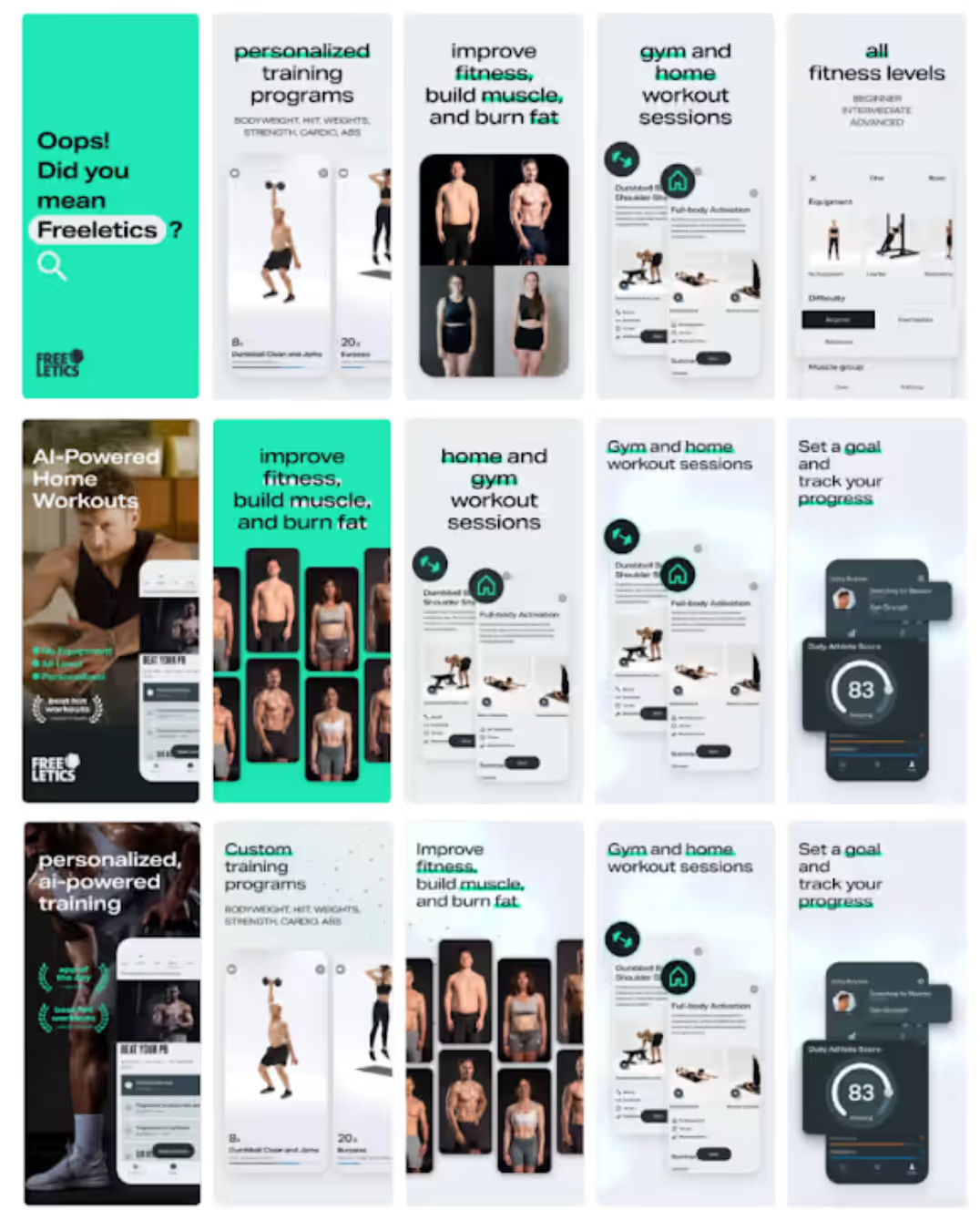
Google Play offers a similar tool called Custom Store Listings (CSL), which follows the same concept but provides even more room for optimization — including the title, short description, full description, icon, and screenshots. Each CSL can be targeted to a specific country or even individual keyword clusters, allowing for highly precise audience segmentation and improved conversion performance.
CSL (Custom Store Listings) is the Google Play equivalent that allows you to create personalized app pages for different countries, languages, audience segments, or even specific paid campaigns.
CSLs enable teams to build alternative app pages tailored to the needs and interests of particular user groups. This level of personalization helps increase conversion rates and significantly improves the overall performance of both paid and organic acquisition campaigns.
Thanks to CPP and CSL, you can significantly increase your app’s visibility in the App Store and Google Play by targeting specific keywords, as well as boost downloads for those queries through optimized visual assets and higher CPP/CSL conversion rates.
Vlad Skakovskyi, Senior Mobile App Marketing Specialist
App store algorithms take into account how users rate your app. That’s why rating and reviews remain one of the key ASO trends 2026. In the Apple App Store, for example, more attention is given to the average rating and user reviews. Apps with ratings below 3.5–4.0 rarely reach the top — conversely, 90% of featured apps have a rating of 4.0 or higher. Therefore, it’s important to monitor feedback, respond quickly to negative reviews, fix issues, and encourage satisfied users to update their ratings.
Ethical data management and privacy are important app store optimization trends 2026. Companies must follow ethical principles in data handling. For example, they should obtain consent only for data that is critically necessary for app functionality and funnel analysis.
Consent is the permission a user gives to collect and use their personal data, including for cookies and other tracking technologies on websites.
It is also critical to comply with GDPR and other regulations to maintain user trust. Respecting privacy increases audience loyalty.
Analytics form the foundation of strategic decisions in ASO. They are needed not only to track installs but also to understand who actually uses the app, where users come from, how specific events perform, and whether the app generates revenue.
In 2026, ASO should focus on:
Additionally, it is important to use marketing analytics with attribution (via services like AppsFlyer or Adjust) and in-app user behavior analytics (for example, through Amplitude, Mixpanel, or Firebase). This enables linking paid channels to real in-app actions and optimizing ASO strategies based on data rather than assumptions.
ASO in 2026 requires a deep understanding of the user, new interaction formats, adaptation to AI algorithms, and the ability to quickly test hypotheses. Those who manage to combine creativity, data, and fast decision-making will gain a significant advantage in app store rankings.
If you’re unsure which ASO trends will be most effective for your business in 2026, reach out to the Promodo team. We’ll help identify priorities, build an optimization plan, and ensure the growth of your app in your niche.

Team Lead of Content for promodo.com
Experienced in working with data, expert recommendations, and real business cases to create clear and valuable content that delivers real business impact. Passionate about discovering new insights, exploring industry trends, and turning complex topics into practical, easy-to-understand content.
You may also like
Choose quality and trusted services to improve the presence of your company on the Internet, and feel free to contact our UK team if you have any questions.

Multilingual SEO works only when you have a clear strategy, well-planned site architecture, and localized content. How do you build it right?

While paid ads generate $2 in return for every dollar spent, real estate businesses consider a pay-per-click (PPC) strategy as a sustainable option.

Have you ever thought of improving your business performance and your brand’s online presence? At Promodo, we take pay-per-click PPC campaigns among the best
We at Promodo are ready to help you improve your performance across all digital marketing channels.
Get started



.svg)


