


Content


Copywriter at Promodo
Over nearly three years as a copywriter, I’ve written for US and European startups and companies, including SE Ranking. I enjoy working with words—finding the right phrasing, organizing ideas, and turning them into clear and useful content that shows real value and helps businesses grow.
In auto parts, the purchase may still happen offline, but the shopping journey increasingly starts online. Buyers search for parts, check fitment, compare prices, and check availability before deciding where to buy. At the same time, mobile shopping, AI tools, and faster delivery are becoming part of that process.
In this research, we looked at the 2026 auto parts eCommerce market, including market size and growth, leading players, traffic sources, buyer behavior, and trends that matter for retailers.
Looking at the broader automotive eCommerce market, which includes parts, accessories, and vehicles, Fortune Business Insights estimates it will reach $135.14 billion in 2026 and grow to $440.83 billion by 2034. North America accounts for around 33% of the global market.
The aftermarket eCommerce segment is growing even faster. Persistence Market Research estimates it at $121.8 billion in 2026, with the market expected to reach $318.1 billion by 2033 — a 14.7% CAGR.
The U.S. aftermarket is already a major market on its own. Mordor Intelligence estimates it will be worth $238.75 billion in 2026 and reach $292.27 billion by 2031, growing at a 4.12% CAGR.
Across sources, one number holds steady: online auto parts sales are compounding at 12–17% annually — roughly double the pace of offline.
One forecast estimates U.S. eCommerce sales of aftermarket parts at around $23 billion, excluding marketplaces, and $44.6 billion including marketplaces.
Independent garages account for just over 56% of the U.S. aftermarket market, according to Mordor Intelligence. Online DIY activity is also growing, with a projected 7.56% CAGR through 2031.
Tariffs are putting pressure on the 2026 outlook. Mobility Global estimates they could reduce aftermarket revenue by 5–6% and squeeze supplier margins. At the same time, the aging U.S. vehicle fleet continues to support demand for replacement and maintenance parts.
Europe’s aftermarket is moving steadily toward online buying. BCG expects the independent aftermarket to reach around €117 billion by 2035, with eCommerce penetration among DIY and IIFM buyers rising from roughly 30% today to 70%. Workshops are moving in the same direction: 58% already use eProcurement, and adoption could pass 70% by 2035.
A growing share of older, out-of-warranty vehicles is likely to keep demand for aftermarket parts high. By the end of 2026, Europe is expected to have around 371 million out-of-warranty vehicles — about 84% of the total fleet. The average vehicle age is also set to rise from more than 14 years in 2026 to 16 years by 2034.
The shift to eCommerce is already visible in market size. Europe’s eCommerce aftermarket is estimated at $91.73 billion in 2026 and could reach $409.10 billion by 2034.
Online retailers are growing with it. AUTODOC reported €484.9 million in revenue in Q1 2026, up 13.5% year over year. In 2025, the company generated €1.81 billion in revenue from 9.3 million active customers across 27 European markets. Kfzteile24 and Oscaro are also among the major independent online parts retailers in the region.

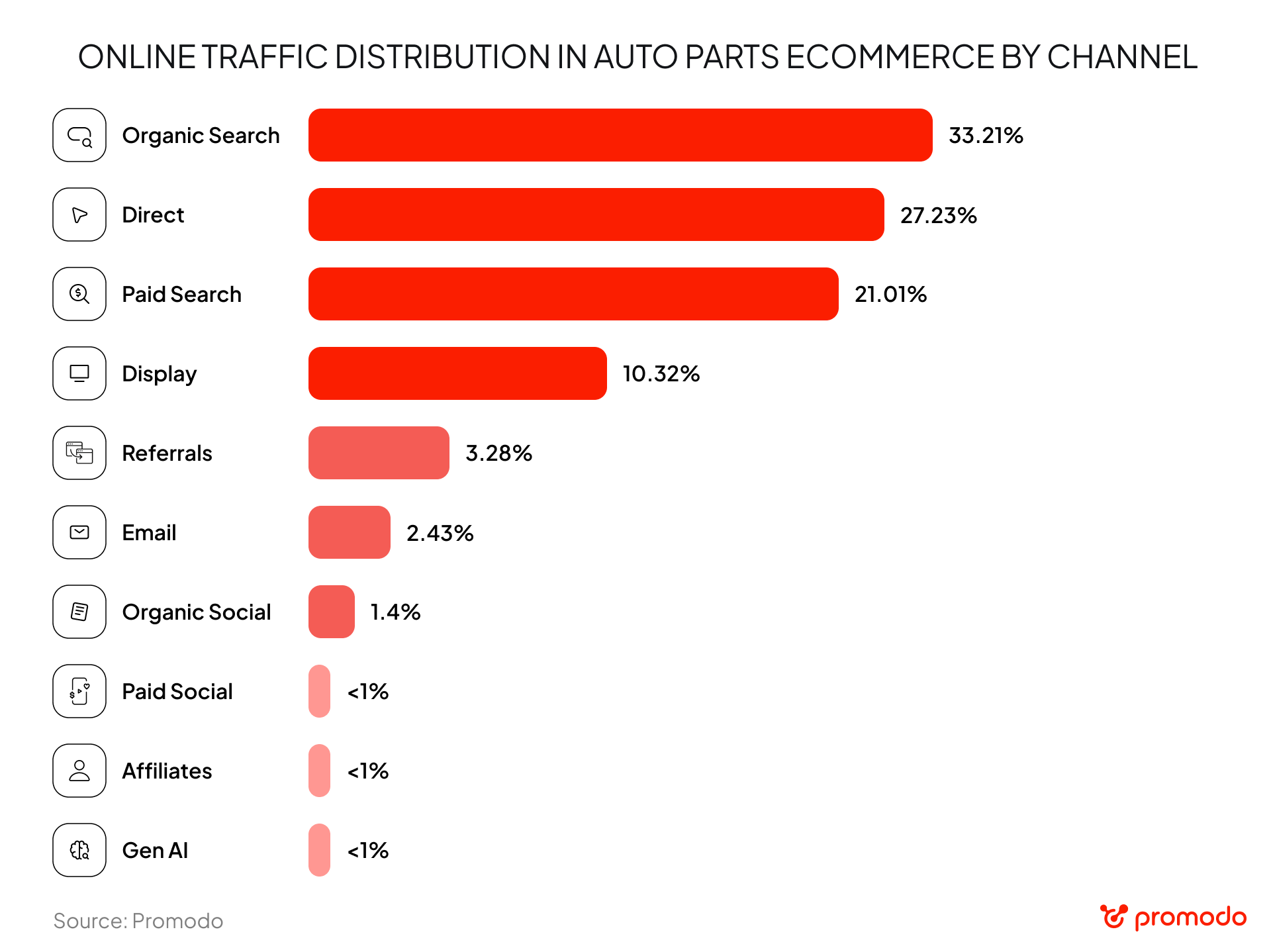
Our Similarweb analysis of some major auto parts retailers shows that organic search, direct, and paid search account for more than 80% of traffic on average. Organic search leads at 33.2%, followed by direct at 27.2% and paid search at 21.0%. Other channels contribute much smaller shares (referrals at 3.3%, email at 2.4%, and Gen AI at 0.3%).
The U.S. market has a mix of large parts chains and online marketplaces. Major players include:
The market remains fragmented, with no single retailer dominating across both physical and online channels. AutoZone, O’Reilly, and Genuine Parts Co. have also shown strong profitability and capital efficiency among major aftermarket distributors over the past five years.
North America leads the global aftermarket by revenue. Europe is expected to grow fastest by market value, while Asia Pacific is adding vehicles at the fastest rate. China is a major market in the region, with automotive eCommerce estimated at $15.5 billion in 2026. Major platforms include Tmall Auto, JD Auto, and Alibaba.
At the beginning of 2026, the average age of cars and light trucks on U.S. roads reached a record 13 years. Domestic vehicles are more than three years older on average than foreign nameplates, and the gap will grow through 2028.
Globally, the number of vehicles in operation is expected to grow from 1.6 billion to 1.9 billion by 2034. At the same time, more vehicles are moving into the 6–14-year range, when they are typically out of warranty but still worth repairing.
For aftermarket retailers, an aging fleet means more vehicles staying on the road longer and needing maintenance and replacement parts. This supports steady demand for auto parts.
Auto parts buyers have different priorities depending on what they need, where they shop, and what matters most at the point of purchase.
According to YouGov's survey, physical channels still account for more auto parts purchases than online. Retail stores were used by 45% of buyers, followed by local repair shops at 37% and online channels at 32%. Dealerships and specialty shops each accounted for 22%, while 12% bought from junkyards or other second-hand sources.
Price is the top purchase factor, cited by 74% of buyers. Part availability matters to 54%, while location, customer service, and warranty each influence roughly 45–47% of buyers.
According to YouGov, just over half (53%) of auto parts buyers research multiple sources and compare options before buying. Search engines are the most-used research resource, cited by 51% of respondents, followed by retailer websites (30%) and forums (19%).
Among buyers aged 18–29, 64% do extensive research across multiple sources, compared with 40% of those aged 65 and older. Older buyers are also more likely to rely on brand familiarity or convenience alone: 22% say they do so, the highest share of any age group.
The sources people turn to for advice also vary by age. Social media influences 30% of buyers aged 18–29, compared with just 5% of those 65 and older. Recommendations from friends and family show a similar gap, at 54% among younger buyers versus 31% among older ones.
Purchase priorities differ, too. Older buyers put more weight on service (54%) and location convenience (56%). Younger buyers are more influenced by brand reputation (47%) and customer reviews (38%). Mechanics remain a consistent source of advice across all age groups.
AI is becoming part of the shopping journey. 24% of online shoppers plan to start their holiday shopping on AI platforms such as ChatGPT, Claude, and Google Gemini this year, up from the previous season.
Early ChatGPT Ads campaigns in auto parts are also showing promising results. Some reports online show CPCs of around $0.50 and conversion rates above 6% in some categories.
AI is already showing up in vehicle research, too. Ekho’s early-2026 study found that 30% of buyers use generative AI during the purchase journey, with ChatGPT making up 68.4% of that usage.
Fitment is one reason AI matters for this category. A modern vehicle has around 30,000 individual parts, according to NAPA, making it easy for buyers to order the wrong part when shopping online.
.webp)
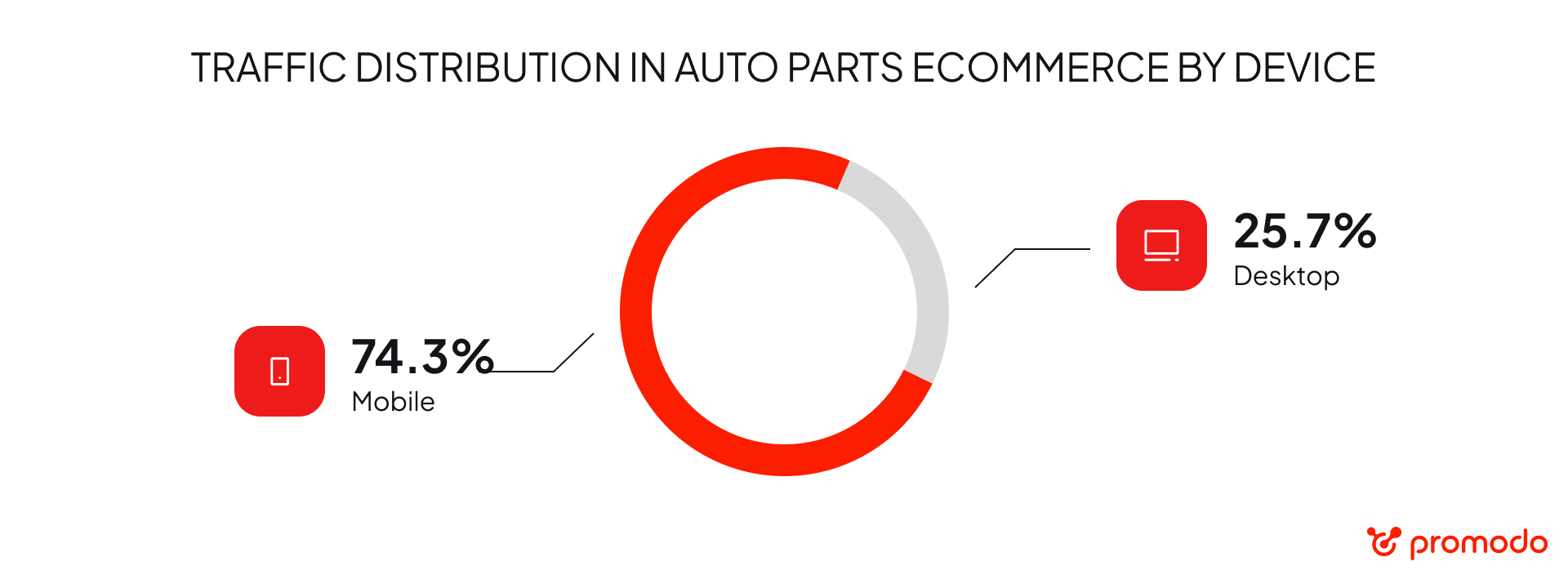
Fitment searches, stock checks, and purchases are increasingly happening on mobile rather than desktop. Using Similarweb data, we analyzed several major market players and found that mobile accounts for 74.3% of traffic on average.
EVs have fewer moving parts overall, but they also require a different set of components, including battery management modules, high-voltage connectors, regenerative braking components, and inverters.
The Electrical Parts segment is expected to grow by around 12.4% annually through 2034 as more EVs enter the aftermarket.
Mordor Intelligence identifies last-mile logistics and same-day delivery as two of the fastest-growing drivers in the automotive aftermarket over the next two years. The trend is strongest in North America and the EU and is expanding into urban markets across Asia-Pacific.
Faster delivery is reducing one of the main advantages physical auto parts stores have over online retailers: speed.
Mordor Intelligence also identifies AI-powered parts fitment as another fast-growing driver in the automotive aftermarket. Unlike broader AI shopping tools, this focuses specifically on using AI to match customers with the right part for their vehicle at the point of search.
We’ve gathered a few expert recommendations for auto parts businesses based on the recent findings and our experience with automotive SEO, automotive PPC, and eCommerce.
Shoppers need to enter their vehicle and quickly see parts that fit. If that process is slow, confusing, or unreliable, they can easily move to Amazon, eBay, or another retailer.

We saw mobile clearly outweigh desktop in auto parts research and shopping. Fitment searches and stock checks often happen on a phone, sometimes while the customer is already working on their car.
That makes a smooth mobile experience especially important: even a responsive site can lose conversions if the fitment flow or checkout is awkward.
Test fitment and checkout on real mobile devices, paying close attention to how easy the controls are to use. Also, keep the path from entering a vehicle to seeing compatible products as short as possible.
AI is becoming another way people discover products, and auto parts are a particularly relevant use case because shoppers often have very specific questions about vehicles and compatibility.
Tools like GELIOS by Promodo can show which queries mention your brand and how often competitors appear alongside you.

Auto parts catalogs can contain hundreds of thousands or even millions of SKUs. Managing campaigns for each product manually isn't practical. Broad category campaigns can miss the specific vehicle and part-number searches customers make.
We've applied these approaches to large and complex eCommerce catalogs and know it works. Our G-MOS automation can handle catalogs of up to 3 million products. In one case, our client used G-MOS to automate ad-group creation, with the resulting campaigns generating up to 50% of the brand's search traffic
We've also worked specifically with zombie SKUs: for an auto parts retailer with more than 1 million SKUs, we used automated labeling to isolate low-performing products and restructure campaigns around them. It helped increase revenue by 430%.
We've also used our ABC/XYZ approach to prioritize inventory and advertising spend based on both product value and demand predictability.
Online doesn't mean offline is going away. Many customers still buy parts in stores or through workshops, especially when they need something quickly. Your online and offline journeys should support each other.
As vehicles stay on the road longer, make sure your catalog and content reflect the vehicles customers are actually maintaining.
Prioritize coverage for vehicles in the 6–14-year range, where aftermarket demand is particularly relevant.
Keep 15+ year-old vehicles in the mix. They represent a smaller segment, but can still generate steady demand.
Start building EV-specific fitment data and content now as more older EVs enter the aftermarket.
Many shoppers compare several sources before buying. If your site only appears when someone already knows which part they need, you're missing an important part of the journey.
Create content around installation, compatibility, troubleshooting, and choosing the right part.
Retarget visitors who researched a product but didn't purchase.
Build content for younger shoppers in particular, as they tend to rely on multiple sources during product research.

Copywriter at Promodo
Over nearly three years as a copywriter, I’ve written for US and European startups and companies, including SE Ranking. I enjoy working with words—finding the right phrasing, organizing ideas, and turning them into clear and useful content that shows real value and helps businesses grow.
You may also like
Choose quality and trusted services to improve the presence of your company on the Internet, and feel free to contact our UK team if you have any questions.
.avif)
How can you make search engines favor your business? How can you ensure visibility and trust with the local audience? The key is local SEO.

If you're seeking to boost traffic to your website, understanding the significance of selecting the right financial keywords is crucial.

A prominent ranking is critical while some 34.2% of users click on the top organic result on Google.
We at Promodo are ready to help you improve your performance across all digital marketing channels.
Get started





.svg)


