


Content



Journalist at Promodo
For over 6 years, I have been working as a journalist in the communications and marketing industry. I help brands communicate effectively through written content, engage with market experts, and create professional materials on topics related to business and marketing, sharing insights on working with marketing tools.

Service Development Manager at Promodo

Your company is already working on Generative Engine Optimization and optimizing its brand's presence in AI search. But how can you tell these efforts are paying off? Publishing new content, optimizing pages, or building external mentions doesn't tell you much on its own. It won't show if AI has started noticing your brand more often or whether it shows up in answers to queries relevant to the business.
At the same time, you can't measure visibility in AI search the same way you measure Google rankings. Generative systems build answers differently, and the answers themselves are highly personalized and shaped by each user's own conversation history.
So before choosing a metric to track AI mentions, you need to figure out what exactly you mean by "AI visibility" and how to get data you can actually trust. Let’s talk about it in this article.
AI visibility shows how often a brand appears in generative systems' answers to queries relevant to its category, products, or services.
AI might mention a company alongside a few other options, use its website as a source of information, include the brand in a comparison, or directly recommend it to the user. But a brand simply appearing in an LLM's answer doesn't automatically mean that presence is valuable to the business.
In traditional search, we're used to thinking in terms of position: a page ranks for a specific query, and you can track its place in the results over time. Generative answers don't have that kind of stable scale.
The same query, run again, can return a different set of brands or a different order of appearance. So you shouldn’t treat the result of a single run as a fixed ranking and use it to make claims like "our brand ranks third in AI."
Instead, it's more accurate to talk about how often a brand appears across a sample of queries.
If a brand shows up in answers for 40% of a given set of relevant prompts, that's already a measurable figure you can track over time or compare against competitors.
Repeated measurement is what matters here. A single run only shows one specific answer from the system at one specific moment. A series of runs lets you spot a trend and understand how stable the brand's presence really is.
.webp)
The most basic thing you can do to assess AI visibility is check whether your brand shows up in answers to your target queries at all. To do this, you build a relevant set of queries and check which brands are mentioned in the AI's answers.
This lets you see which queries your brand already shows up for, where it's missing, and how your presence compares with competitors.
For example, if a brand is mentioned in 42% of answers in a relevant sample, while its main competitor appears in 58%, that's already a clear signal for further work. You can check again a month or a quarter later to see if anything has changed.
Important: the length of an AI answer can change over time. If a system used to name five brands and now names ten, the number of mentions might grow simply because the answers got longer — not because your brand became more visible. So for long-term monitoring, it's also worth tracking the makeup of the answer itself: how many brands and how much information a given model's answer typically includes.
Once you know which queries your brand shows up for, the next question is how stable that presence actually is. Here you should measure mention frequency. For example, you check 50 relevant prompts and get the following results:
At the same time, it’s also important to look at the total number of mentions. A brand can be mentioned more than once within a single answer.
Take this query as an example: "Where can I buy a smartphone in Chicago?" To answer it, an LLM might weigh several factors at once: product range, pricing, delivery terms, store availability, branches, and so on. If your brand is mentioned in the context of several of these factors, that can suggest the model associates it with multiple selection criteria at once.
LLMs don't rank brands on a single scale, nor do they pick one clear 'winner' among them. But a brand that appears more often within a single answer may end up with a stronger presence relative to competitors. It gets associated with more of the criteria that matter for that particular user query.
We recommend making sure your tracking tool captures every variant of your brand name: with the domain, without the domain, and common spelling variations. Otherwise, some mentions may not be captured in the data. GELIOS — Promodo's tool for tracking AI mentions — checks for all of these variants during monitoring, so brand presence data doesn't get lost.
Gemini, Google AI Overviews, ChatGPT, and other systems can produce different answers to the same query, draw on different sources, and represent brands differently.
It makes sense to analyze data from each platform separately before looking at the overall picture.
For Google, there's also a separate data source: Google Search Console. Google already provides reporting on how often links to your site appear in its generative Search features, including AI Overviews and AI Mode. But this data only reflects a site's presence within Google's own AI features. It can't replace monitoring brand mentions across other AI systems.
This reporting is new and isn't yet available in every account.

An automatically generated list of prompts can be a useful starting point, but it doesn't necessarily reflect how your actual audience behaves. So it's better to start with what you already know about your customers.
Sources you can use to build prompts:
Informational:
Commercial:
Comparison:
Grouping prompts this way shows you not just how often AI mentions your brand, but also at which stage of the decision-making process it appears.
There are two separate tasks here:
Referral traffic from AI can be a useful indicator, but it shouldn't be your only KPI. Some AI-driven visits lose their source information and end up showing in analytics as Direct or Organic traffic.
To find out where a customer actually came from, you can add the question "How did you hear about us?" to the customer journey. If someone names ChatGPT, Gemini, or another AI service, you can connect that data to leads, sales, and revenue.
To build a system like this by hand, you have to build and update a database of prompts regularly, run them across different AI systems, track mentions of your brand and competitors, and then compare the results over time.
GELIOS by Promodo automates the core parts of this work:

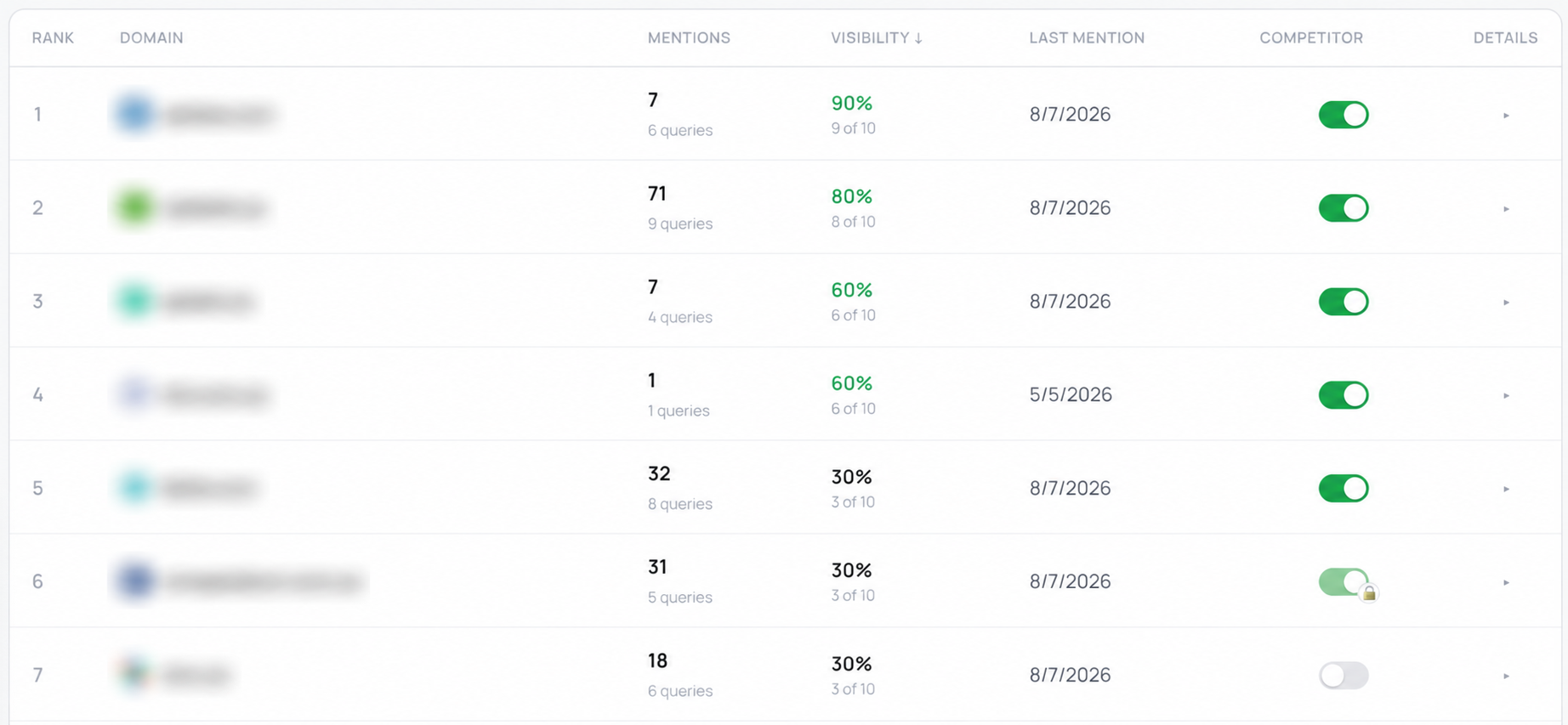
This is the kind of data you can use as the foundation for your GEO.

Not every metric you can pull from AI-answer monitoring is suitable as a measure of GEO performance. Some metrics are useful for analysis, but if you make them your primary KPI, they'll give you a distorted picture of brand visibility.
Measuring visibility in AI search is, first and foremost, a tool for identifying where your business has room to grow. It shows where it's winning and where it's losing compared to competitors.
At the same time, there's no need to constantly track every single mention. Because AI answers vary, results can shift slightly from one run to the next, but running additional daily checks doesn't necessarily make the measurement any more accurate. At the same time, every query has a cost, so overly frequent monitoring increases spending without a proportional benefit to the business.
In GELIOS, we start with the idea that AI visibility should be measured when the data is needed to make a specific decision, not simply for the sake of having the metric. This approach keeps measurements accurate enough and helps avoid constant monitoring of a metric solely for tracking.

Journalist at Promodo
For over 6 years, I have been working as a journalist in the communications and marketing industry. I help brands communicate effectively through written content, engage with market experts, and create professional materials on topics related to business and marketing, sharing insights on working with marketing tools.
Service Development Manager at Promodo
You may also like
Choose quality and trusted services to improve the presence of your company on the Internet, and feel free to contact our UK team if you have any questions.

Answering the big question on today’s agenda of what is digital marketing in real estate, Promodo experts decided to dive deeper into eight core services.

In today’s digital world, SaaS (Software as a Service) companies have become an integral part of the business landscape.

With a strong sales ratio of 37.01%, luxury real estate is steadily establishing itself as the Seller's market.
We at Promodo are ready to help you improve your performance across all digital marketing channels.
Get started


.png)


.svg)


