


.png)
.png)
Etnodim is a Ukrainian brand of contemporary embroidered clothing and accessories with a strong cultural identity.
Google Shopping is one of Etnodim's key acquisition channels, and its performance depends almost entirely on how complete and well-structured the product feed is.
The challenge: most of the traffic was concentrated around branded queries. Google Shopping already worked well for people who knew the brand. But Etnodim was losing potential buyers who searched by category attributes instead — material, garment type, embroidery region, or color.
Automating the work on the product feed let the team spend far less time on manual catalog optimization — while Google Shopping started reaching a whole new layer of non-branded demand.

This case won three awards at MIXX Awards 2026 — two Silvers, for Best Use of Technology and AdTech Campaign, and a Bronze for Innovative Solution.
We analyzed search patterns and identified the key attributes shoppers use to find embroidered clothing: embroidery region (Lemko, Poltava, Hutsul), material (linen, cotton), color, and product type. Most product listings, however, didn't have a complete set of these attributes.
As a result, Google simply didn't have enough information about the products and showed them less often for relevant non-branded queries.
Embroidered clothing can't be classified using generic apparel attributes alone — size, color, and fabric aren't enough to capture what makes each piece distinct.
A shopper searching for "Hutsul vyshyvanka with geometric pattern" knows exactly what they want. But standard Google Shopping algorithms don't account for this level of nuance, so even genuinely relevant products can miss the search scenarios they should be matching.
The idea: teach the algorithm to understand the cultural and visual specifics of Ukrainian clothing — without rewriting thousands of product listings by hand.
We used AI to connect standardized feed data with the real logic of how users search. The model also analyzed product images to add missing attributes to the feed and generate more relevant titles and descriptions.
To build the solution, we implemented FeedGen — an open-source tool built on Google Cloud Vertex AI. We configured it not just to generate new titles and descriptions, but to build them around the actual logic of user search behavior.
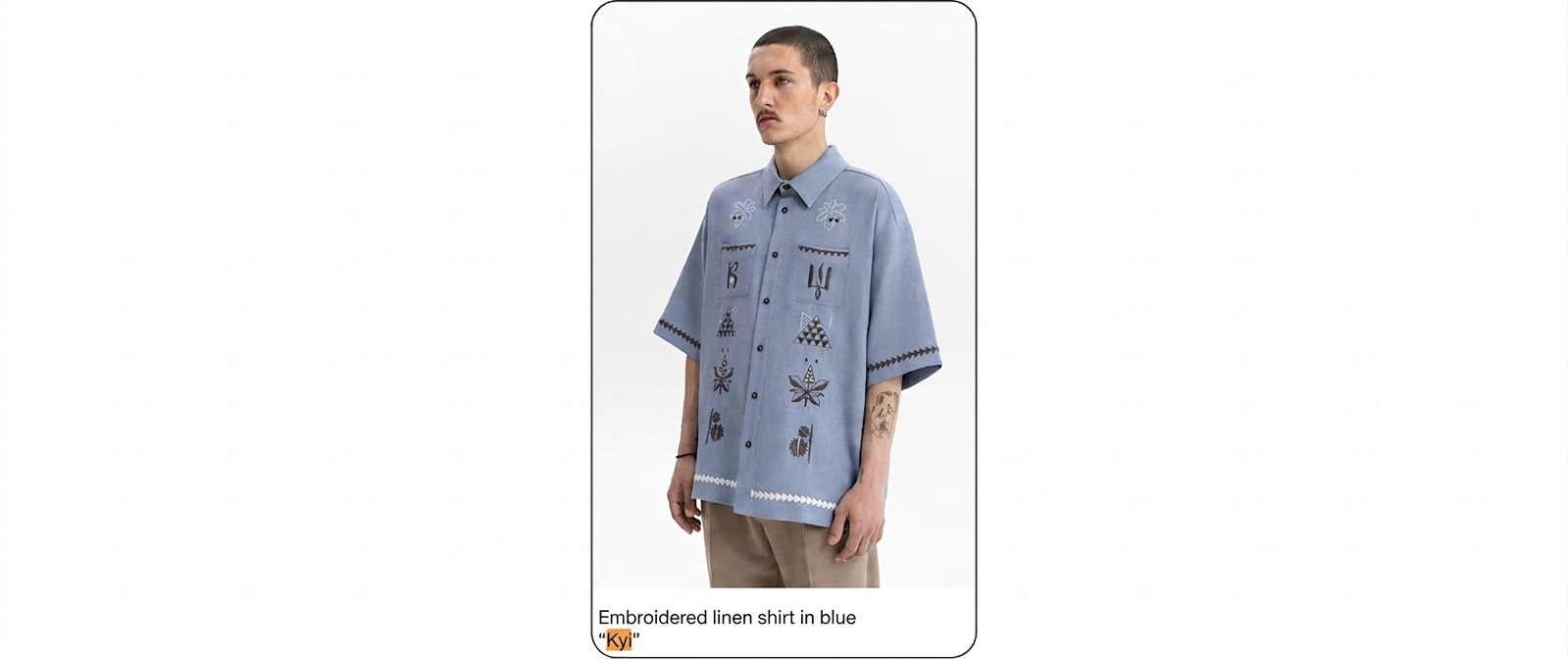
1. We identified the attributes the target audience uses to search for embroidered clothing.
2. We described to the language model how the existing titles were structured — which attribute each word or phrase represented. This gave the model a correct interpretation of the source data and became the foundation for generating new title variations.
Gender | Material | Product Type | Product Detail
3. /We enabled AI-powered image analysis to add missing but important attributes to the feed — color, for example.
4. We defined the key product attribute keys the model could draw on to generate new titles and descriptions.
Gender | Product Type | Material | Color | Pattern | Style | Brand
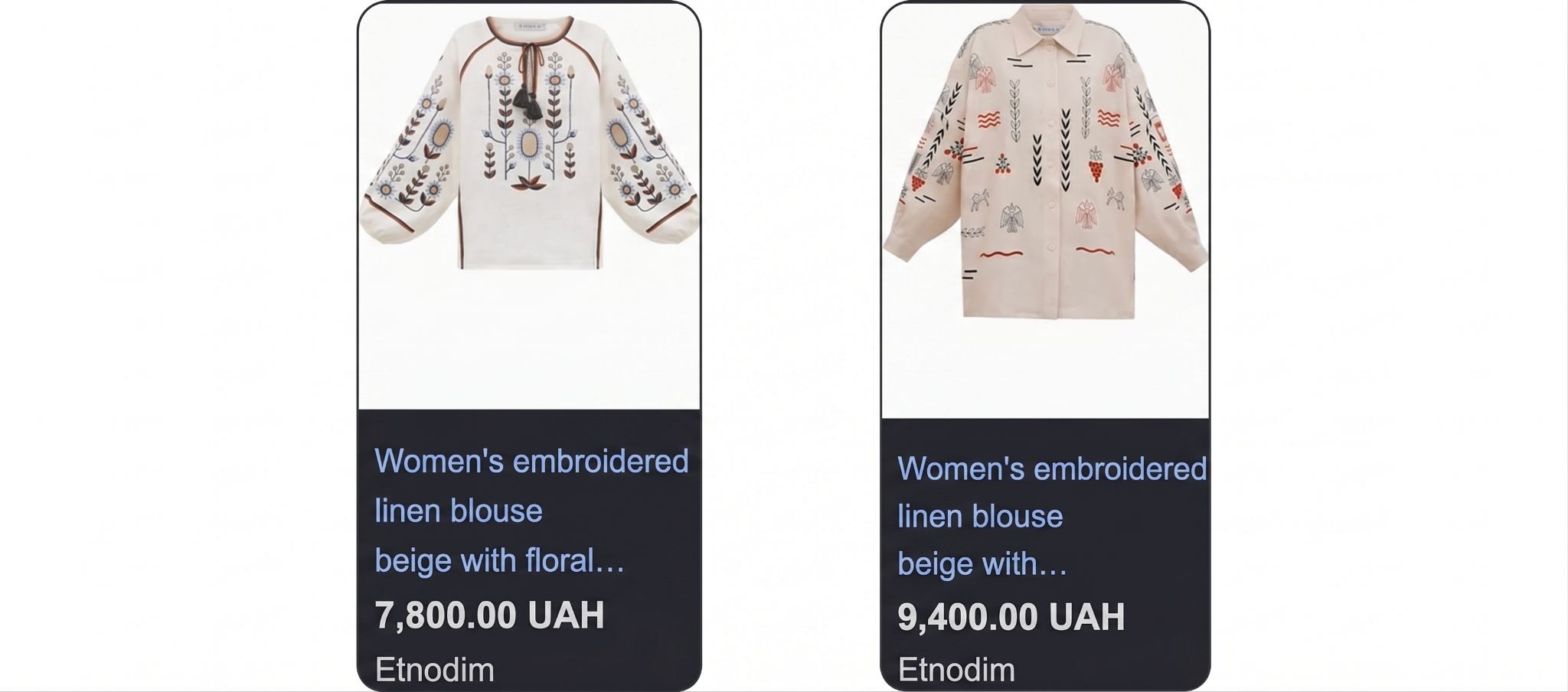
5. We built two title-generation templates that combined all the necessary attributes in the order shoppers actually search, based on real query structures.
Material | Gender | Product Type | Color | Name | Brand
Product Type | Gender | Color | Name | Brand
For descriptions, the model drew on the product attribute keys, the original description text, and the AI image analysis.
We deliberately limited how "creative" the model could get: a scoring system filtered out generations like "magical fabric that will change your world."
The result was an updated product feed that described products far more precisely — for shoppers and for Google's algorithms alike.
This is the first application of FeedGen in Ukrainian fashion eCommerce. We adapted the tool to a local market and a product category with deep cultural context, which improved the accuracy and relevance of the product feed well beyond what standard enrichment can achieve.
Unlike classic feed enrichment, which only reshuffles existing data, this tool generated entirely new attributes based on image analysis of the products themselves.
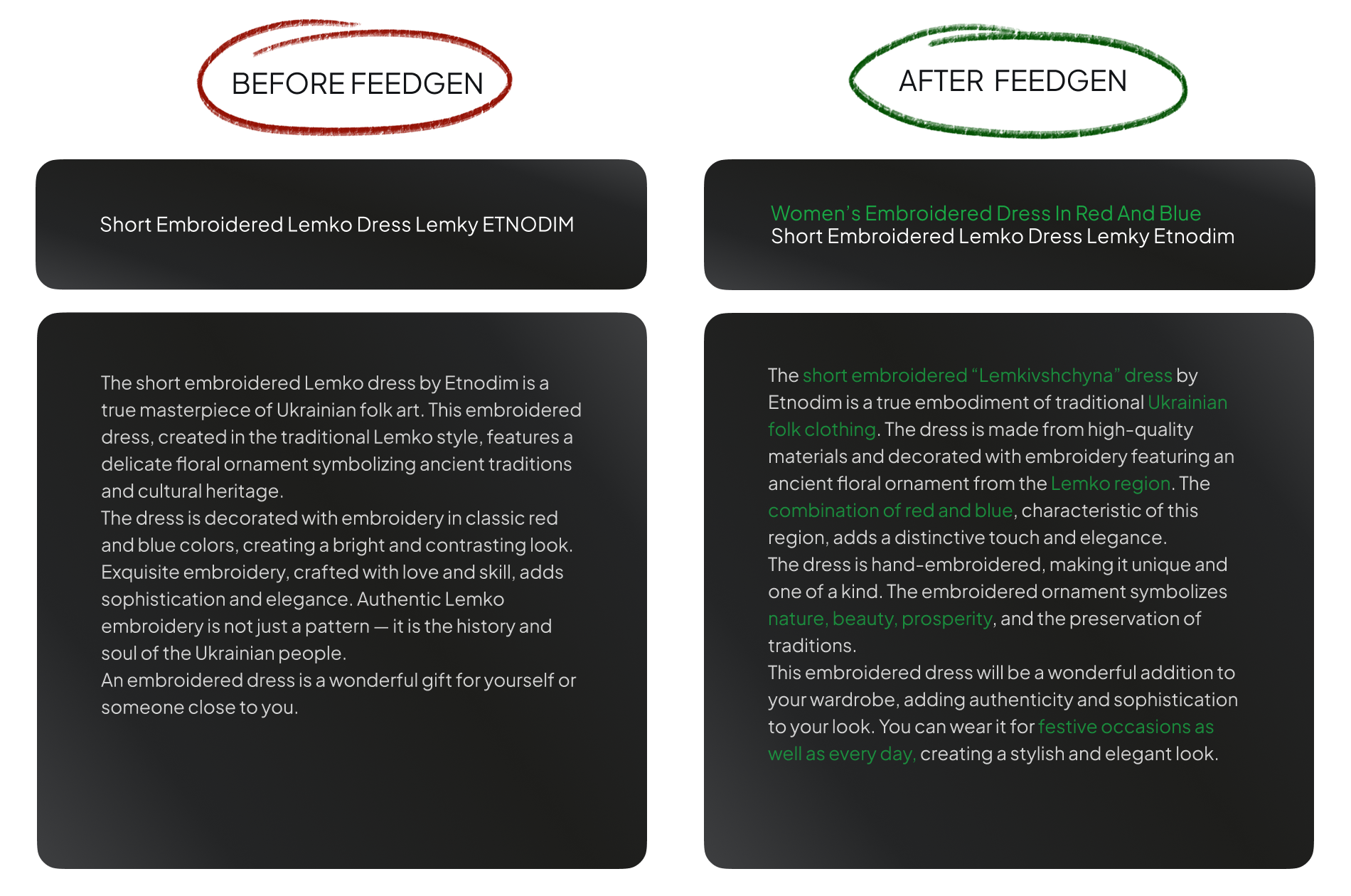
More informative titles and descriptions helped Google understand the products better. As a result, relevant items started appearing more often for non-branded queries and matched user search intent far more precisely.
Optimizing the product feed significantly expanded impression share for non-branded, category-level queries and lifted overall Google Shopping performance — including a 196% increase in conversions.
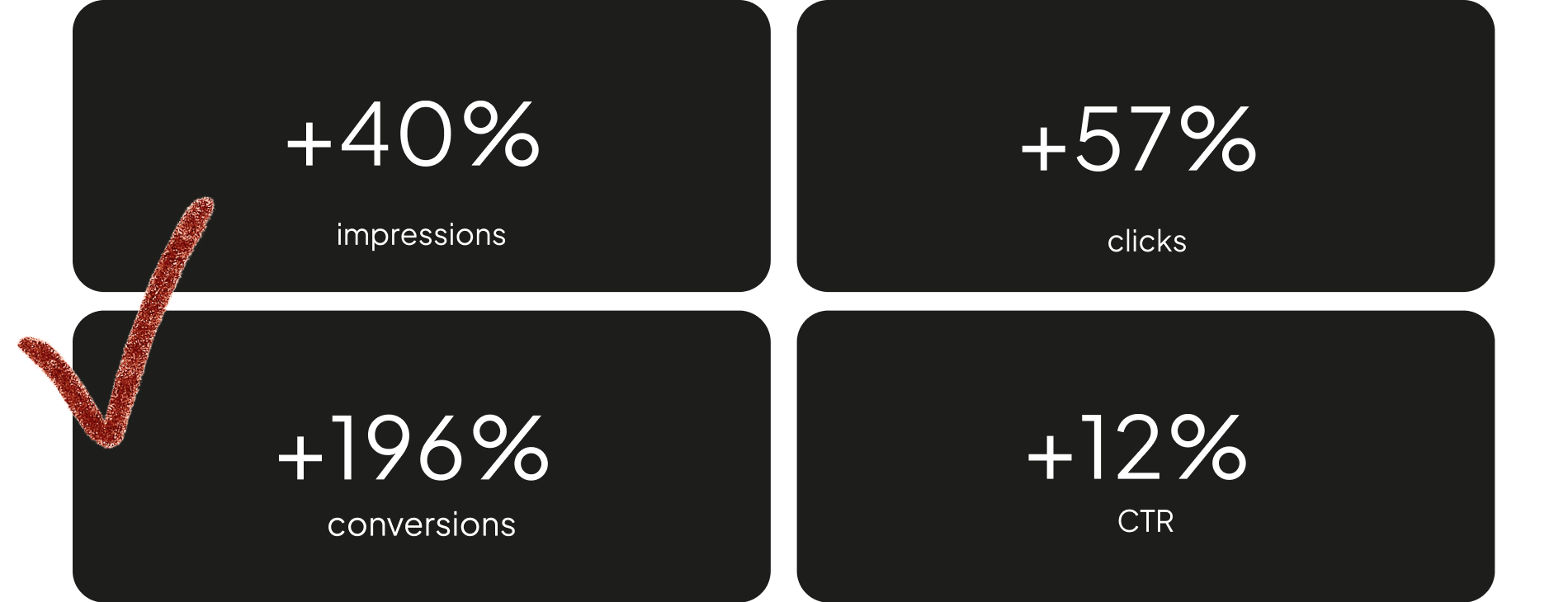
The biggest driver of growth wasn't a bigger ad budget — it was a better-structured product feed. The more relevant attributes Google received about each product, the more precisely the algorithm could find shoppers with high commercial intent and understand what makes Ukrainian embroidered clothing distinct.

Case studies
Check out how we help companies like yours overcome challenges and rise to the next level.
.png)
AI traffic
Revenue from AI traffic




.png)


.webp)
.svg)


