
Freetour.com
eSputnik
Google Tag Manager
Google Sheets
Velocity
FREETOUR.com is an online platform for booking walking tours with local guides in more than 140 countries. Guides set their own pricing, and many tours run on a pay-what-you-think-it's-worth basis.
Promodo already works with FREETOUR.com in several areas. In PPC, we doubled ROI and lowered acquisition costs. In retention, we built an email marketing strategy from scratch that brought +85% email revenue and 400,000 returned customers.
As the email channel grew, so did the effort needed to support it. Regular promo updates took a lot of the client team's time, and every new trigger required developers, which meant competing with product development for their resources.
So the next goal was clear: automate recurring processes, make it easier to launch new communications, and reduce dependence on the tech team.
We now pass behavioral events through Google Tag Manager (GTM) instead of building a separate backend integration for each scenario. This speeds up launches and takes load off the developers.
On top of this setup, we launched three scenarios:
In the first half of 2026, these three scenarios generated 24.81% of all trigger email revenue.
For behavioral triggers, we needed a simpler way to pass events from the website to eSputnik. For personalized campaigns, we needed to cut the manual steps involved in monthly content updates.
We built two automation mechanisms: one for trigger scenarios and one for personalized promo campaigns. Together, they reduce the operational load and create a foundation for further growth.
The main challenge was launching new triggers without adding work for the development team.
With the standard approach, developers had to set up every event transfer from the website to eSputnik separately. Only after that could the Retention team use the event as a trigger for sending an email.
Together with Promodo's Web Analytics team, we set up event transfer through GTM instead. Now new trigger emails can be launched without waiting for technical work, and communication can respond to what users actually do on the site.
We launched three scenarios:
[[VERTICAL-SCROLL-START]]
[[VERTICAL-SCROLL-END]]
In a single session, a user can view a tour, choose a city, and start a booking. Without additional rules, each of these actions could trigger a separate email. So we needed prioritization logic and event checks before sending.
We separated the scenarios in time and added event checks before each email is sent.
As a result, the system takes the user's subsequent actions into account, chooses the priority scenario, and doesn't send several emails for different steps along the same path.
The roles are split clearly. GTM gives us access to behavioral data without waiting for backend development. The additional logic in eSputnik determines how to communicate correctly based on that data.
For users, this means one up-to-date offer instead of a series of reminders. It prevents over-communication, protects loyalty, and keeps the email channel effective.

GTM passes individual events but doesn't analyze them together. Event checks prevent duplicate emails, but they don't show the user's overall interests.
The next stage is an intermediate logic layer built in n8n. It will collect user actions over a set period, identify interests, and send aggregated data to eSputnik to launch the right scenario.
For example, if a user views a city page and several tours, the system will combine these actions into one event with all the offers they viewed. eSputnik will receive a single dataset and use it to build a personalized email.
The goal is to move from reacting to single actions to full personalization based on user interests.
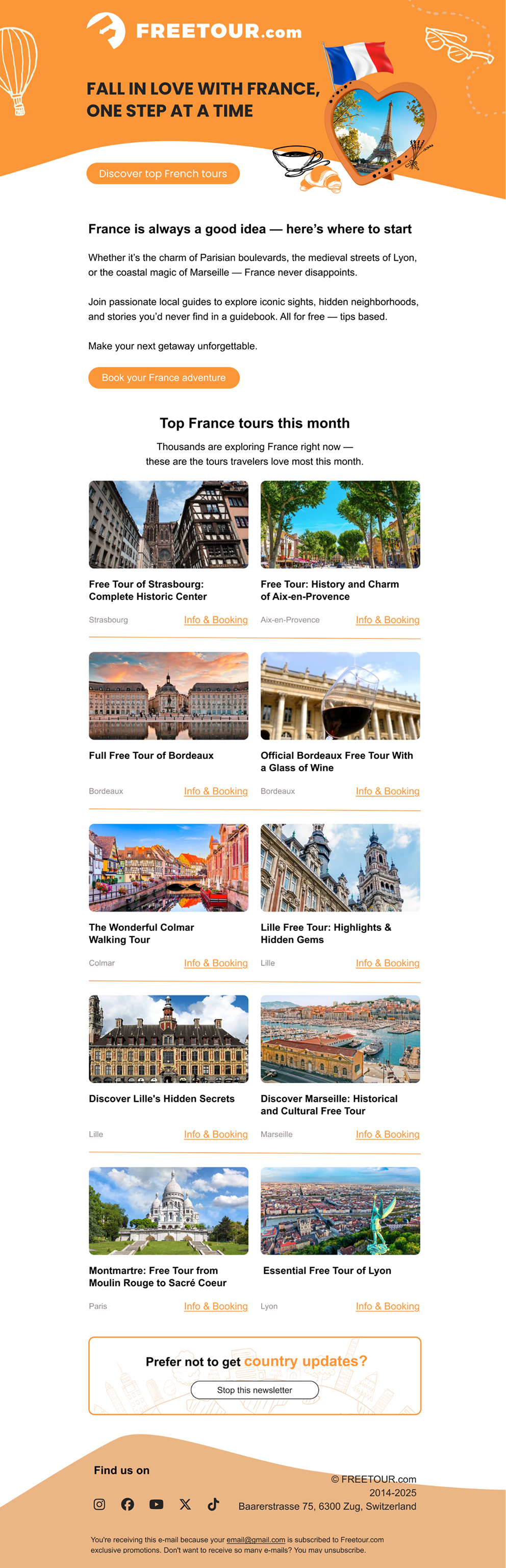
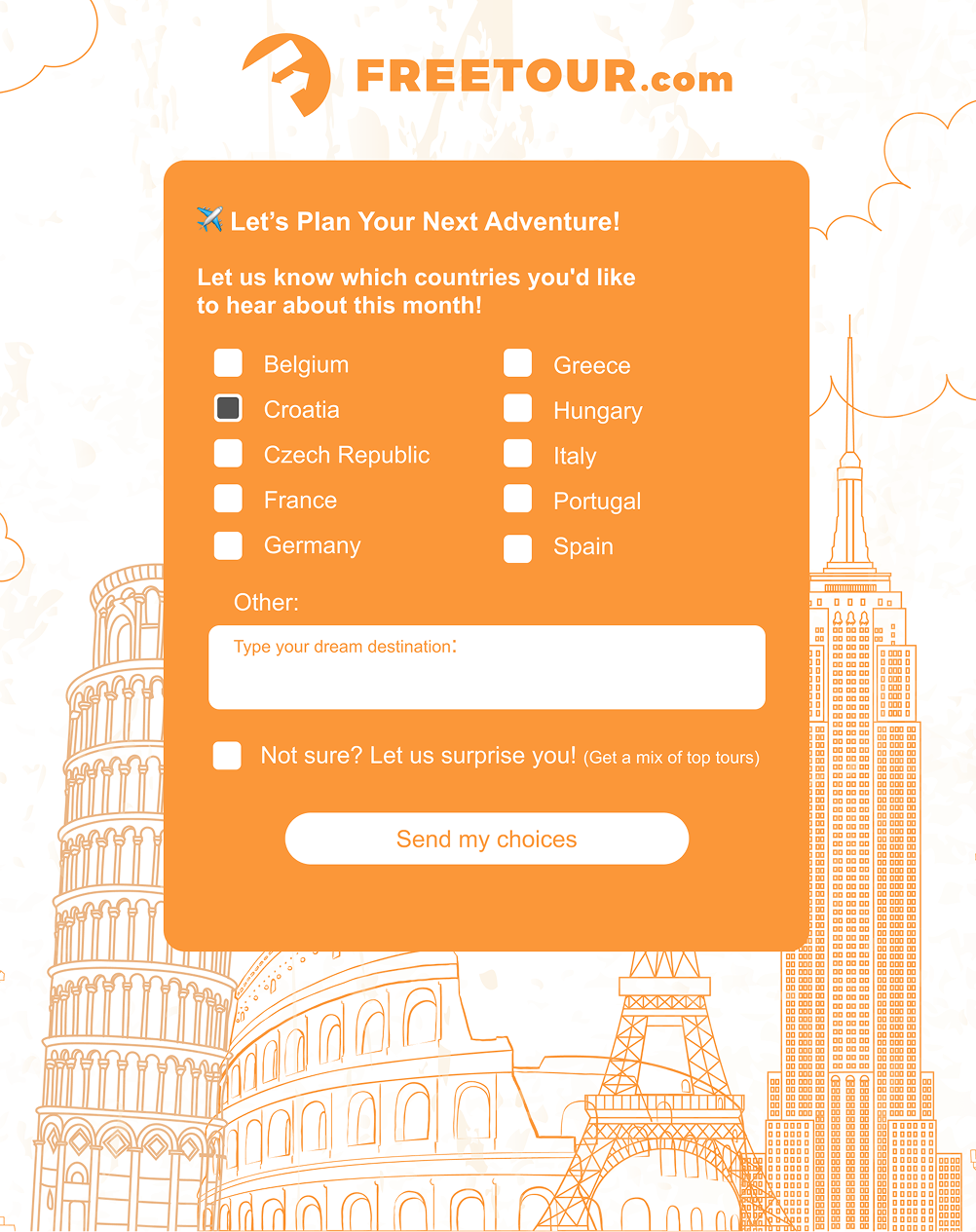
FREETOUR.com offers a huge number of tours in many countries. Knowing which destinations a user is interested in lets us send relevant selections instead of generic ones. So automating regular personalized promo campaigns became our second focus.
The mechanism works in two steps: first we find out which destinations interest the user, then we offer them matching tour selections.
[[VERTICAL-SCROLL-START]]
[[VERTICAL-SCROLL-END]]
[[VERTICAL-SCROLL-START]]

[[VERTICAL-SCROLL-END]]
In total, that's 11 communication variants within a single automated scenario.
Launching the scenario, however, doesn't remove the need for regular updates. Tour offers, links, and other data have to be refreshed in every email.
To avoid editing the HTML of each email, we wbuilt the templates with Velocity and moved all variable content to Google Sheets, connected to eSputnik via External Data Source.
Now a monthly update only requires changing the data in the spreadsheet. The logic and templates stay the same, so not only the sending but also a large part of the ongoing support is automated.
Related case study: +85% Revenue from the Email Channel and 400,000 Returned Customers: Retention Marketing Strategy for FREETOUR.com
Users come to a booking in different ways. Some arrive with a clear plan, while others browse and compare options. Our goal was to read their interest from behavior and offer tours that help them make a decision.
The two email directions cover different stages of that decision.
Behavioral triggers brought users back to the tours, cities, or bookings they had left. Promo campaigns kept their interest in the destinations that mattered to them.
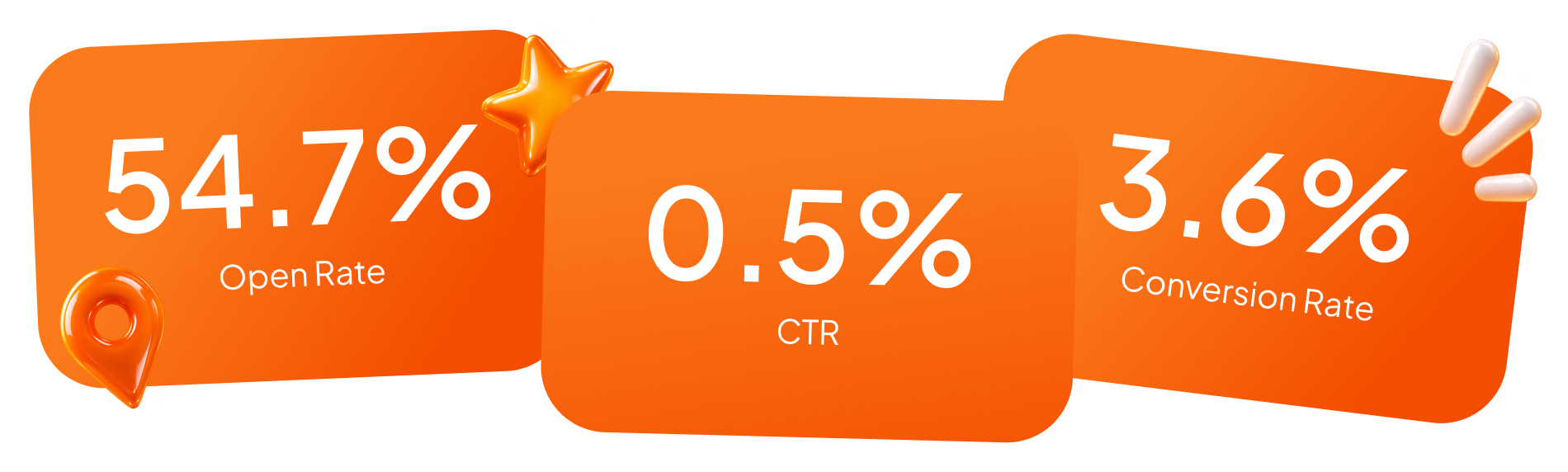
Behavioral triggers. The three scenarios generated 24.81% of trigger email revenue. Their Open Rate and CTR exceeded travel and hospitality industry benchmarks.
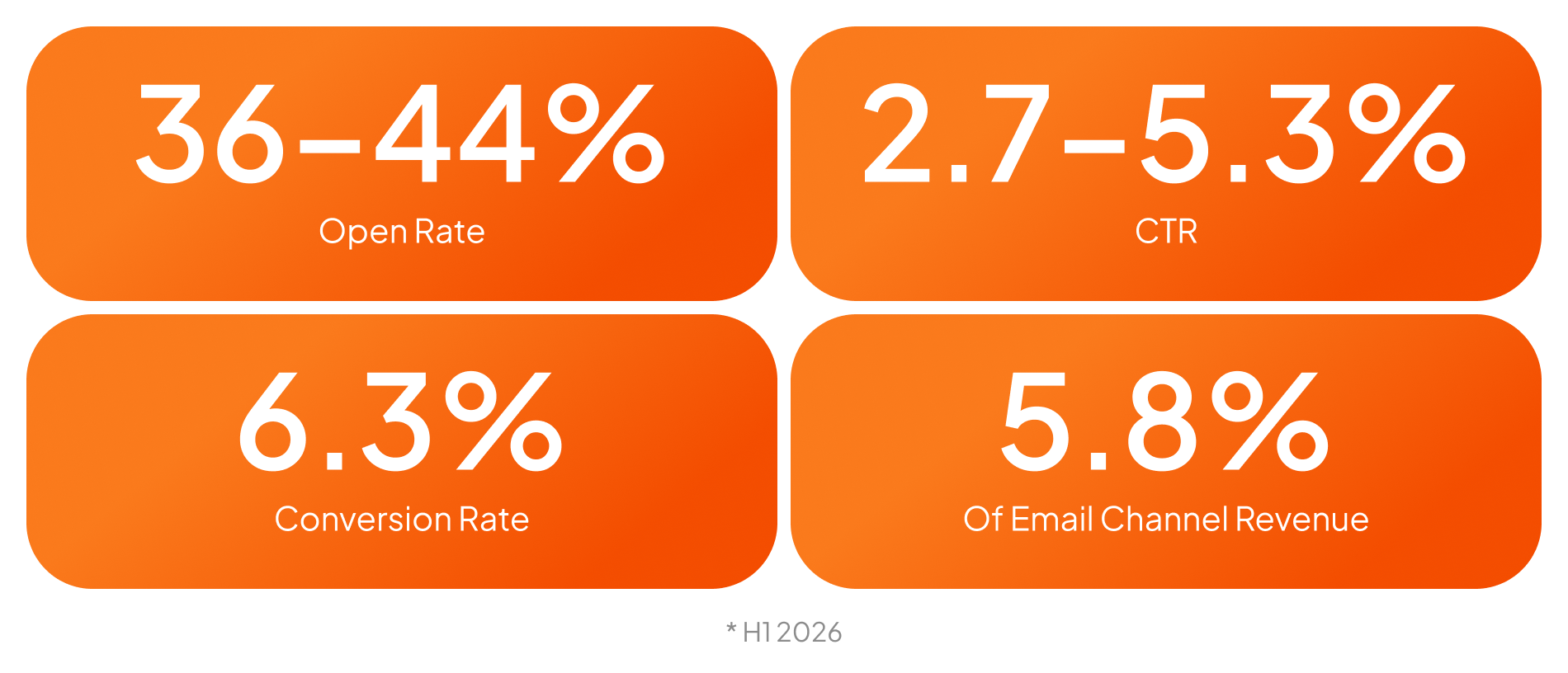
Digests. In the first half of 2026, the digest series brought in 27.14% of total email channel revenue.
Case studies
Check out how we help companies like yours overcome challenges and rise to the next level.

AI traffic
Revenue from AI traffic