


.png)

A manufacturer of power tools and electronics
A manufacturer of power tools and electronics with a network of offline stores and its own eCommerce website. The brand name is withheld under NDA.
The client operates on a mono-brand model: the site sells products under its own brand only, rather than functioning as a multi-vendor catalog. The eCommerce site is also reinforced by a network of offline stores, which strengthens brand awareness.
This mono-brand structure has a direct SEO implication: since the entire assortment consists of products from a single brand, the product page is the most important page on the site — it drives both rankings and conversions. That made the product page the top priority for growth, both for improving visibility in Google and for visibility with AI assistants.
.webp)
In short, the client's goal was for the site to move into a new era, and the Promodo team took on the changes needed to make that happen.
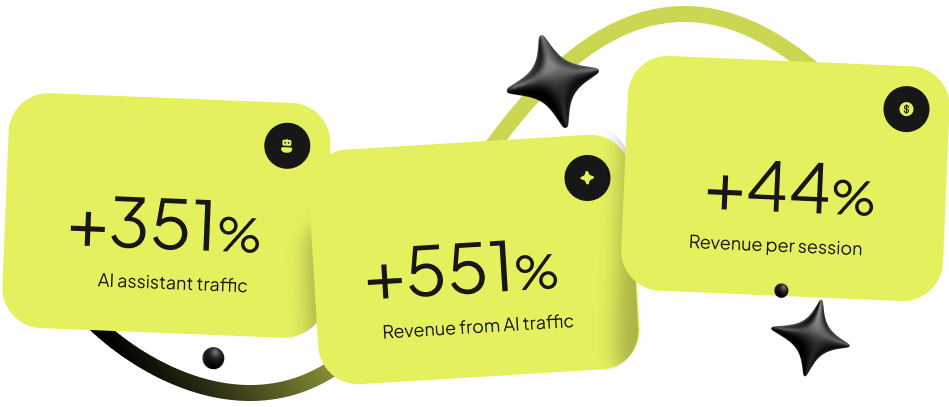
Traffic from AI assistants grew +351% within 3 months of optimizing the product page.
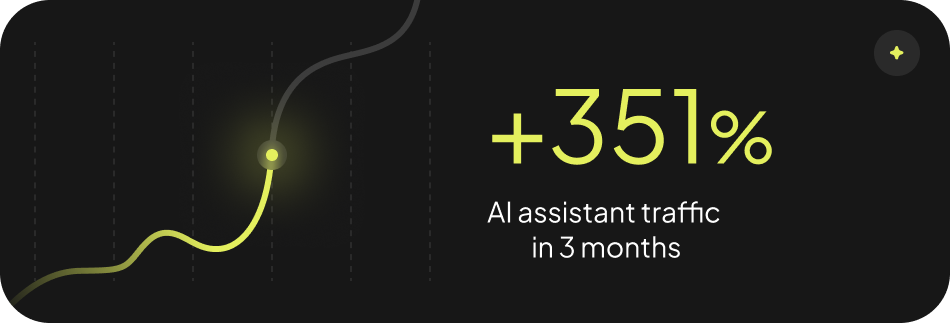
Going into the project, the team understood the client's key characteristic: as a mono-brand, there's no competition between "duplicate product listings" across different marketplaces — the site is the sole primary source of information about the product. Because of this, all SEO weight is concentrated on the product page: if the product page's content isn't accessible to bots, the site loses not only Google rankings but also the chance to be cited by AI assistants, which build their answers from whatever they're able to render. For this reason, the team set aside the classic approach of "adding more content" and instead focused on the accessibility of content that already existed.
At the start of the project, the client's site was already a strong asset: a developed catalog, filled-out descriptions, reviews, videos, and detailed specifications for each product, along with stable brand demand and a functioning offline retail network.
The initial audit identified potential growth points — the problem wasn't a shortage of content, but its accessibility: a large share of the most valuable product information lived on separate URLs/tabs and, from a bot's perspective, wasn't part of the product page at all.
At that point, traffic from AI assistants was minimal and, more importantly, showed no clear growth trend — throughout 2025, the channel fluctuated within one narrow range. The Product schema markup didn't include aggregateRating, meaning there were no social-proof signals present in either search results or AI-generated answers.
The team also identified additional growth opportunities:
Based on a full SEO audit, the team compiled a prioritized backlog of 16 technical work items (T1–T16), plus separate content and E-E-A-T tasks, and tracked it together with the client in a shared tracker — with statuses, owners, and implementation checks on Promodo's side.
Item T1, "Product Page Optimization," received the highest priority: for a mono-brand, the product page is both the landing page and the decision-making page.
The hypothesis: if all product content were returned to the body of the product page and made accessible for bot rendering, the page would become a self-sufficient source of facts — giving both Google and language models something worth citing.

The team first investigated why the product page was effectively "empty" from a bot's perspective. Using a cordless chainsaw listing as an example, they showed the client that part of the content was only available at separate addresses:
To a user, these looked like tabs. To a bot, they were three separate pages. The main product page contained neither the full list of specifications, nor package contents, nor the instructions, nor the video. This exact set of facts is what an LLM uses to answer a query like "which cordless chainsaw should I choose."
That's why the team immediately began moving tab content into the body of the product page. They defined exactly what would move where, with bot-renderability as a strict requirement:
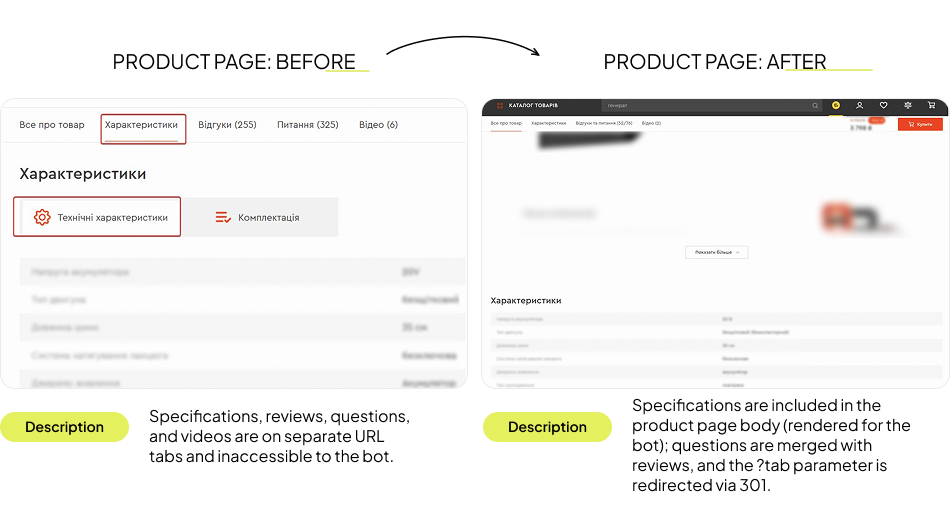
Product images were also moved into the body of the page, with the same bot-rendering requirement.
Since cannibalization was one of the identified problems, the question-tab pages were closed to indexing (noindex, nofollow) and their links were removed from the bot-facing code, while the link remained available to live users. Questions and reviews were moved into separate logic so they would no longer compete with the product page for product-related queries.
An important element for AI visibility is so-called "trust signals" in structured markup, which confirm product quality and reinforce confidence in the store itself.
The reviews block was expanded to include an overall rating: a score, star rating, and review count. This data was added to structured markup as Product → aggregateRating + review, and review text was made accessible in the page code.
[VISUAL: Example of the updated reviews block]
In parallel, the team carried out technical improvements that reinforced the effect:
All changes were implemented in February 2026, which is used as the baseline point for tracking results. Growth observed after February 2026 is therefore likely explained by the fact that the product page, for the first time, became a full-fledged source of facts for AI crawlers.
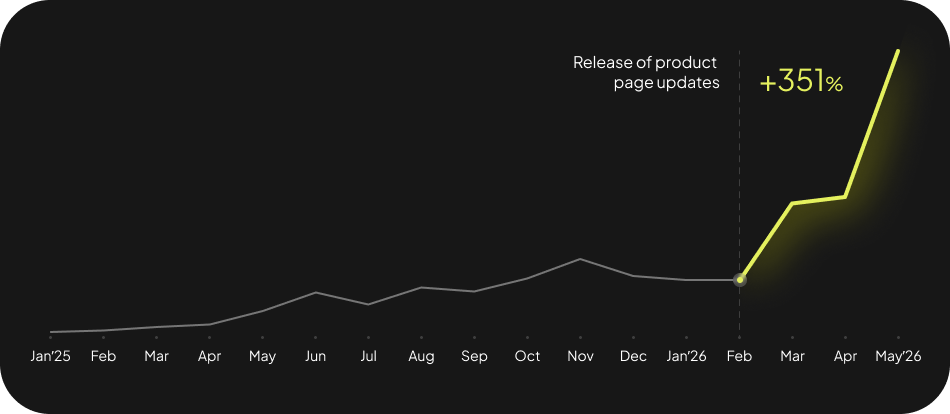
As of May 2026, the following changes were recorded:
Over the longer term, compared with January 2025, traffic from AI sources grew by more than 3,200%. Throughout 2025, the channel had held within one narrow range — breaking out of that range coincides in time with the release of the product page changes in February 2026.
It's also notable that AI assistants began citing product pages specifically: the majority of AI visits in May 2026 land directly on product pages.
Work on the project is ongoing. Next planned steps include work on additional pages that influence trust in the site and brand from both AI assistants and Google — including warranty pages, policies, and certificates — as well as further internal linking. Cooperation with the client continues.
.webp)
Case studies
Check out how we help companies like yours overcome challenges and rise to the next level.
.png)
+196%
+12%




.png)


.webp)
.svg)


