


Content



Team Lead of Content for promodo.com
Experienced in working with data, expert recommendations, and real business cases to create clear and valuable content that delivers real business impact. Passionate about discovering new insights, exploring industry trends, and turning complex topics into practical, easy-to-understand content.

SEO Specialist at Promodo

In 2026, your website is competing for organic visibility not only with other websites but also with AI-driven search experiences and zero-click results. However, in many cases, the biggest competitor is your own website.
This happens when keyword and content cannibalization occurs. It’s a situation where multiple pages on the same domain target the same or very similar search intent. Instead of strengthening your visibility, these pages compete against each other in search engine results.
In this article, we’ll explore what keyword cannibalization is, why it happens, how to diagnose it, and — most importantly — how to fix keyword cannibalization and prevent it in modern SEO strategies.
Keyword cannibalization is a situation where two or more pages on the same website compete for the same or very similar search queries.
Instead of Google clearly identifying one strong, relevant page to rank higher, the search engine is forced to distribute ranking signals between multiple URLs. As a result, none of the pages gains enough authority to perform at its full potential, and all of them typically rank lower than a single consolidated page would.
In simple terms, your own pages start competing against each other for visibility in search results. This is why it’s called “cannibalization”. Basically, the pages on your site are effectively “eating” each other’s chances to rank.
This issue is more common than many teams expect, especially in websites with large content structures, overlapping landing pages, or poorly differentiated SEO targeting.
As SEO specialist Anastasiia Pasteka from Promodo notes:“Cannibalization of content occurs in almost every second project we work on. In fact, it is almost absent only on websites with a minimal number of pages that have just been launched.”
In other words, the larger and more complex your website becomes, the higher the risk that multiple pages will unintentionally start targeting the same keywords and search intent.
Keyword cannibalization typically appears as a side effect of website growth combined with a lack of clear content and SEO architecture. As more pages are added over time, it becomes easier for multiple URLs to target the same or very similar search intent unintentionally.
Below are the main reasons why SEO cannibalization occurs.
The most common cause is publishing new content without analyzing what already exists on the site. Over time, this leads to overlapping blog articles, category pages, and landing pages targeting the same topics or keywords. Without a structured semantic plan, Google struggles to determine which page is most relevant to a given query.
That’s why a well-defined semantic core and site structure should be prepared before any large-scale SEO work begins. Otherwise, search engines are left to “guess” which page deserves to rank.
Content Management Systems (CMS) often generate multiple versions of the same page automatically.
For example:
Google may treat these as separate pages, even though they represent the same content. As a result, they can start competing against each other in search results.
This issue also includes automatically generated filter pages, tag pages, and pagination URLs. While they may seem useful structurally, they often add little SEO value and instead create duplicate or competing pages in the index.
In eCommerce websites, cannibalization often happens due to overlapping intent between categories, subcategories, tags, and filters.
For example, pages like:
may all compete for similar search queries such as “buy all-season tires” or “best all-season tires for SUVs”.
“The most common issue is caused by second- and third-level filters that generate separate URLs and are interpreted by search engines as independent pages, which then start ranking alongside the main category.”
Anastasiia Pasteka, SEO specialist at Promodo
Internal linking plays a key role in how search engines determine page importance. If a large number of internal links with similar or identical anchor texts point to secondary or less relevant pages, Google may interpret them as more important than intended.
As a result, the wrong page can start ranking for key queries, leading to internal competition and diluted ranking signals across multiple URLs.
Cannibalization often occurs when informational and commercial intents are mixed or misaligned across pages.
For example, a category page, a filter page, and a blog article may all target a similar query such as “buy winter tires”:
In this case, category pages, filter-generated URLs, and informational content can all compete for overlapping search intent if their roles in the site structure are not clearly defined.
This creates confusion for search engines about which page should satisfy the user’s intent.
“The problem arises when commercial pages start absorbing informational intent. If guides, instructions, or product comparisons are added to product or category pages, they may begin ranking for informational queries instead of blog content. This makes it harder for search engines to understand which page should match a specific user intent and leads to internal competition between URLs.”
Anastasiia Pasteka, SEO specialist at Promodo
During website migrations, redesigns, or mergers of multiple projects, URL structures often change and new pages are introduced. If old URLs are not properly redirected or remain indexed, search engines may treat both old and new pages as valid results.
This leads to multiple pages competing for the same or very similar keywords, causing cannibalization and splitting organic traffic across URLs instead of consolidating it on a single strong page.
Many website owners underestimate keyword cannibalization, assuming that the more pages they have, the higher their chances of ranking in search results. In reality, the opposite is often true.
When external backlinks point to multiple pages targeting the same keyword, link authority gets distributed across several URLs instead of being concentrated on one strong page.
Since backlink concentration is one of the factors influencing rankings, splitting authority between competing pages weakens the SEO potential of each individual URL.
For example, in a tire eCommerce store, backlinks may point separately to:
Instead of building one highly authoritative page for queries like “buy winter tires”, link equity is fragmented across multiple competing URLs.
Google may alternate between different pages for the same search query, showing one URL one week and another the next.
This creates ranking volatility, where positions fluctuate unpredictably because search engines are unsure which page should be prioritized.
If you notice that different URLs from your site keep appearing for the same keyword in tools like Google Search Console or rank trackers, it is often a strong sign of cannibalization.
When Google ranks the wrong page for a query, users may land on content that does not fully match their intent.
As a result, they leave quickly, return to search results, or continue searching elsewhere.
This can negatively affect:
For example, if someone searches for “best all-season tires for SUVs” but lands on a generic category page instead of a relevant comparison or filtered product page, they are less likely to convert or continue browsing.
For large websites, this issue is especially important.
Instead of using resources to crawl and index new high-priority pages, Googlebot may spend time revisiting duplicate, low-value, or overlapping URLs.
This is particularly common in large:
As a result, important pages may be discovered or refreshed more slowly, limiting overall SEO growth.
As SEO specialist Anastasiia Pasteka from Promodo explains:“We analyze keyword cannibalization not only during the initial SEO audit, but also regularly throughout ongoing website optimization. If multiple pages from the same domain rank for the same query, or rankings fail to improve despite optimization efforts, this is a strong signal for additional review of semantics, competitors, and priority keywords.”
Below, we provide four effective ways of how to check keyword cannibalization.
The simplest way to identify cannibalization is by using a Google search operator: site:yourdomain.com "target keyword"
This query shows which pages from your domain are indexed for a specific keyword.
If Google returns multiple URLs from your website for the same search query, it may indicate keyword cannibalization or overlapping search intent.
For example, a tire retailer could search:
site:yourtireshop.com "winter tires"
and discover that Google indexes several pages such as:
If all of these pages target similar intent, they may be competing against each other in search results.
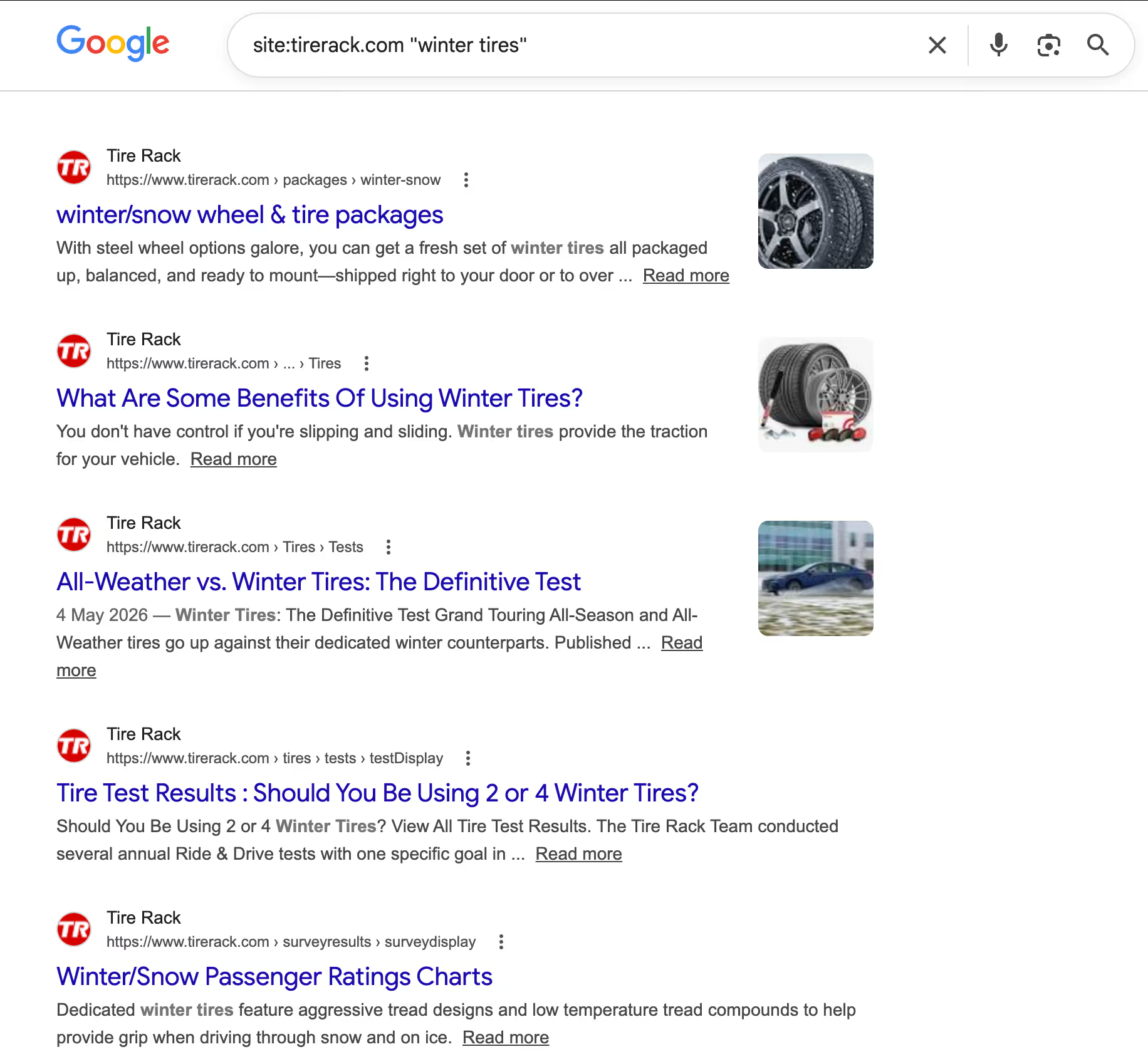
However, this method is best suited for quick spot checks rather than full-scale analysis, since it only helps investigate individual keywords one by one.
Google Search Console is one of the most informative free tools of how to check keyword cannibalization.
It allows you to see exactly which pages are ranking and receiving impressions for specific queries.
How to define cannibalization in GSC:
If you see two or more different URLs ranking for the same search query, this is a strong indication of keyword cannibalization.
In a healthy SEO structure, one primary page should dominate a single search intent. If multiple pages appear simultaneously, it usually means:
This results in search engines splitting ranking signals between multiple URLs instead of consolidating them into one strong page.
For large-scale keyword cannibalization analysis, SEO professionals typically use tools such as Semrush, Ahrefs, or Screaming Frog SEO Spider. These platforms help automate part of the research process and quickly identify problematic areas across a website.
With these tools, you can:
This is especially important for large eCommerce websites such as tire retailers, auto parts stores, and consumer electronics marketplaces, where thousands of category pages, filters, and dynamically generated URLs can unintentionally compete with one another.
SEO tools make it easier to identify structural issues that are difficult to detect manually and provide a foundation for further semantic optimization and cannibalization fixes.

The most systematic way to identify keyword cannibalization is to build a keyword mapping table, where one priority URL is assigned to each target query. This makes it possible to clearly define which page should rank for a specific keyword and where internal competition occurs within the website.
Such a table matches target keywords with relevant pages, their performance metrics (impressions, clicks, rankings), and the actual role of each page within the site structure. If the same query is assigned to two or more URLs, this is already a signal of potential keyword cannibalization.
Example of Semantic Audit Using a Keyword Mapping Table in the Consumer Electronics Industry
But the main function of a semantic audit through a keyword mapping table is that an SEO specialist gets a clear foundation for making decisions about each content page.
Keyword cannibalization directly affects rankings, traffic distribution, and the overall clarity of your site structure. Once you’ve identified overlapping pages targeting the same search intent, the next step is to take action and resolve internal competition between URLs.
There is no one universal method of how to solve keyword cannibalization. The right approach depends on the type of overlap, content quality, and business goals. Below are the most effective way used in modern SEO to eliminate keyword cannibalization.
If two pages cover the same topic, the best solution is to merge them into a single strong page. The content from both pages is combined and rewritten into one comprehensive resource, and a 301 redirect is set up from the old URL to the updated page.
This method is suitable when:
If pages need to remain live (for example, in eCommerce filter or variant pages), but only one should be prioritized, you can add a rel="canonical" tag pointing to the main page on all duplicate URLs.
This signals to Google: “This page exists, but the main version is here. Transfer ranking signals to that URL.”
Sometimes cannibalization is not caused by content, but by internal linking structure. Internal links act as signals of importance: the page that receives more relevant anchor links is often considered more important by search engines.
If internal links point more strongly to a secondary page than to the main one, Google may incorrectly treat the secondary page as the primary ranking URL.
That’s why it is important to analyze which page receives the most internal links with target anchors and adjust the linking structure so that the priority page receives the strongest internal authority. This helps align relevance signals and eliminate internal competition between URLs.
If a page brings no traffic and provides no real value to users, the simplest solution is to either delete it or block it from indexing using noindex. This frees up crawl budget and removes unnecessary competition.
This approach of what to do with keyword cannibalization in seo should be used carefully. You can apply it, only when the page has no unique value and does not attract backlinks.
Sometimes the best solution is to reposition similar pages for different search intents. One page becomes informational (e.g. “How to choose an air humidifier”), while another remains commercial (e.g. “Buy an air humidifier”).
However, this only works if there is a real difference in search intent. If Google still treats the pages as identical, it is better to return to methods 1 or 2.
As SEO specialist Anastasiia Pasteka from Promodo explains:
“Decisions regarding cannibalization should always be based on a holistic evaluation of data, not a single source. I use four key factors: search volume (Ahrefs), SERP and intent analysis, Google Search Console data, and behavioral analytics.”
Identifying and fixing keyword cannibalization is an important part of any SEO strategy. However, it is even more important to build a process that prevents the issue from recurring as your website grows.
Before publishing any new content, always check whether an existing page already covers the target query. Maintain a keyword mapping table where each search query is assigned to a single priority URL.
This ensures that every keyword has a clear “home page” and prevents overlapping content from being created unintentionally.
Instead of producing isolated articles, plan content in clusters. A single pillar page should cover the main topic broadly, while supporting pages target more specific subtopics.
This structure not only prevents cannibalization but also builds a strong internal content architecture that improves topical authority.
Once per quarter, review Google Search Console to identify whether new pages are competing for the same queries.
Look for patterns where multiple URLs start appearing for identical or closely related search terms — this is often an early sign of emerging cannibalization issues.
Every new piece of content should have a clearly defined primary keyword and a documented differentiation from existing pages already on the site.
This should be established during the planning stage, not after publication, to avoid overlap in search intent and keyword targeting.
When working with Unbench, a B2B platform entering the market from scratch, the team conducted thorough semantic research and keyword clustering as part of the initial SEO strategy. Every keyword was collected, grouped by intent, and mapped to a specific page before the site structure was finalized. This ensured that each URL had a clearly defined role and that no two pages would unintentionally compete for the same queries.
The research also directly shaped the site architecture. By analyzing competitor structures and identifying gaps in keyword coverage, Promodo expanded the number of indexable pages in a way that reflected distinct user intents — rather than creating overlapping content that would later need to be consolidated or removed.
A content plan for the blog was built on the same semantic foundation: topics and keyword clusters were identified upfront, and detailed briefs were prepared for each article to prevent intent overlap between informational and commercial pages.
The result? Over eight months, the platform achieved 91.7% overall traffic growth — built on a structure where every page had a purpose, and none competed against the others.
This is what separates reactive SEO from a strategy designed to scale cleanly from the start.
Keyword cannibalization is just one of many issues that can slow down organic growth. However, it is one of the most common SEO mistakes that prevents websites from scaling and achieving stable rankings.

Team Lead of Content for promodo.com
Experienced in working with data, expert recommendations, and real business cases to create clear and valuable content that delivers real business impact. Passionate about discovering new insights, exploring industry trends, and turning complex topics into practical, easy-to-understand content.
SEO Specialist at Promodo
You may also like
Choose quality and trusted services to improve the presence of your company on the Internet, and feel free to contact our UK team if you have any questions.

Whether you’re a personal injury attorney, divorce lawyer, or criminal defense specialist, running the proper PPC marketing for lawyers will grow your practice.

Partnering with an email marketing agency can bring valuable benefits to your team. Find the list of signs that signal that you need an agency.

Each company seeks to maximize its income while determining the market value of a new product.
We at Promodo are ready to help you improve your performance across all digital marketing channels.
Get started





.svg)


