


Content



Team Lead of Content for promodo.com
Experienced in working with data, expert recommendations, and real business cases to create clear and valuable content that delivers real business impact. Passionate about discovering new insights, exploring industry trends, and turning complex topics into practical, easy-to-understand content.

SEO Specialist at Promodo
.png)
The US consumer electronics market is highly competitive, and customer journeys are becoming increasingly complex. Before making a purchase, consumers compare products, read reviews, search for the best deals, and look for nearby stores. As a result, search behavior has become one of the strongest indicators of purchase intent.
For brands and retailers, understanding how people search is just as important as understanding what they buy. Search demand reveals not only which products are popular but also where customers are in the buying journey—from early research to purchase-ready queries. These insights help marketers prioritize the right channels, optimize content, and invest in the strategies that generate the greatest return.
To uncover these patterns, Promodo analyzed search demand across the largest consumer electronics categories in the US market. The research explores how users search for smartphones, laptops, TVs, headphones, and smartwatches, identifying the intent behind their queries and the opportunities brands can leverage to increase visibility and drive sales.
.webp)
To better understand what drives consumer electronics purchases in the US, Promodo's SEO team analyzed search demand using Ahrefs.
The research focused on the five highest-volume product categories: smartphones, smartwatches, headphones, TVs, and laptops. For each category, we analyzed the 300 highest-volume keywords and segmented them across two key dimensions:
This analysis provides a data-driven view of how US consumers search for electronics, what influences their purchase decisions, and where brands and retailers have the greatest opportunities to improve organic visibility and capture demand.
Here's a more analytical and reader-friendly version that flows naturally into the category breakdown.
Our analysis reveals that "best" is the dominant search modifier across all five consumer electronics categories, highlighting that US shoppers actively research products before making a purchase. However, the role of this modifier—and the broader search behavior surrounding each category—varies significantly depending on the product.
The data reveals two distinct purchase behaviors.
The first group consists of research-driven categories—TVs, headphones, and smartwatches. Here, users spend more time evaluating products, comparing features, and looking for expert recommendations. Informational searches dominate, while location-based queries play a relatively minor role, indicating longer consideration cycles.
The second group includes purchase-oriented categories—smartphones and laptops. These searches show much stronger transactional intent. Modifiers such as "near me" and "cheap" appear far more frequently, suggesting that buyers are closer to making a purchase and are actively looking for nearby retailers, competitive prices, or immediate availability.
For marketers, these behavioral differences have important implications. While some categories benefit most from educational content and comparison guides, others require a stronger focus on local visibility, pricing strategies, and commercial landing pages.
Let's take a closer look at each category individually.
Smartphone is the only category where "best" doesn't run away with the majority — it takes just 48.3% of modifier searches, with "near me" close behind at 35.7%, and "cheap" at 14.2%. "Review" barely registers at 1.3%.
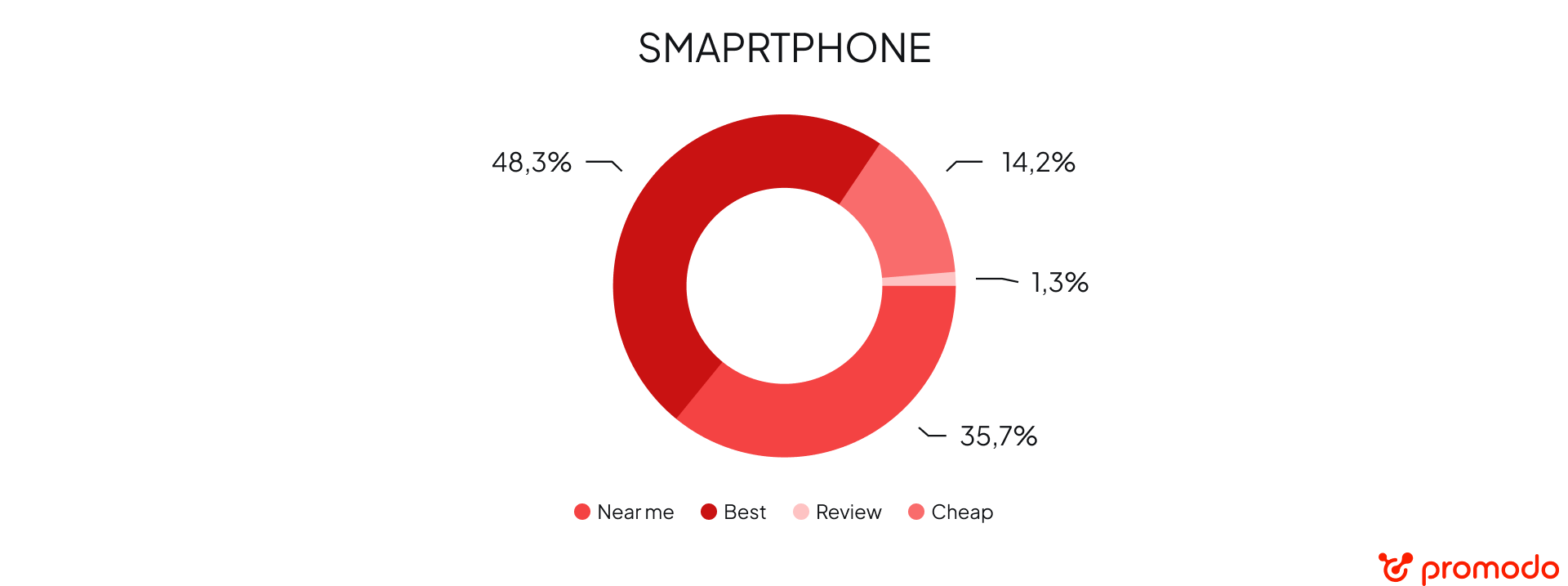
These patterns suggest that smartphone buyers are already close to making a purchase. Around one-third of modifier-based searches include location intent (e.g., "near me" or city-specific queries), making local SEO, Google Business Profile optimization, and well-optimized store locator pages just as important as informational content.
Search intent in the smartphone category differs from most other consumer electronics segments. Informational and Commercial queries generate almost equal demand (around 700K monthly searches each), whereas in other categories informational searches typically dominate. This indicates that consumers move quickly from research to purchase consideration.
The balanced split between Informational and Commercial intent also creates an opportunity to guide users seamlessly through the buying journey. Content marketing should connect model comparisons and buying guides directly to product listings and purchase pages.
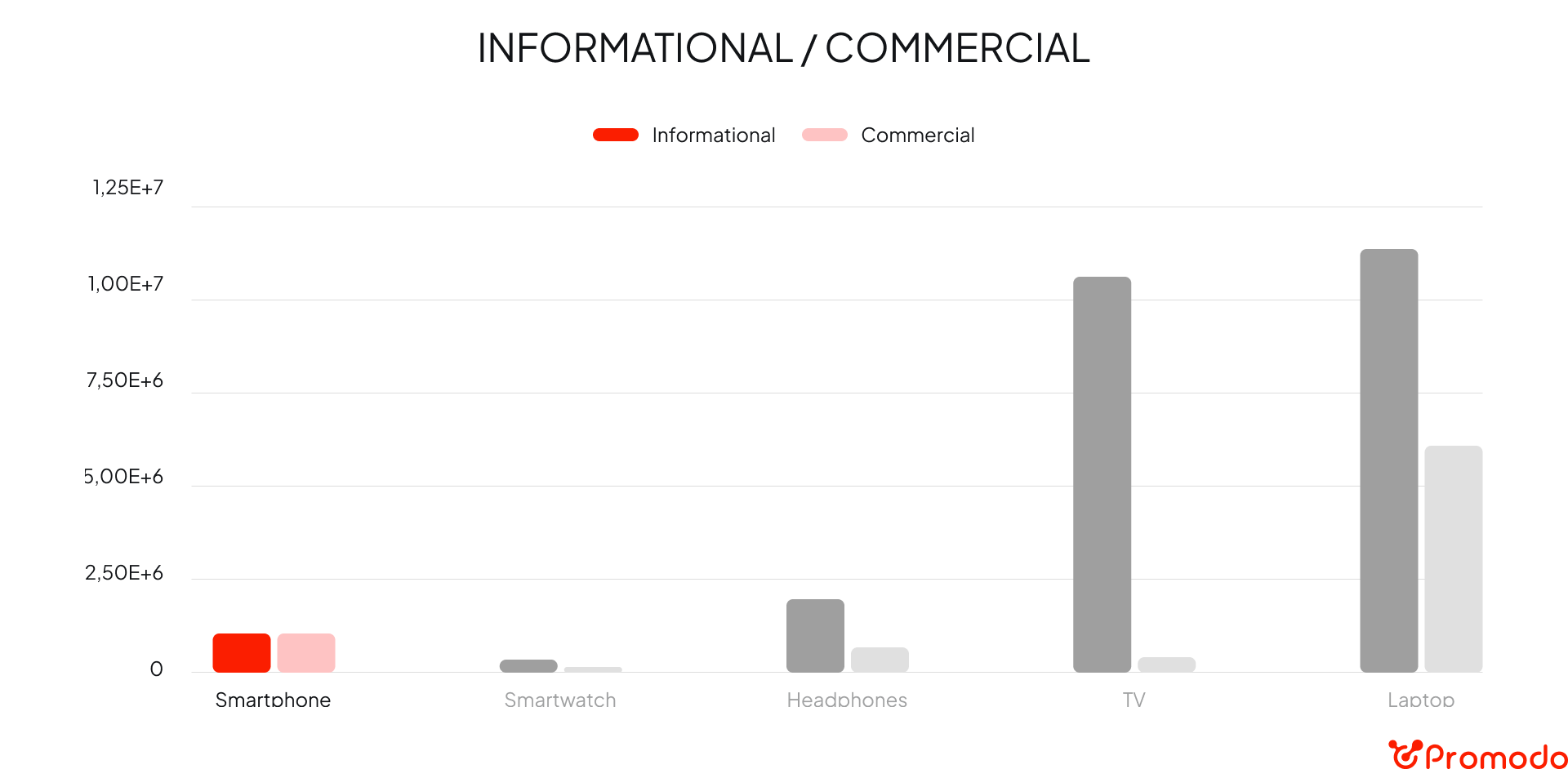
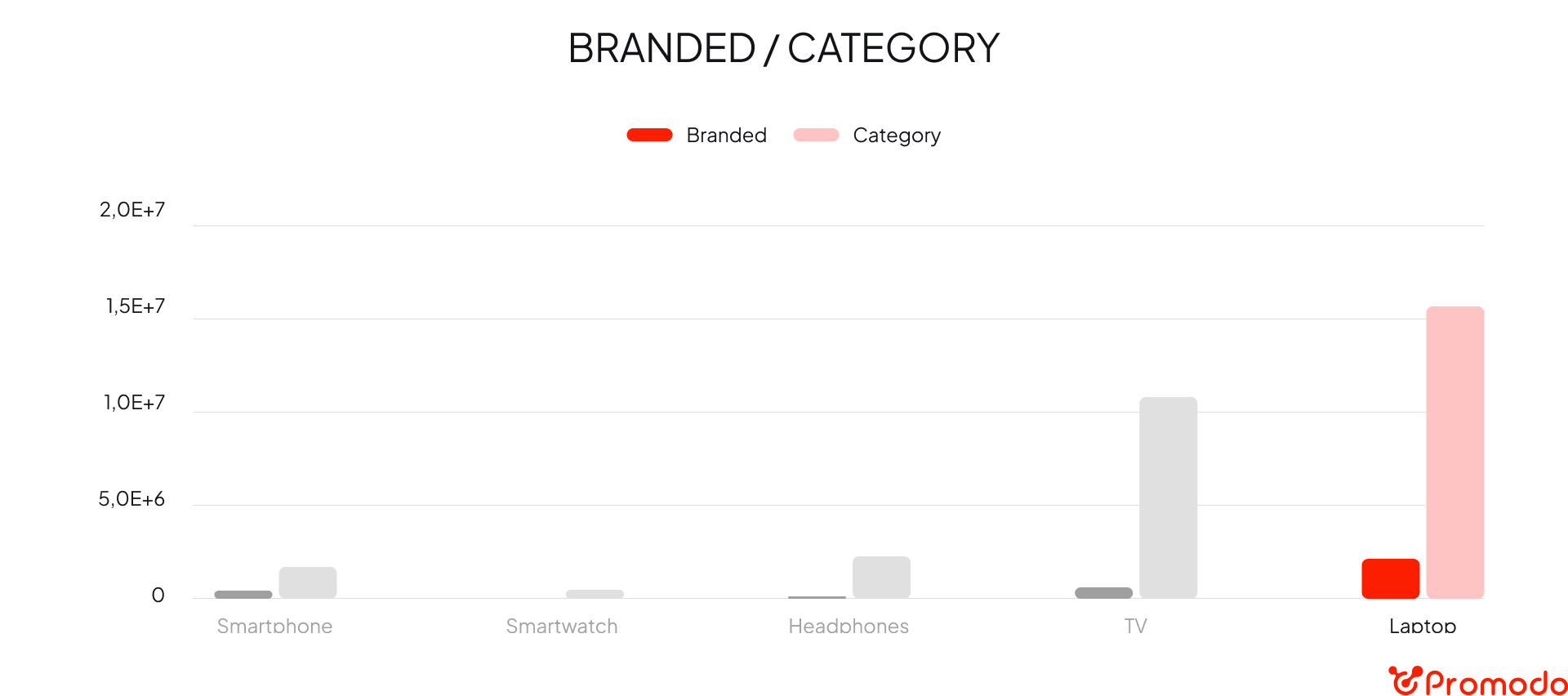
At the same time, non-branded category searches significantly exceed branded searches (approximately 1.5M vs. 300K monthly searches). It means that most users begin their journey without a preferred manufacturer.
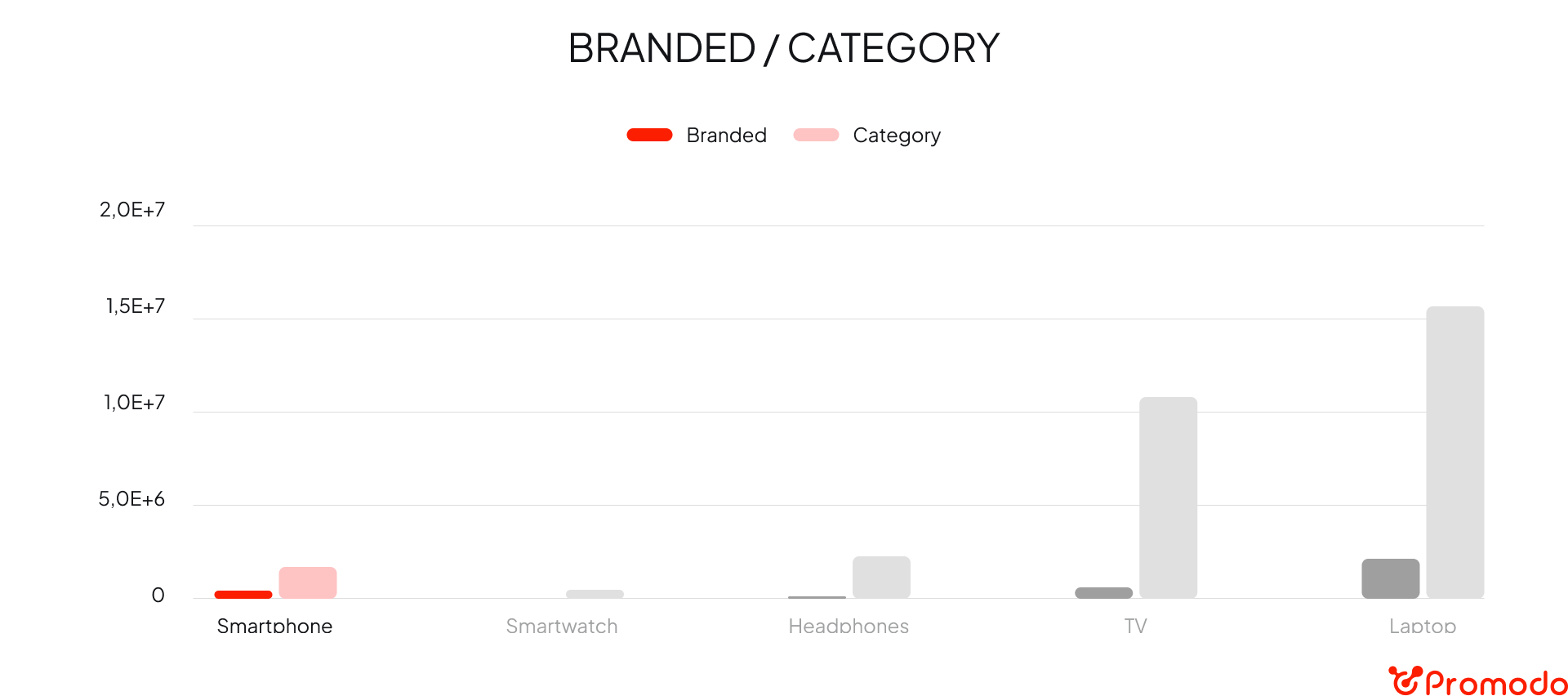
The 5:1 ratio of category to branded searches demonstrates that comparison-driven, non-branded content offers the greatest opportunity to attract shoppers before brand preference is established.
Modifier analysis reinforces these findings. "Best" dominates search behavior, accounting for 65.6% of modifier queries, while "cheap" represents the second-highest share among all analyzed categories at 27.5%. By contrast, location-based intent is almost nonexistent, with "near me" making up just 0.6% of modifier searches—the lowest proportion across all categories.
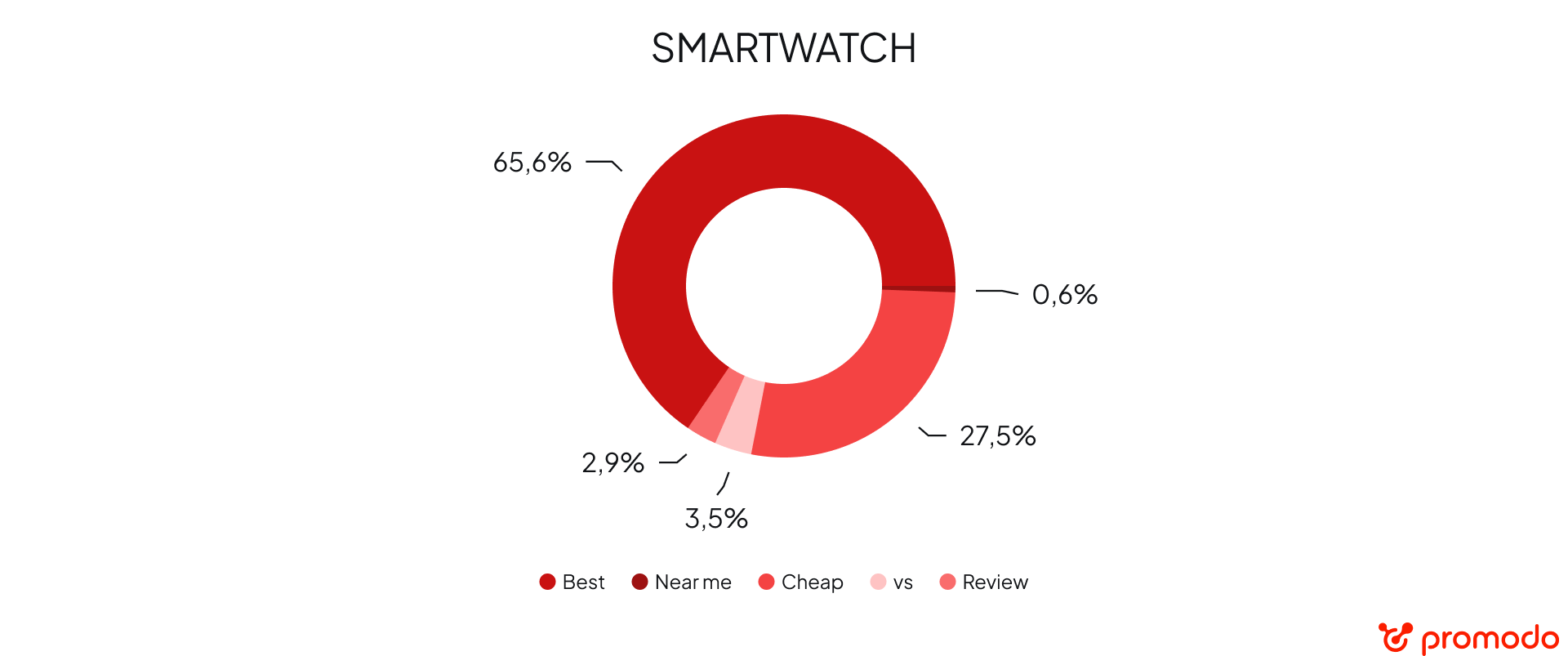
These patterns indicate that smartwatch purchases are primarily driven by online research rather than local shopping. As a result, investments in local SEO are likely to deliver limited returns, while comparison content, buying guides, and budget-focused pages are better positioned to capture demand.
The low share of branded searches further highlights an opportunity for retailers to attract consumers through category-level content before they narrow their choice to a specific device, such as an Apple Watch or Samsung Galaxy Watch.
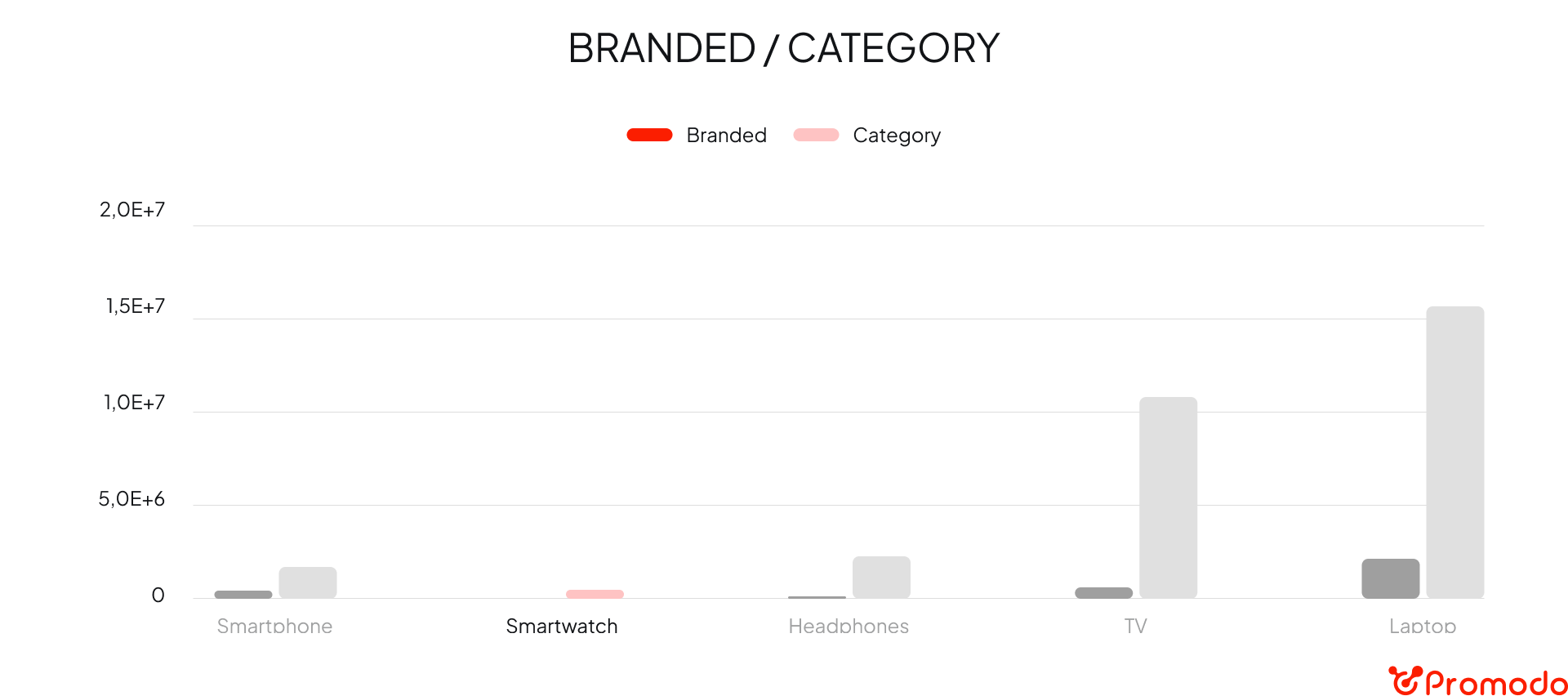
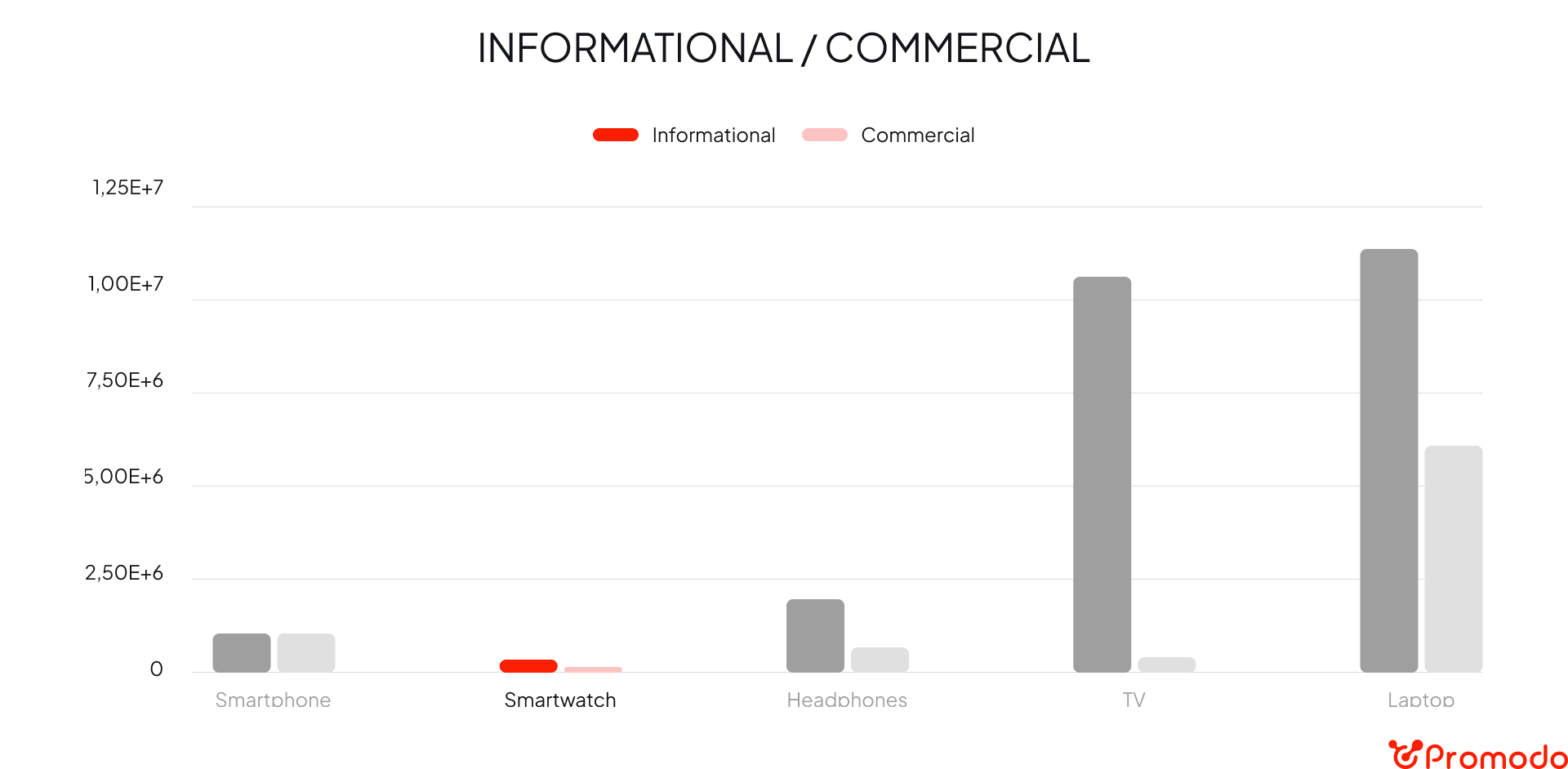
The smartwatch category is characterized by early-stage research and strong price sensitivity. Informational queries account for approximately 400K monthly searches, compared to around 150K commercial searches, indicating that users spend more time exploring options before making a purchase. Non-branded category searches also significantly exceed branded queries (roughly 350K vs. 50K), suggesting that most shoppers have not yet chosen a specific brand.
Searches containing "best" account for 71.8% of all modifier queries, the highest share among the analyzed categories. "Cheap" follows at 14.3%, while "near me" (5.2%), "vs" (4.5%), and "review" (4.2%) make up relatively small portions of demand.

Although local intent exists, it remains limited. With only 5.2% of modifier searches including "near me," physical retail plays a secondary role, likely driven by last-minute purchases, gifting occasions, or urgent replacements. Overall, online research dominates the decision-making process, making high-quality buying guides, comparison pages, expert reviews, and category hubs the most effective content formats for attracting potential buyers.
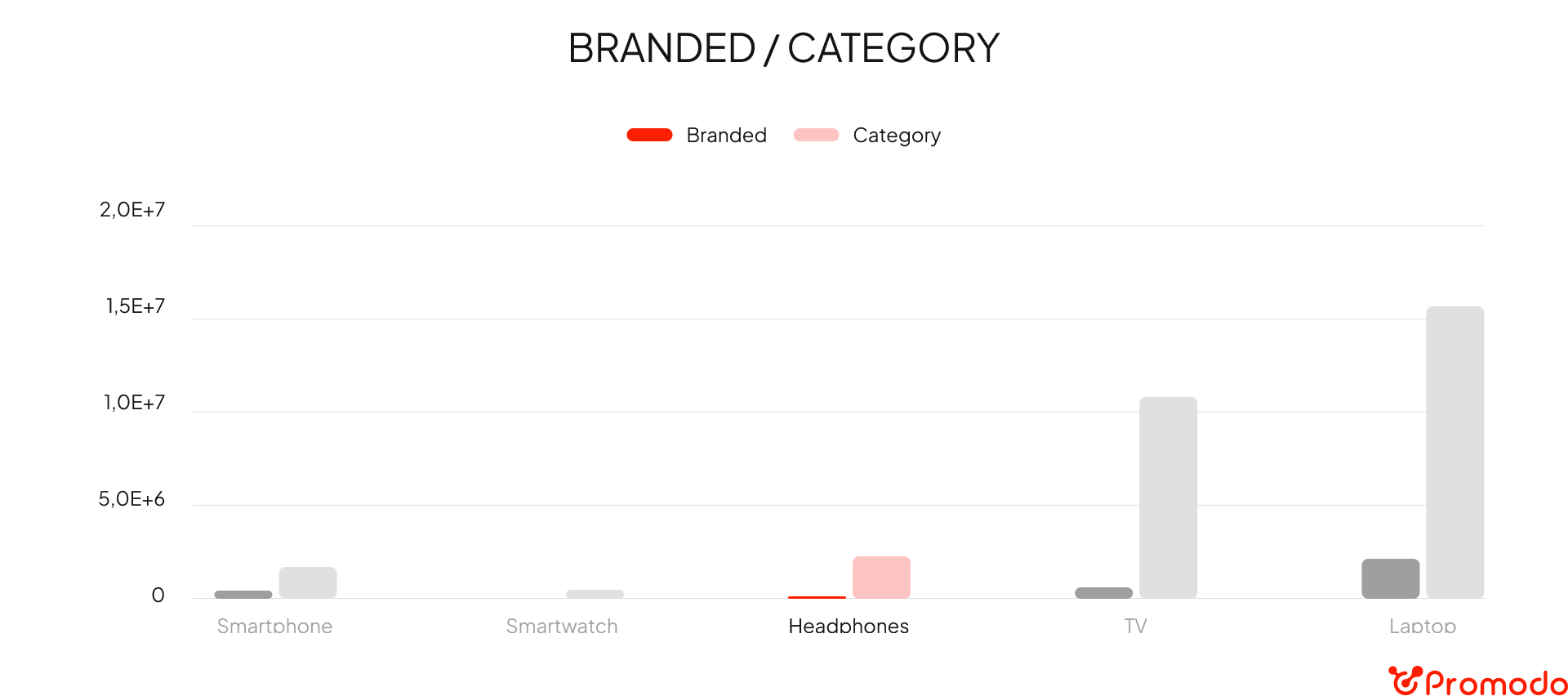
Headphones represent the most research-driven category in the analysis. Informational searches total approximately 1.8M per month, exceeding commercial queries (around 550K) by more than three times—the largest gap among all five product categories. Similarly, non-branded category searches outnumber branded searches by nearly 8:1 (approximately 1.2M vs. 150K), indicating that consumers overwhelmingly begin their purchase journey without a preferred manufacturer.
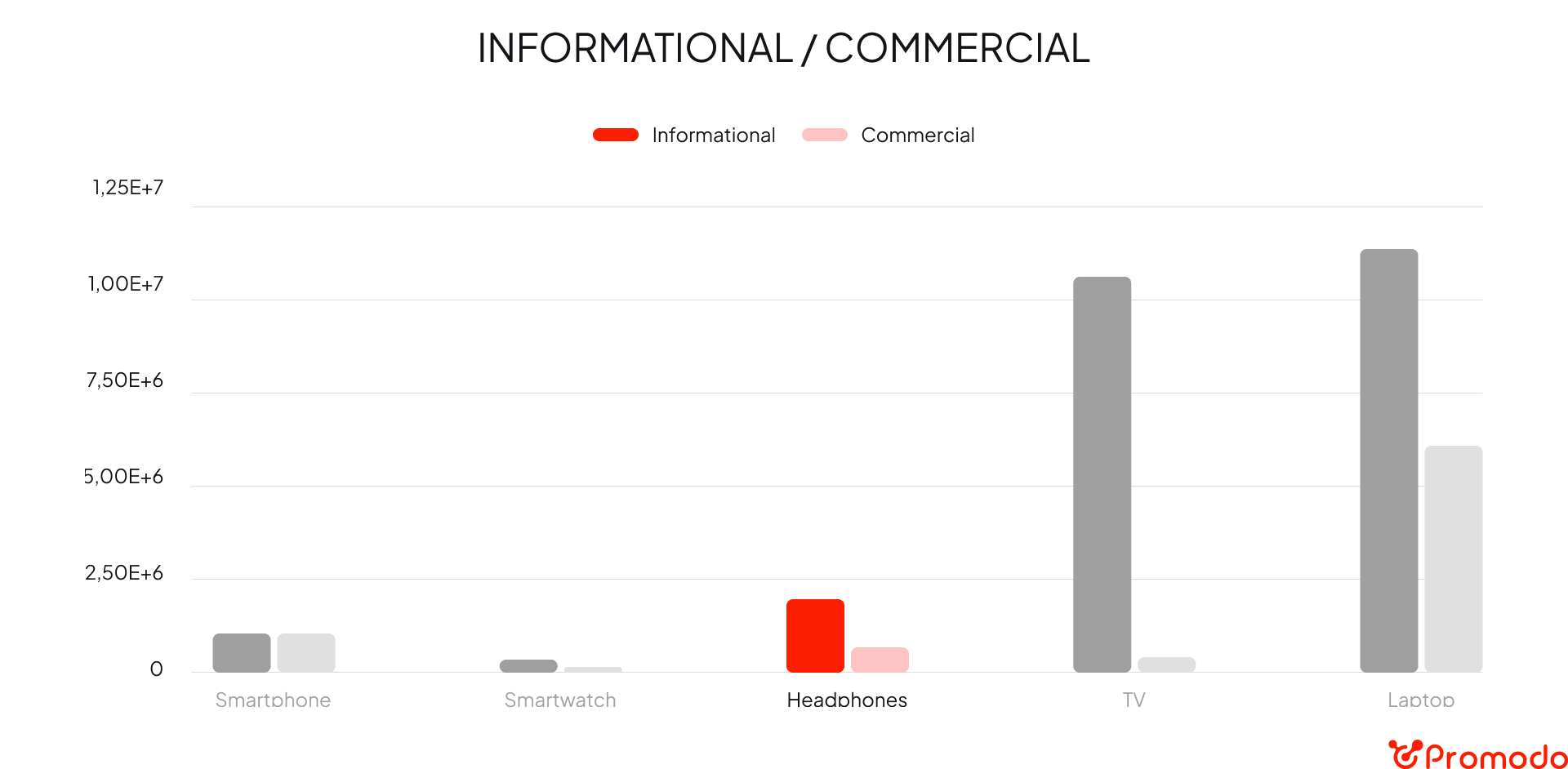
These patterns position headphones as the strongest top-of-funnel category in the study. Consumers spend considerable time comparing products, reading buying guides, and evaluating use cases before moving toward a purchase decision. This creates significant opportunities for retailers and brands to capture demand through educational, comparison-driven content such as best noise-cancelling headphones, best gaming headsets, or best headphones for running.
The exceptionally high 8:1 ratio of category to branded searches also indicates that brand loyalty is relatively weak at the beginning of the customer journey. Many shoppers first define the product features they need—such as ANC, gaming performance, comfort, battery life, or workout suitability—before considering specific brands. As a result, SEO strategies targeting feature- and use case-based queries are likely to generate broader reach than brand-focused content alone.
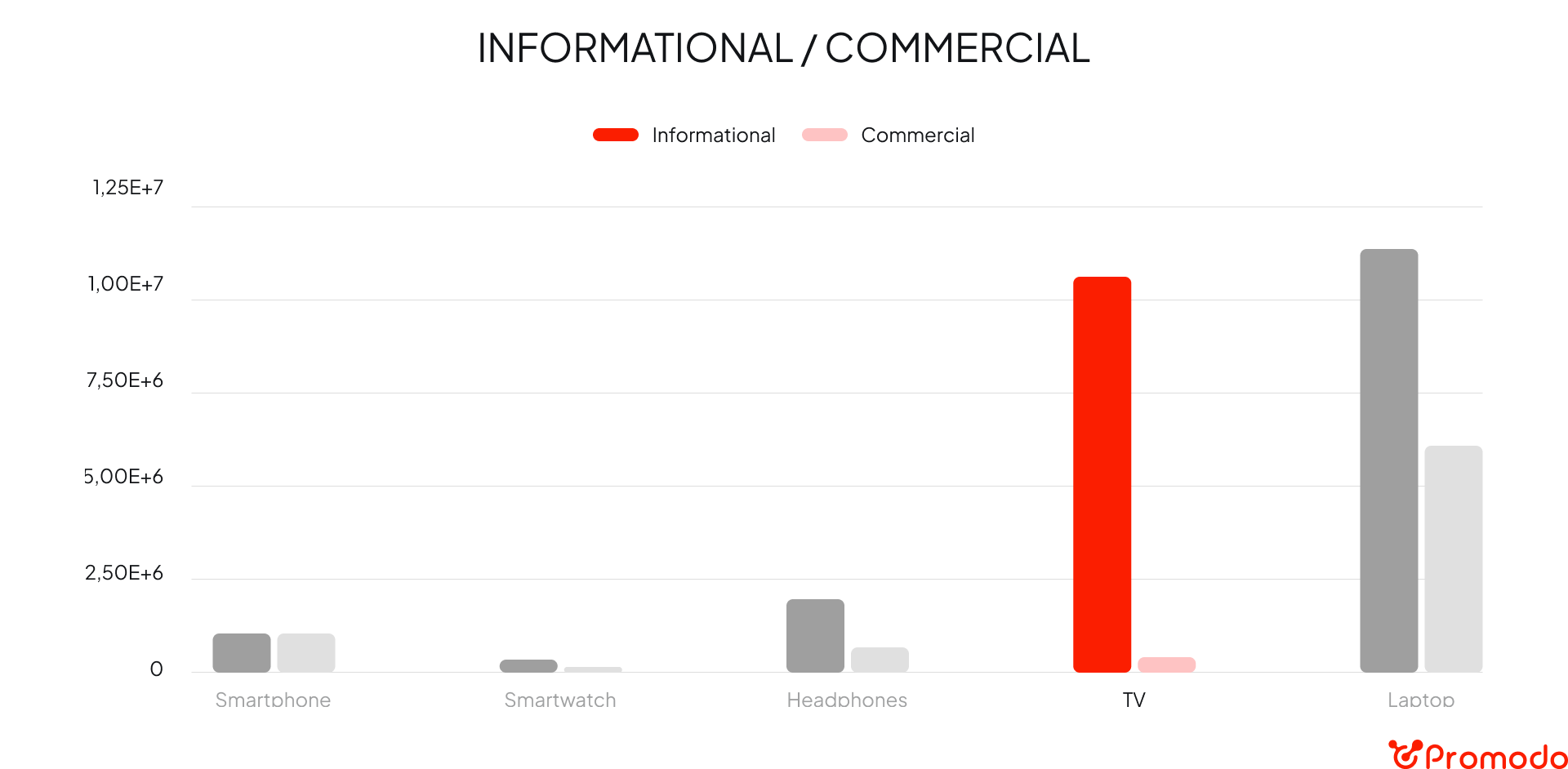
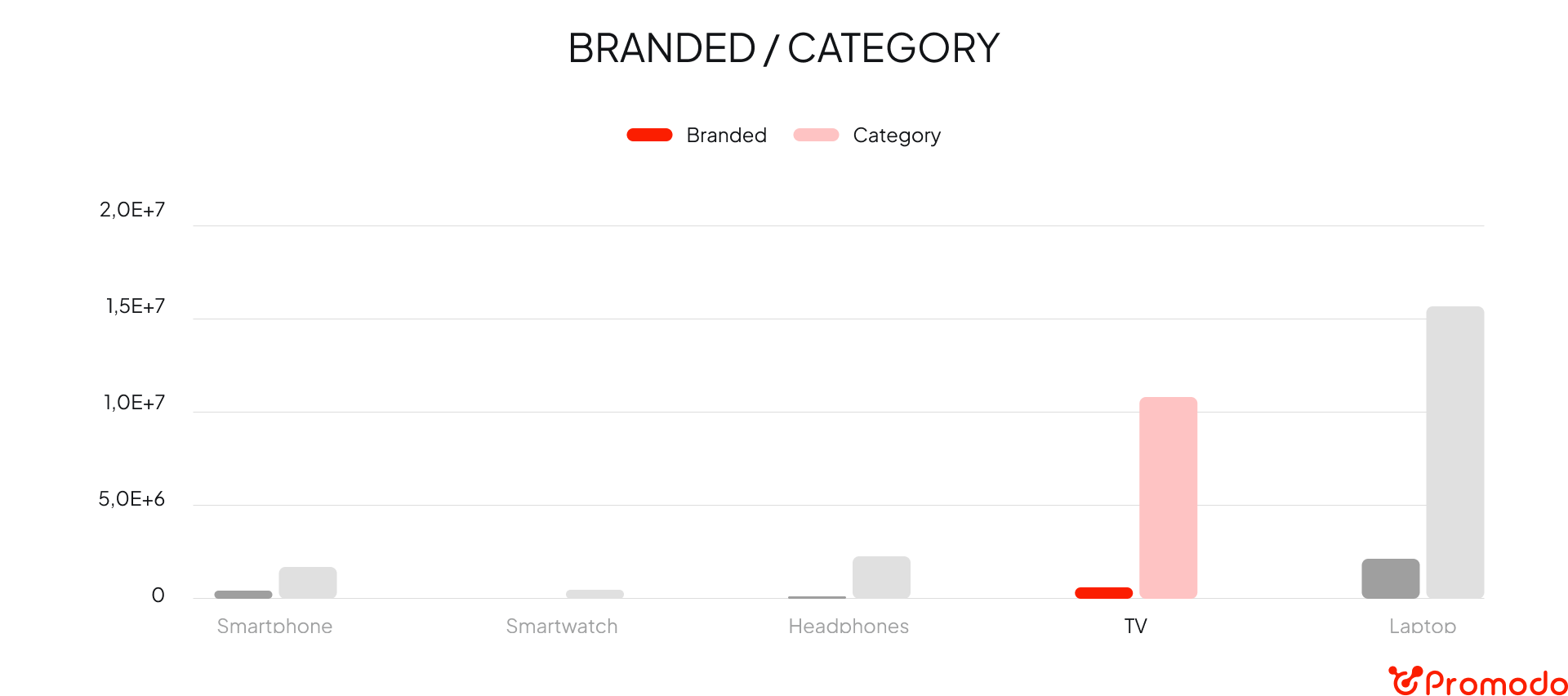
TVs stand out as the most research-intensive product category in the analysis. Informational searches generate approximately 10.5M monthly queries, compared to just 500K commercial searches—an exceptional 20:1 ratio, the largest gap across all five categories. Non-branded category searches also vastly exceed branded searches (around 10M vs. 800K), confirming that most consumers begin their buying journey by exploring product types and features rather than specific manufacturers.
[[SLIDER-START]]
[[SLIDER-END]]
Modifier analysis further highlights this behavior. Searches containing "best" account for 80.7% of all modifier queries—the highest share of any category analyzed. This is followed by "vs" (9.0%) and "review" (7.0%), while "cheap" represents only 2.0%, the lowest proportion across all categories. Location-based intent is virtually nonexistent, with "near me" generating negligible search volume.
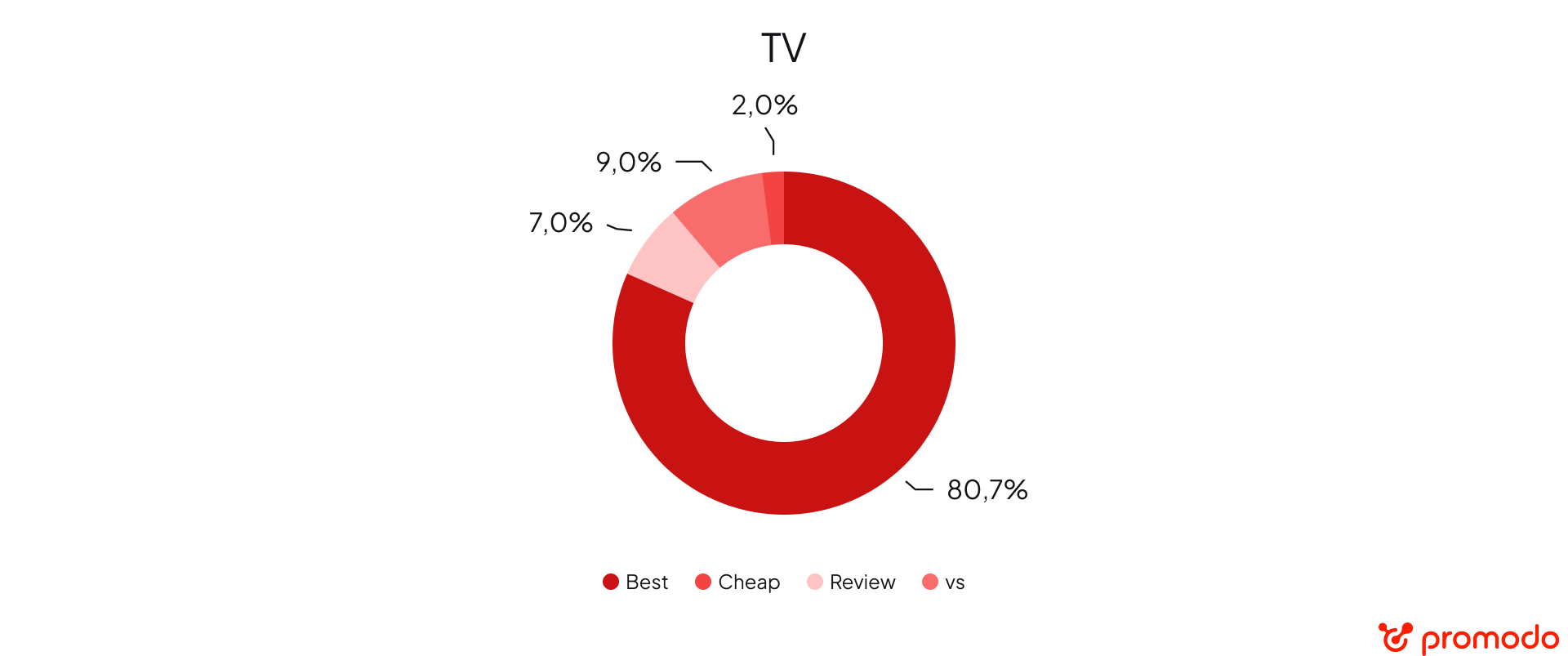
These findings indicate that purchasing a TV is a highly considered decision. Rather than searching for discounts or nearby retailers, consumers invest significant time comparing technologies, screen sizes, display quality, gaming performance, and value for money before narrowing their options. The prominence of "best," "vs," and "review" queries suggests that users seek expert recommendations and detailed comparisons long before reaching the purchase stage.
The strong dominance of category over branded searches also shows that brand preference is often formed late in the decision-making process. Consumers typically start by identifying the type of TV that fits their needs—such as best OLED TV, best TV for gaming, or best TV under $1,000—before deciding between brands like Samsung, LG, Sony, or TCL. This creates a substantial opportunity for retailers and publishers to capture early-stage demand with educational content, buying guides, comparison pages, and feature-focused resources that naturally guide users toward product and category pages.
From an SEO perspective, the TV category requires a strategy centered on authority and expertise rather than transactional optimization alone. Success depends on comprehensive comparison content, technology explainers, interactive buying guides, and regularly updated "best" rankings that address evolving consumer questions and purchasing criteria.
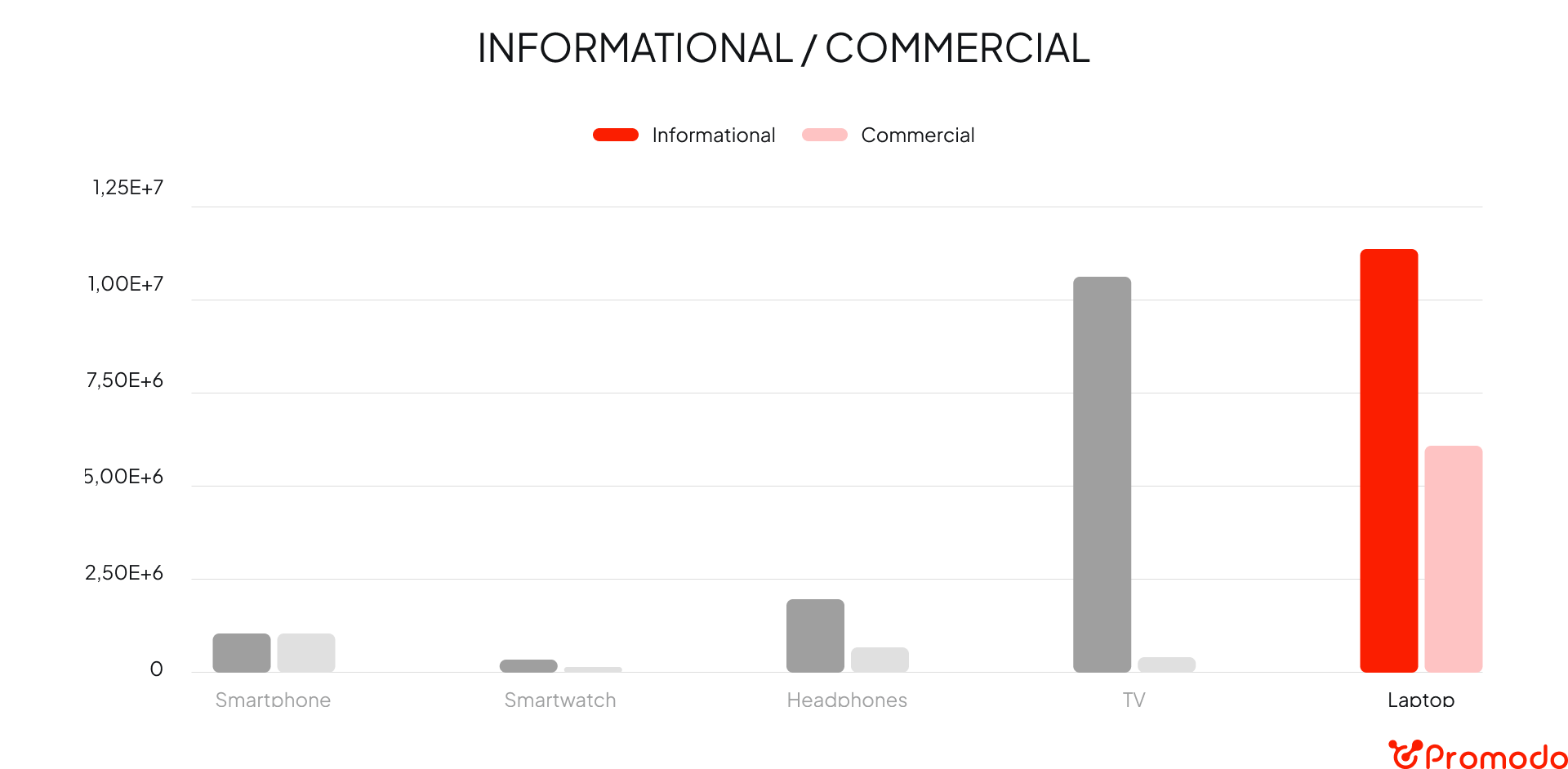
Laptops generate the highest overall search demand of all analyzed product categories while maintaining the strongest balance between research and purchase intent. Informational searches total approximately 11.5M per month, compared to around 6M commercial searches—the narrowest gap among the high-volume categories and the largest commercial search pool in absolute terms. Non-branded category queries also dominate branded searches by roughly 10:1 (15M vs. 1.5M), indicating that consumers typically define their requirements before selecting a manufacturer.
[[SLIDER-START]]
[[SLIDER-END]]
Modifier analysis reflects this balanced behavior. "Best" remains the leading modifier, accounting for 57.8% of searches, but "cheap" (18.2%) and "near me" (16.2%) represent substantially larger shares than in categories such as TVs or headphones. Meanwhile, "vs" (4.4%) and "review" (3.5%) account for a relatively small portion of demand.
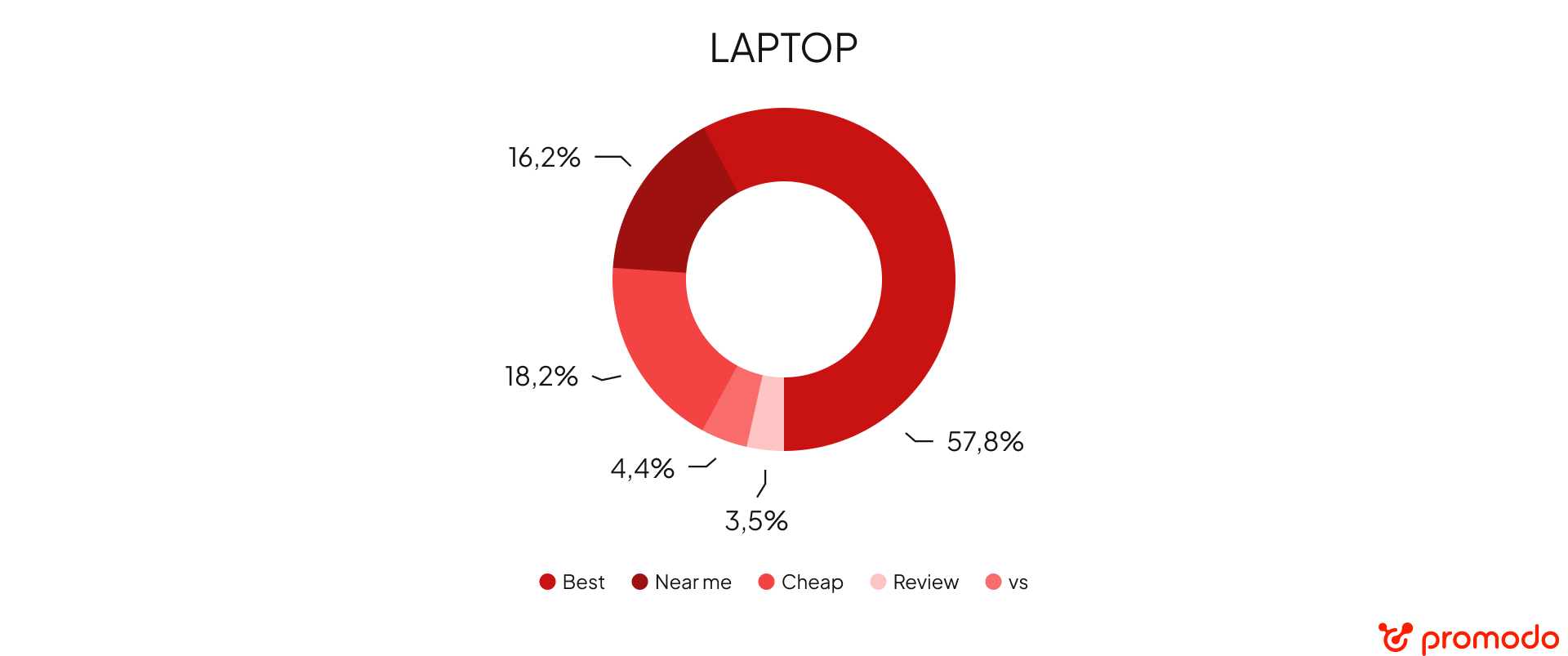
These patterns suggest that laptop shoppers frequently transition from research to purchase within the same search journey. While many users begin by comparing models and specifications, a significant share quickly shifts toward finding competitive prices or products available for immediate purchase. The combination of strong informational and commercial demand makes laptops the category with the greatest opportunity to influence consumers throughout the entire buying funnel.
The relatively high share of "cheap" and "near me" searches—together accounting for more than one-third of all modifier queries—also points to more immediate purchase intent than in other electronics categories. Unlike TVs, which are typically planned purchases, laptops are often bought under time-sensitive circumstances, such as replacing a broken device, preparing for school or university, starting a new job, or upgrading work equipment. As a result, shoppers place greater emphasis on both affordability and local availability.
Despite the strong commercial intent, the 10:1 ratio of category to branded searches shows that most consumers still enter the market without a fixed brand preference.
Instead, they search around specific needs or budgets—for example, best laptop for students, best laptop for programming, or cheap laptop under $500—before narrowing their options to brands such as Dell, Lenovo, HP, or Apple. This creates a significant opportunity for retailers to capture early-stage demand through category pages, buying guides, budget-focused content, and use case-specific recommendations that naturally lead users toward transactional pages.
Overall, the laptop market requires a full-funnel SEO strategy that combines authoritative educational content with highly optimized commercial and local landing pages. Compared with the other product categories, laptops offer the strongest potential to generate both organic traffic and revenue because research and purchase intent are closely aligned.
Search behavior varies significantly across consumer electronics categories, meaning no single marketing channel fits every product. Some categories are driven by local purchase intent, while others require extensive research before consumers are ready to buy. Aligning SEO, PPC, GEO, Local SEO, Content Marketing, and Email Marketing with these behaviors helps brands engage shoppers at every stage of the journey.

Team Lead of Content for promodo.com
Experienced in working with data, expert recommendations, and real business cases to create clear and valuable content that delivers real business impact. Passionate about discovering new insights, exploring industry trends, and turning complex topics into practical, easy-to-understand content.
SEO Specialist at Promodo
You may also like
Choose quality and trusted services to improve the presence of your company on the Internet, and feel free to contact our UK team if you have any questions.

Today, Promodo SMM experts are sharing invaluable advice about how not to fall for a phishing scheme on Facebook.

Retention marketing itself is already a trend. With the rising cost of acquiring new customers, companies are finally paying more attention to...
.avif)
“You’d better know your target audience!” – marketers tell us often and persistently.
We at Promodo are ready to help you improve your performance across all digital marketing channels.
Get started




.svg)


