


Content



Team Lead of Content for promodo.com
Experienced in working with data, expert recommendations, and real business cases to create clear and valuable content that delivers real business impact. Passionate about discovering new insights, exploring industry trends, and turning complex topics into practical, easy-to-understand content.

PPC Automation Specialist
https://academy.promodo.ua/course/kurs-avtomatizaciyi-akauntiv-google-ads-5

Understanding how consumers search for tires online provides valuable insights into purchasing behavior, seasonal demand fluctuations, and regional market dynamics. We’ve already published the eCommerce tire market research. However, the research of the demand analysis captures real consumer intent, revealing not only what products people need but also when they need them and the factors influencing their purchasing decisions.
As Promodo works extensively with tire retailers, we regularly analyze the tire market to develop a deeper understanding of consumer behavior in the United States. To support this research, Promodo’s SEO experts conducted a comprehensive analysis of search demand across the country, combining keyword research, search volume analysis, seasonality trends, and state-level demand distribution. The study covers both commercial and informational search queries, as well as geo-modified searches that reflect strong local intent in consumer decision-making.
This approach allows us to identify:
The findings reveal that the U.S. tire market is highly commercial, strongly influenced by local intent, and significantly shaped by regional weather conditions.
One of the clearest signals from the analysis is that consumers rarely begin their journey by searching for tires as a product category. Instead, they search for solutions that combine affordability and accessibility.
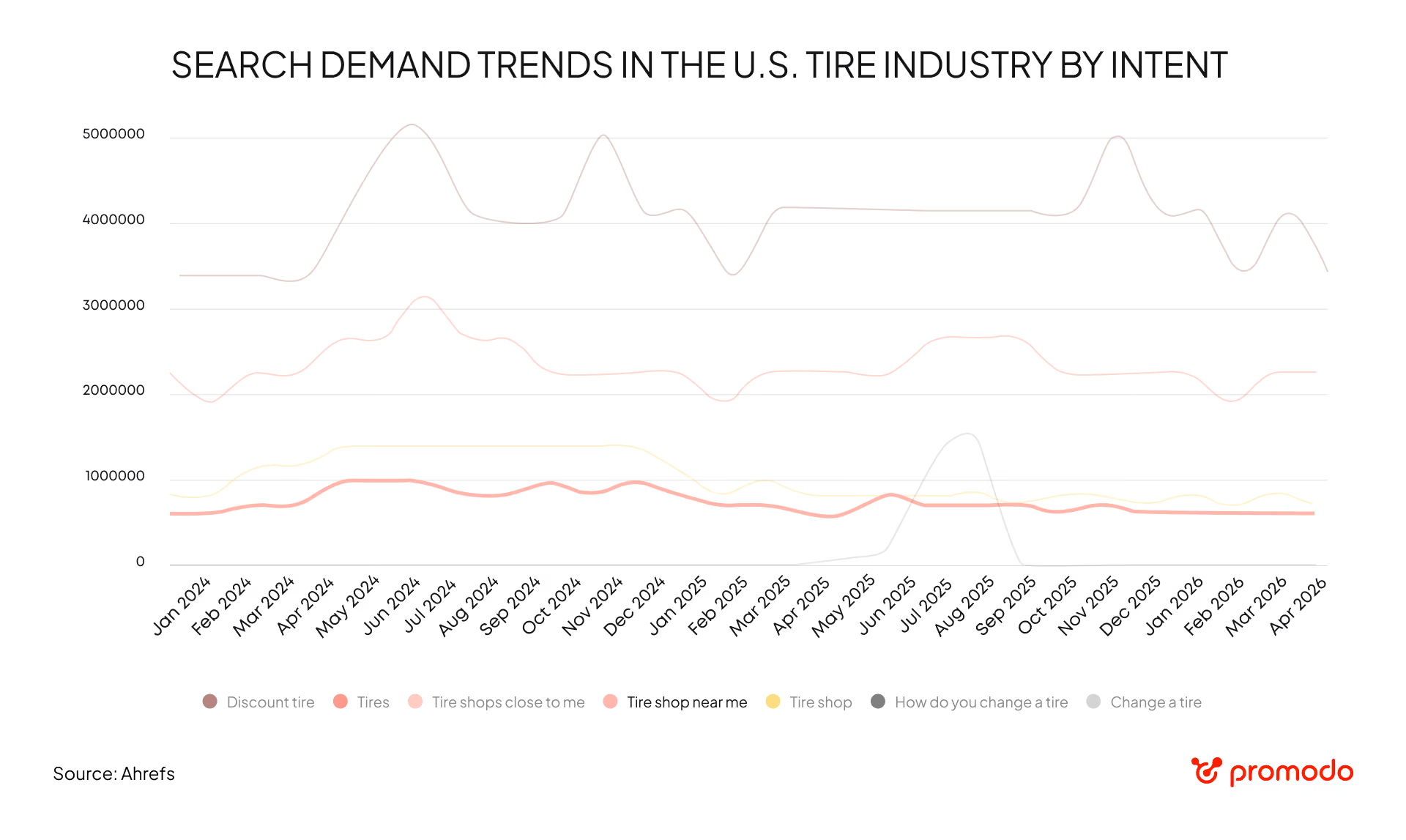
The highest-volume keyword in the market is "discount tire," generating approximately 3.3–5 million monthly searches. By comparison, the generic keyword "tires" attracts only 0.5–1 million searches per month.

This gap suggests that price is often the primary consideration even before brand, tire type, or technical specifications enter the decision-making process.
Consumers are not simply looking to buy tires; they are actively looking for the best deal.
This trend reflects broader economic behavior in the automotive market, where replacement purchases are frequently necessity-driven rather than aspirational. As a result, consumers tend to prioritize promotions, discounts, and perceived value.
For retailers, this means pricing strategies, promotional visibility, and discount-focused messaging play a huge role in capturing demand as well as driving conversions.
Search demand also demonstrates the importance of local intent.
The query "tire shop near me" generates approximately 1.8–3.3 million monthly searches, making it one of the most important search patterns in the category.
Unlike many eCommerce purchases, tires require installation, balancing, and often additional maintenance services. As a result, consumers frequently combine online research with offline purchasing and service fulfillment.
This creates a hybrid customer journey where proximity, availability, and service convenience significantly influence purchasing decisions.
For businesses, local SEO is no longer a supplementary channel but a fundamental component of customer acquisition. Retailers that effectively optimize local search visibility, store pages, inventory availability, and location-specific content are better positioned to capture high-intent traffic.
Search demand analysis reveals clear seasonal patterns across the United States.
Two primary demand periods emerge throughout the year:
Search activity increases during May, June, and July.
This trend is likely associated with:
Consumers appear more willing to invest in vehicle maintenance and tire replacement ahead of seasonal travel periods.
The most significant demand growth occurs between September and November.
This period consistently produces the highest search volumes across the market and is closely linked to winter preparation.
As temperatures decline, consumers begin researching tire replacements, winter tire options, and maintenance services to ensure vehicle safety during colder months.
“The Promodo team analyzed years of data, mapped temperature against sales volume, and found a clear ±1°C threshold where behavior shifts: people stop browsing and start buying immediately. Based on this insight, we enter the auction earlier than competitors — and capture sales while traffic is still cheap.”
Borys Dziundziuk, PPC Automation Specialist at Promodo
This creates a short but highly valuable performance window where early market entry allows advertisers to capture high-intent traffic at lower acquisition costs. Promodo’s automotive PPC strategy is built around proactively entering the auction before competitors react, increasing budgets at the onset of demand acceleration, and then strategically scaling down once CPC inflation begins due to intensified competition.
While commercial searches dominate the market, informational queries still provide valuable insights into consumer behavior.
Keywords such as "how do you change a tire" typically generate lower search volumes compared to transactional searches. However, the data identified notable exceptions. During June–August 2025, searches related to changing a tire experienced a significant spike, reaching nearly 1.9 million searches.

Although informational demand is smaller in volume, it is a critical entry point in the customer journey. It allows brands to reach users early, before they become price-focused or start searching for “near me” options, and build trust through helpful, practical content.
For tire retailers, content marketing should focus on answering real user questions like tire selection, replacement timing, and maintenance basics. This positions the brand as a reliable source of guidance during the research phase, when CPC is still low and competition is less intense.
At Promodo, we see that brands investing in educational content gain stronger visibility in organic search and higher conversion rates later in the funnel, as users tend to return to sources they already trust.
The state-level analysis reveals substantial differences in demand across the United States.
The strongest search demand is concentrated in states with harsher weather conditions and a greater need for seasonal tire replacement.
These states consistently outperform national averages and display stronger seasonal demand patterns. The findings indicate that consumers living in regions with severe winter conditions are significantly more proactive in researching and purchasing tires.
Although autumn represents the primary tire-buying season nationwide, peak demand timing differs between regions.
In Alaska, demand reaches its highest point in October.
In Vermont, peak demand occurs one month later, in November.

These differences highlight the importance of localized marketing strategies for tire shops. Businesses that rely solely on national seasonal calendars risk missing regional demand windows.
A state-specific approach allows retailers to synchronize promotions, inventory allocation, and advertising spend with local consumer behavior.
States such as Florida and Georgia demonstrate lower and more stable search demand throughout the year.
Monthly search volumes typically range between approximately 390 and 880 searches, with far less seasonal fluctuation than in northern markets.
This pattern reflects the reduced impact of winter weather on driving conditions.
In warmer climates, tire replacement is more likely to be driven by wear, mileage, performance needs, or routine maintenance rather than seasonal preparation.
As a result, marketing messages centered on durability, fuel efficiency, and value may resonate more strongly than winter-readiness campaigns.
The research highlights several high-impact opportunities for businesses operating in the US tire market. What makes this category particularly unique is the combination of high commercial intent, SKU-level specificity, strong local demand, and pronounced seasonality. This creates a search ecosystem where performance depends not only on visibility, but also on precision at scale.
Consumers overwhelmingly enter the tire market through discount-driven and purchase-intent queries, rather than product discovery.
Search behavior shows that users are significantly more likely to search for deals, promotions, or retail brands than for generic tire categories. This means that capturing demand at the bottom of the funnel is critical.
For Promodo, this is a core area of expertise. Our PPC team has been running large-scale search campaigns for tire retailers for years, structuring accounts specifically around high-intent commercial queries and maximizing ROI during peak demand windows.
The dominance of “near me” searches confirms that tire purchasing is fundamentally local and service-driven. Even when users research online, the final conversion almost always happens in a physical location due to installation requirements.
This makes local SEO, Google Business Profile optimization, and location-based landing pages essential components of the acquisition strategy.
Promodo supports tire retailers with integrated PPC + SEO local strategies, ensuring visibility across both organic and paid local inventory, including map results, service ads, and store-level campaigns.
One of the most underutilized opportunities in the tire industry is the ability to scale campaigns at the SKU and tire model level.
Consumers frequently search using highly specific queries, including exact tire sizes, models, and performance attributes (e.g., 225/65R17 all-season tires, Michelin Defender LTX, etc.).
This creates a massive opportunity for granular search coverage.
Promodo addresses this through advanced PPC infrastructure, including own tools like G-MOS and Ads Hub, which allow scaling campaigns across thousands (or even millions) of tire SKUs and variations.
This approach enables:
Instead of treating tires as broad categories, Promodo structures campaigns around product-level intent ecosystems, ensuring maximum visibility across the entire decision-making spectrum.
“Most eCommerce projects in the tire industry operate with hundreds or even thousands of SKUs across multiple attributes such as size, brand, season, and type. Manually covering all possible combinations in search campaigns is practically impossible — it either requires excessive time investment or inevitably leads to coverage gaps. Automated approaches like G-MOS enable scalable campaign structures by generating ad groups for every filter combination on the website, automatically updating as the product assortment changes and reducing reliance on constant manual management. Meanwhile, Ads Hub addresses critical operational blind spots — monitoring disapproved ads and products, ensuring feed accuracy, and detecting technical issues. Ignoring these ‘invisible’ processes often results in lost traffic and sales even for large in-house teams, without them realizing it.”
Borys Dziundziuk, PPC Automation Specialist at Promodo

The period from September to November represents the most critical revenue window in the tire industry across most U.S. states.
However, Promodo’s long-term PPC experience in this vertical shows that seasonality is not just monthly, it is highly granular, sometimes shifting within days based on weather conditions and temperature changes.
This is where Promodo’s PPC strategy becomes particularly effective: we increase budgets ahead of competitors, capture high-intent traffic early, and then scale down once auction pressure and CPC inflation begin.
This cycle typically repeats multiple times per year and consistently improves cost efficiency during peak demand periods.
Although informational searches represent a smaller share of total search volume, they play a critical role in shaping early-stage consumer perception and long-term brand trust.
Tire buyers often move through a multi-step journey: from basic questions (“how long do tires last?”) to comparisons and finally to price-driven searches like “discount tire near me.”
Promodo recommends leveraging content marketing as an upstream demand-generation tool, not just a traffic channel.
High-performing content formats include:
This is also where Generative Engine Optimization (GEO) becomes increasingly important. As users shift from traditional search engines to AI-driven answer systems, brands must ensure their content is structured, authoritative, and easily interpretable by generative models.
Promodo integrates GEO principles into content strategies to improve visibility not only in Google search but also in AI-generated answers and recommendation systems.

Team Lead of Content for promodo.com
Experienced in working with data, expert recommendations, and real business cases to create clear and valuable content that delivers real business impact. Passionate about discovering new insights, exploring industry trends, and turning complex topics into practical, easy-to-understand content.
PPC Automation Specialist
https://academy.promodo.ua/course/kurs-avtomatizaciyi-akauntiv-google-ads-5
You may also like
Choose quality and trusted services to improve the presence of your company on the Internet, and feel free to contact our UK team if you have any questions.

In this article, we’ll explain the DAU, WAU & MAU meanings, how they are calculated, and how to use them in practice.

Once upon a time, in a town far far away, a certain eCommerce company’s marketing expert presented a brand awareness strategy to the board of directors.

Despite the undeniable results that come from PPC, studies keep showing that people still have more trust in organic results.
We at Promodo are ready to help you improve your performance across all digital marketing channels.
Get started



.avif)
.svg)


