




Budynok Igrashok (BI) is one of the largest specialized retailers in the children’s toys segment. The company operates 69 stores across 24 cities and the country's largest online toy store.
Increase online sales from Search advertising by 50% while maintaining campaign efficiency.
For years, the company built its growth around a single target audience group, namely parents shopping for children aged 0–12. This strategy consistently delivered strong results.
However, beginning in 2022, Ukraine's toy market entered a prolonged period of stagnation.
As a result, scaling online sales became significantly more challenging. Competition intensified not only among traditional toy retailers but also from marketplaces, grocery chains, consumer electronics retailers, pharmacies, and gray-market sellers rapidly expanding their digital presence. Traffic acquisition costs increased while target audiences became increasingly fragmented.
In a shrinking market, continuing to target the same audience with the same product categories would only lead to gradual decline. To achieve further growth, a fundamentally different approach was needed.
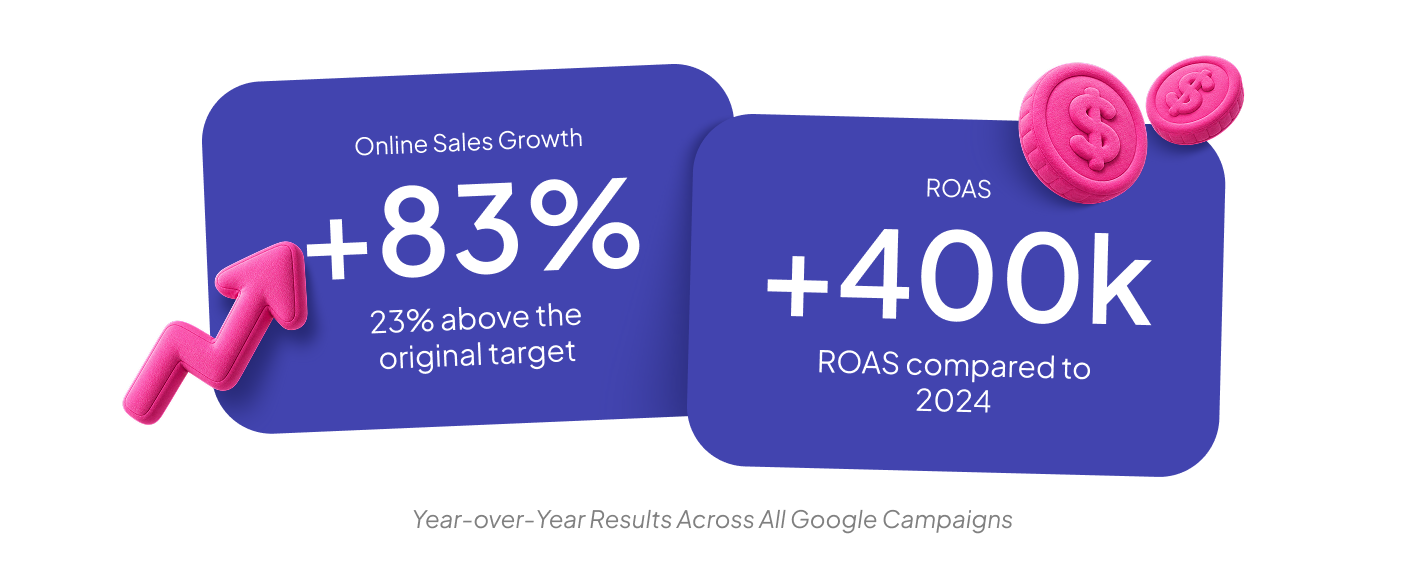
The campaign ran from April through December 2025 and delivered the following results:
Our client conducted market research and uncovered an important insight: one in four toys worldwide is purchased by an adult either for themselves or for another adult. Communities of passionate collectors have formed around collectible toy series, united by their favorite characters and brands. Some collectible items have even become investment assets.
Customer interviews in Ukraine revealed another powerful driver—nostalgia. For many adults, toys evoke positive childhood memories and offer a sense of comfort during challenging times.
At the same time, toys increasingly serve as a form of emotional recovery. Adults are turning to them as a way to unwind, disconnect from the constant flow of news, and relieve stress.
Despite these trends, most respondents did not perceive the BI retailer as a place where adults could shop for themselves. To change this perception, the company launched a new brand strategy—"Everyone Plays"—and expanded its product assortment by 2.5×. The retailer introduced adult-oriented product categories, including premium building sets, collectible figures, board games, gaming merchandise, books, comics, manga, and more.
The Search campaign strategy was built around three key stages:
To validate the approach, we selected six underperforming product categories. While these categories represented a significant share of the assortment, their average ROAS was 35% lower than both the account average and other product categories. This made them the ideal candidates for testing and optimization.
Expanding the product assortment without increasing the advertising budget required more than additional effort—it required a smarter prioritization system. To achieve this, we developed a five-step optimization framework.
Expanding the assortment by 2.5× created a new challenge: hundreds of new SKUs were now competing for the same advertising budget. Spreading spend evenly across the entire catalog would mean that no product received enough investment to generate meaningful results.
To solve this, we moved beyond the standard category-based structure commonly used in Performance Max campaigns. Instead of relying solely on advertising metrics, we incorporated insights from the client's commercial team and unit economics to determine where budget would have the greatest impact.
Performance marketing and commercial teams ultimately answer the same questions: Which products deserve more investment? Which should be scaled? Which should be deprioritized? The difference lies in the tools they use.
In merchandising and inventory management, these decisions are often driven by the ABC-XYZ analysis—a well-established framework that classifies products based on their contribution to revenue and the consistency of customer demand.
Rather than applying this model directly to Google Ads, we adapted it for performance marketing. The traditional framework contains nine segments, making it too complex for campaign management. Instead of replicating it, we redesigned it into a four-group prioritization model, with each group assigned its own bidding and budget allocation strategy. This simplified structure made the approach practical for large-scale Performance Max optimization while preserving the core business logic behind the original methodology.
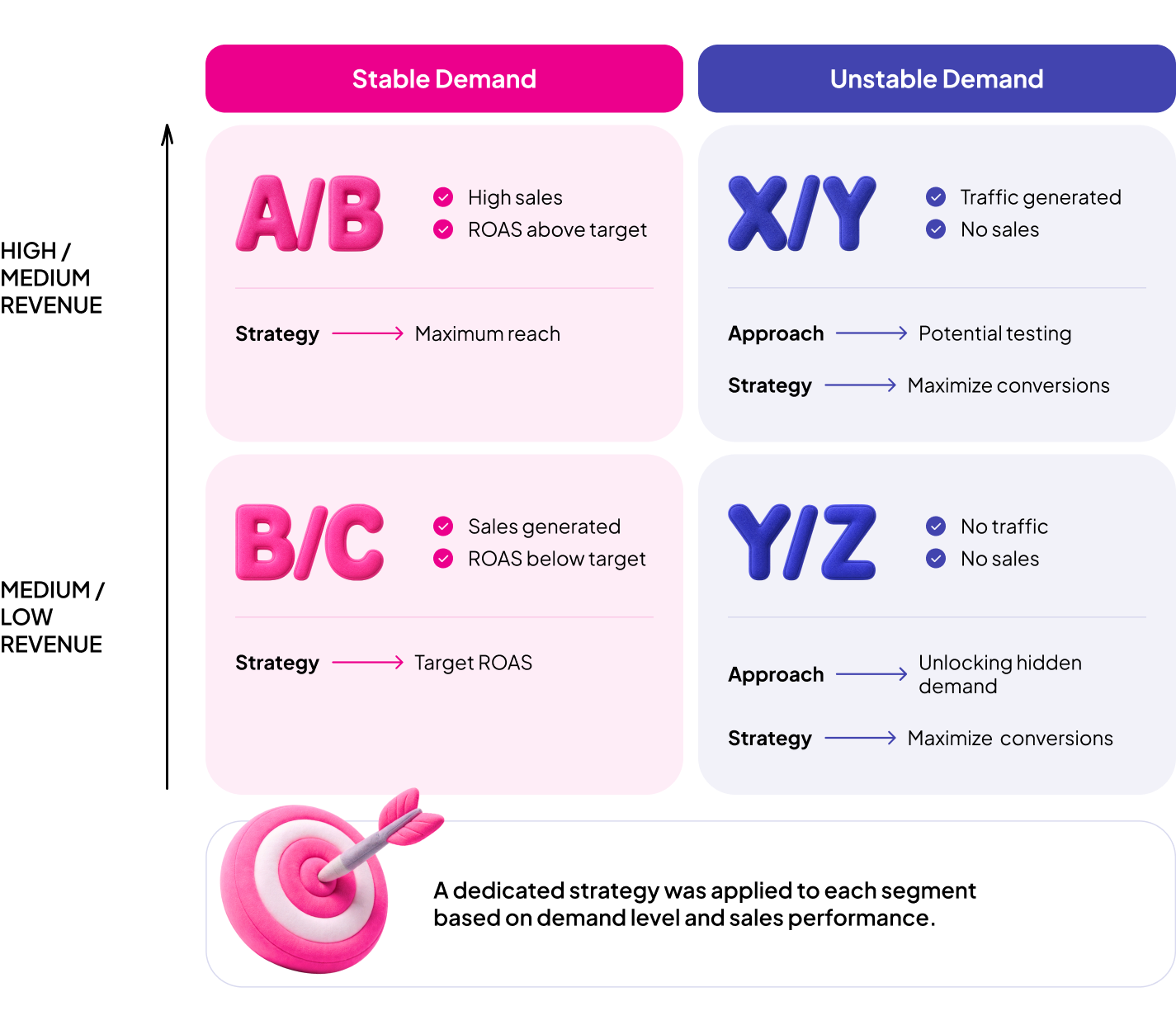
A key insight emerged from the Y/Z segment, which we called “zombie products.” These are typically new or lesser-known items that receive little to no traffic for a simple reason: Google’s algorithms naturally prioritize products with historical performance signals and often overlook products that lack them.
For most retailers, 80–90% of the catalog falls into this category. Yet hidden among these products are future bestsellers—items with genuine market demand that the system has simply never had a chance to discover.
To unlock this potential, we used a Maximize Conversions strategy that allowed these products to gain visibility and accumulate performance data. As a result, zombie products became an additional source of revenue rather than remaining invisible within the catalog.
Managing tens of thousands of SKUs manually, however, is impossible. To solve this, every product was assigned a dynamic performance label—A/B, B/C, X/Y, or Y/Z—which was automatically updated based on its current performance.
If a zombie product started generating conversions, it was automatically promoted to the A/B group and moved into campaigns with a different bidding strategy. If its performance declined, it returned to the testing cycle for further evaluation.
This created a self-adjusting system that continuously reallocated priorities based on real customer demand. Instead of relying on a one-time analysis, the framework enabled ongoing discovery, testing, and scaling of products with the highest growth potential.
Performance Max is an all-in-one campaign type that serves ads across Google's entire ecosystem, including Shopping, Search, Display, Gmail, Maps, and other Google properties.
However, even with a well-structured budget allocation strategy, Performance Max can remain difficult to control. Display creatives and other visual placements may consume 30–40% of the budget, reducing investment in Shopping inventory and making bidding strategies less predictable.
To solve this, we restructured the campaign architecture.
We configured Performance Max to focus exclusively on Shopping inventory, while separating display placements into dedicated campaigns. This approach ensured that product-focused budgets were spent on product-focused placements, giving us far greater control over the performance of each product group and allowing bidding strategies to operate much more accurately.
Shopping ads can only match products to search queries when Google understands exactly what each product represents.
This became especially important when targeting the kidult audience. Adult buyers rarely search for generic terms such as "collectible figure." Instead, they use highly specific queries, such as "limited-edition Darth Vader figure" or searches based on a particular franchise, character, or collection.
A standard product feed typically includes only basic attributes such as the product title, price, category, and availability. That level of information isn't sufficient for Google to recognize these highly specific search intents.
In SEO, category pages have long been optimized using filters such as franchise, character, series, material, and other product attributes. We applied the same principle to PPC.
We extracted non-standard product attributes from the website and added them to the Shopping feed. For collectible figures, for example, the feed was enriched with fields such as:
Each product category received its own tailored set of attributes, and developing this system took six months.
As a result, every product evolved from a basic catalog entry into a rich data profile, enabling Google to match it with the highly specific queries that the new audience was actually searching for.
While Performance Max performs well for broad product discovery, it often struggles with highly specific search queries, serving similar—but not necessarily relevant—products.
The enriched product feed enabled us to launch automated Search campaigns across the entire catalog alongside Performance Max. This ensured that highly specific search queries were matched with the exact products users were looking for.
Building Search campaigns for thousands of SKUs manually would have required years of work and constant maintenance.
Instead, we automated the process using G-MOS, Promodo's proprietary campaign automation platform.
Based on the enriched product feed, G-MOS automatically generated ad headlines, descriptions, and keywords for every product in real time. As a result, each SKU became eligible to appear in both Shopping results and Search ads, allowing the retailer to capture highly specific, high-intent queries where competition was lower and purchase intent was significantly higher.
Together, the two tools addressed different parts of the same system: the automated allocation framework determined which product to promote at any given moment. In contrast, G-MOS determined how to present it to the right audience.
Because customer demand changes over time, products cannot remain in static campaign groups indefinitely.
After four months of manual testing, we identified the optimal migration frequency: moving products between campaigns once every seven days. This cadence allowed us to adapt to changing demand while avoiding unnecessary relearning by Google's algorithms.
Once the approach had been validated, we automated the entire process using Ads Hub, Promodo's proprietary campaign management platform. This enabled us to scale the system while maintaining consistent performance and eliminating the need for manual campaign management.
The adapted ABC-XYZ methodology proved its effectiveness and became the foundation for further scaling of the strategy.
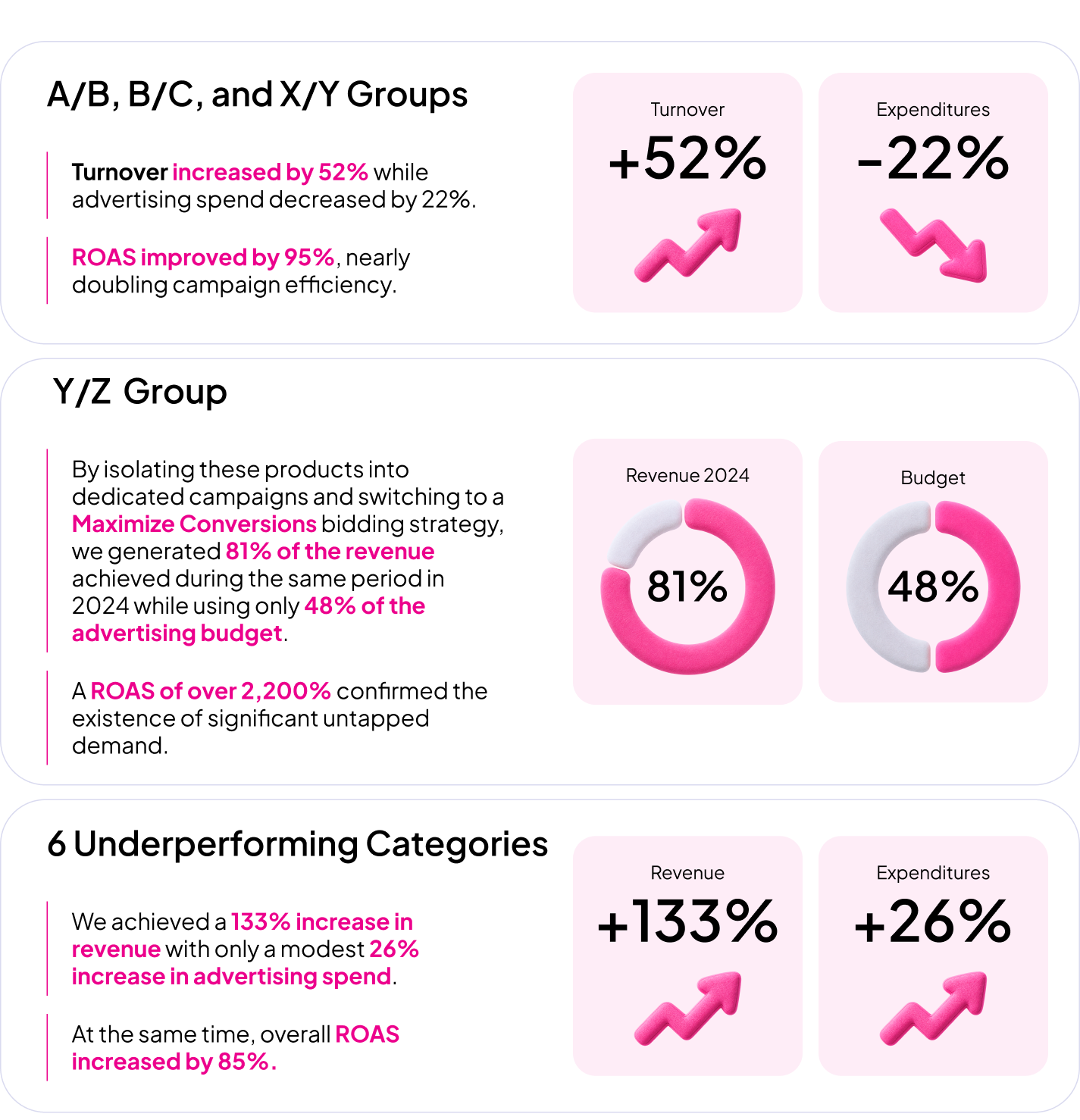
For the A/B, B/C, and X/Y product groups, concentrating budgets on high-potential products significantly improved efficiency. Revenue increased by 52% while advertising spend decreased by 22%, resulting in a 95% improvement in ROAS. This demonstrated that smarter product prioritization could generate higher sales with lower investment.
The greatest opportunity came from the Y/Z "zombie products"—SKUs that had previously received little or no visibility. By separating these products into dedicated campaigns and switching to a Maximize Conversions bidding strategy, the team uncovered substantial hidden demand. During the test period, these campaigns generated 81% of the revenue achieved during the same period in 2024 while using only 48% of the advertising budget. At the same time, they delivered a ROAS of more than 2,200%, confirming that many previously overlooked products had strong commercial potential once given sufficient exposure.
The methodology was first validated on the six underperforming product categories selected for the pilot. Despite their historically weak performance, the optimized campaigns delivered 133% revenue growth with only a 26% increase in advertising spend, while overall ROAS improved by 85%.
The broader business metrics confirmed that these improvements were not isolated campaign wins, but the result of a scalable, systematic approach.
%201.webp)
Case studies
Check out how we help companies like yours overcome challenges and rise to the next level.
.png)
AI traffic
Revenue from AI traffic




.png)


.webp)
.svg)


