


Content



Team Lead of Content for promodo.com
Experienced in working with data, expert recommendations, and real business cases to create clear and valuable content that delivers real business impact. Passionate about discovering new insights, exploring industry trends, and turning complex topics into practical, easy-to-understand content.

Agentic commerce refers to a trading model in which an AI agent can search for products, compare offers, make decisions based on user-defined criteria, and, with the user’s permission, complete a transaction.
Today, artificial intelligence is increasingly taking over parts of the customer journey. We have already covered how to make your brand cited and recommended by AI when consumers are choosing products. But it seems that AI’s role in the customer journey will not stop there. The next stage is when AI does more than simply help users find and choose a product — it can also complete the purchase on their behalf.
According to McKinsey, by 2030, between $3 trillion and $5 trillion in global consumer commerce could flow through agentic commerce. While this is still a forecast, it highlights the scale of the potential shift that businesses should start preparing for now.
Agentic commerce is an online commerce model in which AI agents can independently handle part or all of the purchasing journey. They can take care of product discovery, feature analysis, product comparisons, order placement, and even transactions. Unlike a conventional AI assistant, an agent does not simply respond to user requests. It independently analyzes available options, makes decisions based on predefined criteria, and performs the necessary actions with minimal human intervention.
Modern AI platforms are gradually moving from recommendations to transaction execution. For example, Microsoft is developing Copilot Checkout, Perplexity has Instant Buy, and Google is introducing checkout functionality in AI Mode for selected merchants. ChatGPT can also display products and direct users to complete purchases on the seller’s website.
For businesses, this means AI is becoming another touchpoint between a product and a buyer. In this scenario, users may not visit the retailer’s website at all during the product discovery and purchasing process.
To enable this type of interaction, technology companies are developing dedicated protocols and standards. OpenAI and Stripe have developed the Agentic Commerce Protocol (ACP) to support purchases in ChatGPT. Google, together with key eCommerce players including Shopify, Etsy, Wayfair, Target, and Walmart, is working on the Universal Commerce Protocol (UCP) — an open standard for AI-driven commerce.
As a result, the logic of customer interaction in eCommerce is likely to change. Previously, the primary goal was to bring users to a website and persuade them to make a purchase. Now, businesses also need to make their products accessible not only to people but to AI agents that can independently discover, compare, and purchase products on behalf of users.
.webp)
To understand the difference, it is important to distinguish agentic commerce from conversational commerce. If you have added a chatbot to your website that answers customer questions or recommends products, that is conversational commerce. In this case, AI assists the shopper, but the person still reviews the options and makes the final decision.
An AI agent in an agentic commerce scenario can independently find offers across different stores, compare ingredients, prices, availability, and delivery terms, select the best option, and, after receiving the user’s confirmation, complete the purchase.
Conversational commerce helps you shop, while agentic commerce shops on your behalf.
The emergence of agentic commerce is changing more than just the way orders are placed. It is gradually reshaping the entire customer journey to purchase.
In traditional eCommerce, businesses try to guide shoppers through a sequence of touchpoints: Google search or an ad → website → product page → cart → checkout → purchase. At each stage, marketers optimize conversion rates, UX, and content to reduce the number of users dropping out of the funnel.
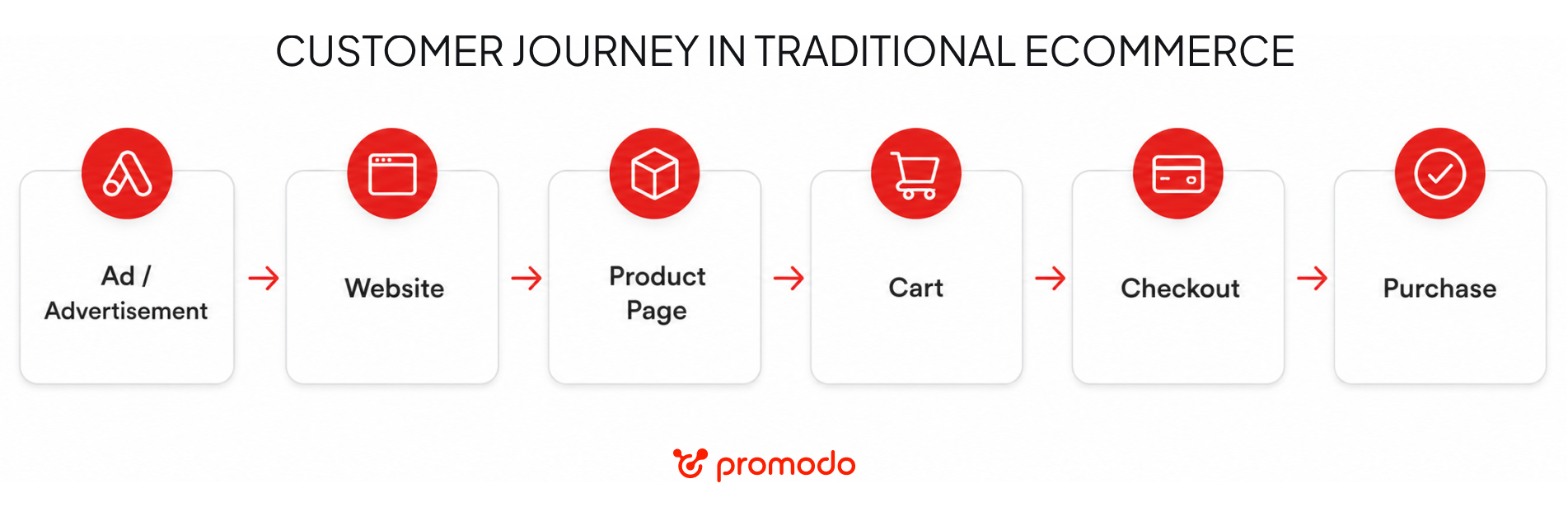
One of the main goals of eCommerce marketing has traditionally been to bring users to the website. The more relevant traffic a store attracted, the more opportunities it had to generate sales.
With agentic commerce, some of these steps can take place without direct user interaction with the website:
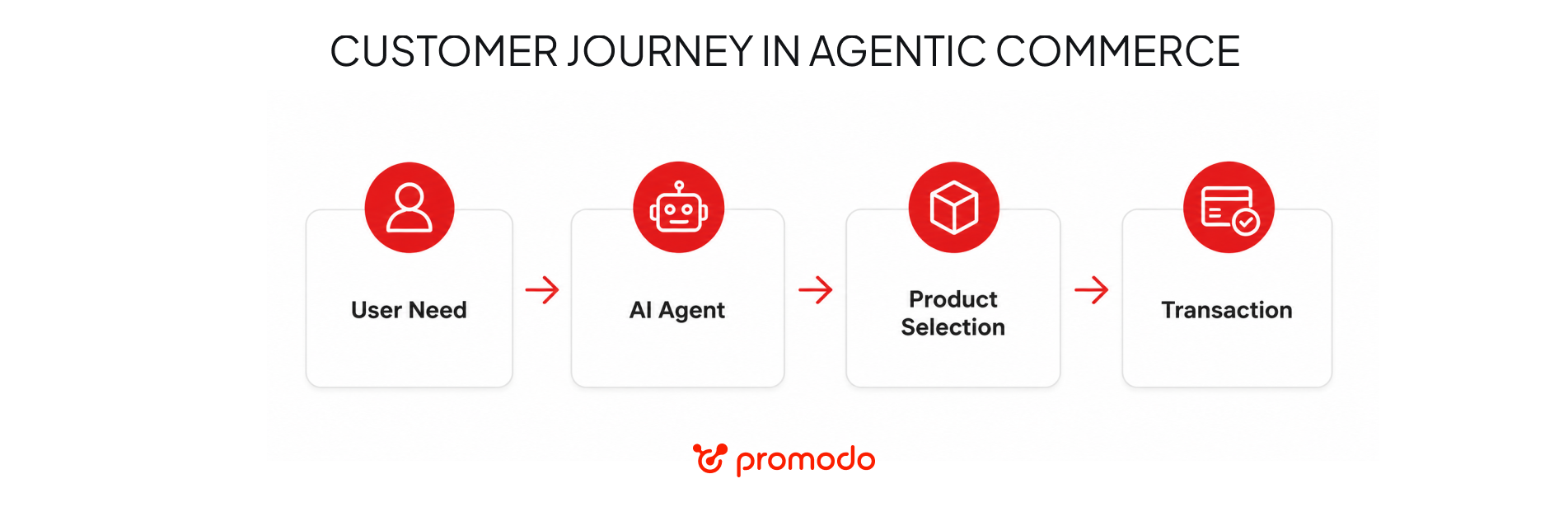
In the new model, users may not open a website at all during the discovery and selection stages. They describe what they need to an AI, which then independently searches for and compares available offers.
Agentic commerce is still at an early stage, so businesses do not need to rush into rebuilding their entire eCommerce operations around AI agents. Instead, they should prepare the foundation that will allow this new sales channel to work effectively.
The key objective is to make sure an AI agent can find your product, correctly understand its characteristics, compare it with competitors, and access enough information to recommend it to the user. That is why preparing for agentic commerce does not start with developing a complex AI solution. It starts with data quality, technical infrastructure, and a strong digital presence.
An AI agent does not interpret a product page in the same way a human does. To make a decision, it needs specific, structured data: product name, price, specifications, product variants, availability, delivery and return conditions, and more.
Therefore, the first step is to audit your product pages and make sure the information they contain is:
It is also important to submit your product catalog to platforms that use this data for their shopping and AI solutions. For example, Google Merchant Center allows you to provide Google with information about your product range, which can then be used across its shopping tools and AI features. In addition, consider implementing eCommerce Schema Markup on product pages. This helps search engines and AI systems understand what you sell, how much it costs, and whether a product is available. Together, these structured data sources help AI platforms discover, interpret, and use information about your products.
High-quality product data is becoming the foundation for eCommerce businesses’ interaction with AI systems. The more relevant and structured information an algorithm receives, the more accurately it can understand what a business sells and how well a product matches a user’s request.
At Promodo, we already use AI to enrich product data. For example, in our Etnodim case study, we optimized the product feed to increase visibility for non-branded category queries in Google Shopping. Analysis of search patterns showed that shoppers were looking for embroidered clothing not only by product type or color, but also by specific attributes such as embroidery region, material, and pattern. At the same time, many of these characteristics were missing from product pages. To scale this work, we used FeedGen powered by Google Cloud Vertex AI. AI analyzed existing product feed data and product images, identified additional attributes, including color, and then used them to generate more relevant titles and descriptions. The content structure was built around the actual logic of users’ search queries.
To make your business part of agentic commerce, you need to ensure that AI can access information it can use for comparison.
For example, instead of “A powerful laptop for work and entertainment,” it is better to use “15.6-inch laptop, Intel Core i7 processor, 16 GB RAM, 512 GB SSD, Full HD display, weight: 1.7 kg.”
This does not mean you should abandon emotional content. User-focused communication remains important. However, it should be complemented by enough specific product characteristics for AI to compare your product with competing offers.
Therefore, make sure to review:
For example, imagine a user asks an AI: “Find me a laptop under $750 with at least 16 GB of RAM, a 512 GB SSD, and delivery within two days.” For an agent, it is not enough to find a suitable product. It needs to verify whether the offer meets all the criteria in the request.
That is why information about price, availability, delivery times, payment options, and return policies needs to be clearly stated and kept up to date. This allows AI agents to evaluate your store against specific user requirements.
If information that is important for the purchasing decision is hidden in a banner, image, or unclear part of the interface, AI may simply fail to take it into account.
Agentic commerce requires interaction between the AI platform, online store, product catalog, checkout, and payment infrastructure. Protocols such as ACP, AP2, UCP, and others are being developed to standardize this type of interaction.
At the same time, connecting to a specific protocol should not be treated as a one-time task. The agentic commerce ecosystem is still evolving, so businesses are better off with flexible eCommerce infrastructure, robust APIs, and structured data that can be adapted to new channels.
Being accessible to AI agents is not just a technical issue.
When an agent compares sellers, it needs to evaluate not only product characteristics but also the seller itself. That makes trust signals such as reviews, brand mentions in independent sources, reputation, transparent purchasing terms, and high-quality company information increasingly important.
This is where agentic commerce overlaps with GEO. GEO helps brands appear in AI-generated answers to user queries. In the context of agentic commerce, the goal is to make your offer relevant and competitive enough for an agent to select it over other options.
That is why it is important to regularly check how AI platforms perceive your brand and products for real commercial queries from your target audience. To help with this, we created GELIOS. It automatically generates queries based on your website’s topic and allows you to check whether your brand is mentioned in AI-generated answers.
|

If AI is gradually becoming a new entry point in the customer journey, businesses need to learn how to measure its impact.
As platforms introduce more attribution capabilities, businesses should track:
This will help businesses understand the real value that AI brings to their business.
Although the impact of agentic commerce on eCommerce is still relatively limited, businesses should start preparing for these changes now. As the saying goes, “make hay while the sun shines”: brands that begin adapting today will have a better chance of being among the first to be selected by AI agents when this way of shopping becomes mainstream.
At Promodo, we help businesses prepare for this shift by optimizing product feeds and content, working with GEO, and assessing the technical readiness of eCommerce businesses for new AI-driven channels.

Team Lead of Content for promodo.com
Experienced in working with data, expert recommendations, and real business cases to create clear and valuable content that delivers real business impact. Passionate about discovering new insights, exploring industry trends, and turning complex topics into practical, easy-to-understand content.
You may also like
Choose quality and trusted services to improve the presence of your company on the Internet, and feel free to contact our UK team if you have any questions.

In this Promodo article, we will explain what Google Ads bids are and how to choose the method of bidding depending on the goals of your advertising campaign.

In this article, Promodo experts will explain how outreach works, why it is important for online commerce, and how to build an effective strategy in 2025.

Ecommerce merchandising is the ultimate task each business owner has to consider to drive more sales.
We at Promodo are ready to help you improve your performance across all digital marketing channels.
Get started



.png)
.svg)


