Content


Copywriter at Promodo
Over nearly three years as a copywriter, I’ve written for US and European startups and companies, including SE Ranking. I enjoy working with words—finding the right phrasing, organizing ideas, and turning them into clear and useful content that shows real value and helps businesses grow.

PPC Automation Specialist
https://academy.promodo.ua/course/kurs-avtomatizaciyi-akauntiv-google-ads-5

ChatGPT now has ads. That gives tire businesses another way to reach people who are already looking for answers. Someone might be comparing winter tires, checking what fits their car or searching for a nearby installer.
But how do these ads work, and are they worth testing for your business? Let’s look at what you need to know before getting started.
ChatGPT ads are sponsored placements that generally appear below ChatGPT’s response. They’re clearly labeled, so people can tell the ad apart from the answer.
OpenAI is also testing ads that appear during image generation. But there's an important distinction: paying for an ad doesn't mean a brand can influence ChatGPT's answers or recommendations. Advertisers also don't get access to users' private conversations.
Who can see them? For now, ads are mainly shown to eligible adults on the Free and Go plans in supported markets. Users on paid plans like Plus, Pro, Business, Enterprise, and Edu won't see them. Some Free users can also choose an ad-free experience with lower usage limits.
Turning off ad personalization doesn't mean ads disappear completely. They can still be related to what someone is discussing in ChatGPT. However, ads won't appear in Temporary Chats.
What does this mean for advertisers? Don't base your potential reach on ChatGPT's total number of users. Not everyone can see ads, and even among those who can, your ad will only appear when it's relevant to their conversation.

Imagine someone with a 2020 Honda CR-V looking for winter tires. They might start by asking which tires are best, then compare a few options and look for a shop that has them in stock. At each point, they need something different, and that’s where a relevant ad could help.
In the table below, we put what that journey might look like. Tire sizes can vary even within the same model year, so shoppers should always check their vehicle’s tire placard or manual.
These examples show where an ad might be useful, not how often ChatGPT will show one. The best opportunities are usually the questions you can answer with a clear, relevant offer.
Customers often have a lot of questions before they’re ready to buy. ChatGPT ads are still new, but we see potential in them, as they can reach people at the right moment—when they’re comparing tires, checking fitment or looking for an installer.
- Borys Dziundziuk, PPC Automation Specialist at Promodo
Unlike Google Search ads, ChatGPT ads don’t rely on a keyword list. The system considers what someone is discussing, your ad and landing page, your campaign settings, and the situations you describe as relevant. If the user allows ad personalization, other signals may also matter. OpenAI hasn’t published a fixed formula for how these factors are weighed.
Good context hints add details that aren't already obvious from your ad or landing page. Keep them specific, relevant to your offer, and accurate as your products, prices, or availability change.
A hint doesn’t guarantee that your ad will appear. It also doesn’t replace campaign settings: writing “near me” won’t restrict your ad to a specific location.
Keep different offers separate when they serve different needs. For example, someone booking wheel alignment should land on a relevant service page.
If you sell hundreds or thousands of tires online, you don’t want to build an individual ad for every size. Product ads use information from your catalog, such as product names, prices, and availability, to show relevant items. OpenAI supports several ways to provide that information, including file upload, a hosted link, and SFTP.
Your catalog needs regular updates; items can expire after two weeks without a refresh.
Uploading a feed for ads does not automatically make those products appear in organic ChatGPT answers.
Each tire variant needs the right size, brand, model, load and speed ratings, price, stock status, and product link. Make it obvious whether the price is for one tire or a set. And don’t assume a car’s year and model are enough to confirm fitment. Let shoppers check the exact specification on your site.
You may be able to group products by season, brand or price range. Check the current options in your Ads Manager account before investing in a large feed integration.
If customers book appointments instead of ordering online, a standard ad may be a better fit. You can use it to promote tire fitting, balancing, alignment, seasonal changeovers or mobile fitting. Standard campaigns support single- and multi-image ads.
Your ad should tell drivers what you offer, where to find you and how to book. Start with a few offers and link each one to a page with your location, opening hours, pricing where possible and a clear booking option. Only promote same-day service if it’s actually available.
ChatGPT ads can be charged by impressions (CPM) or by valid clicks (CPC), depending on the campaign. OpenAI has recommended starting maximum CPC bids of $3–5 for certain campaigns. That’s a suggested bid, not an average price advertisers pay—and definitely not a tire-industry benchmark. Your actual costs will vary.
A better starting point is what you can afford to pay for a customer. Say 2% of people who click an ad place an order, and you earn $80 in contribution margin from each order. You would break even on advertising at $1.60 per click (2% × $80). If you actually pay $4 per click, that campaign needs a higher conversion rate, better margins or repeat purchases to make financial sense.
For a fitting shop, measure the value of jobs completed, not just bookings submitted. For an online store, factor in delivery, discounts, returns and other costs. Choose a budget you’re comfortable testing, and check the current minimum spend in your account rather than relying on an old industry estimate.
If you’d like a clearer idea of what a test could cost for your business, our PPC team can help you assess your options and plan a budget.

Clicks alone won’t tell you whether your ads are bringing in customers. Ads Manager shows impressions, clicks, costs, and tracked conversions. You can use the OpenAI Pixel, the Conversions API, or both to track actions on your site. Add UTM tags to review visits in your own analytics, too.
Give the results time to come in before making decisions. OpenAI offers attribution windows of 7, 14 or 30 days after a click, as well as optional view-through reporting. Conversion data may take 24–48 hours to update, and spend data can also be delayed.
Look at how many people saw or clicked your ad, how many bought or booked, and how much profit those customers brought in after advertising costs. Ads Manager and your website analytics may report different numbers because they count conversions differently.
If possible, compare your test with a similar location, time period or customer group. Keep seasonal changes in tire demand in mind, too.
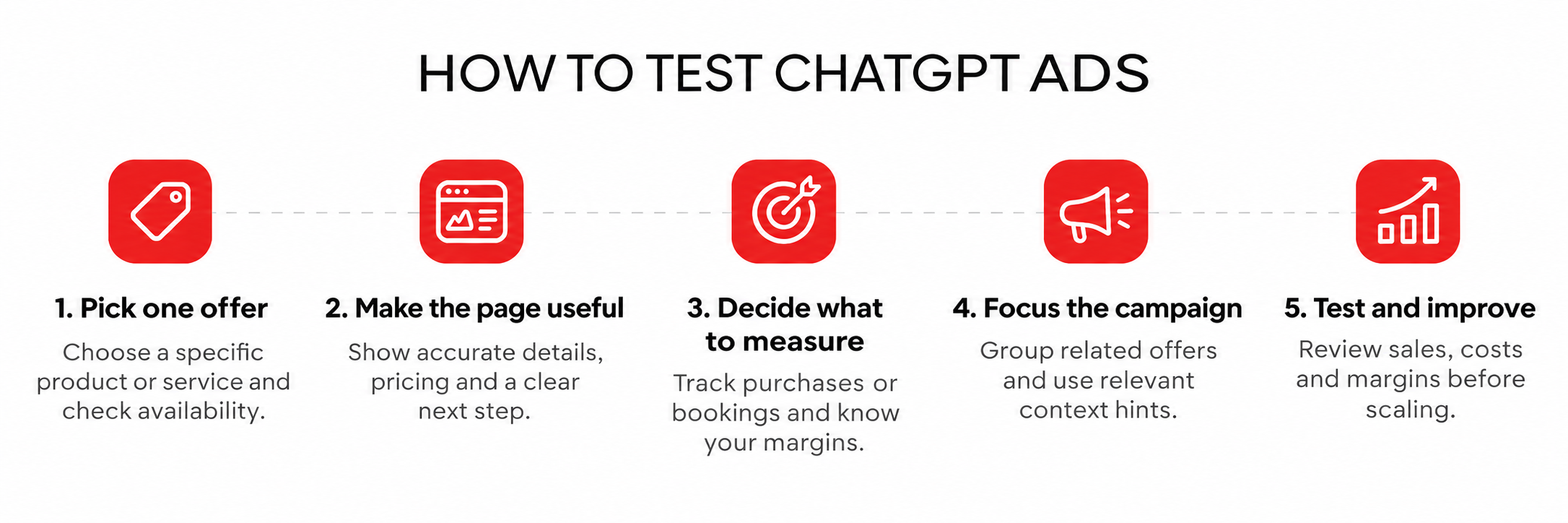
First, check whether advertising is available in your market and whether your offer meets OpenAI’s policies. Then choose something specific: perhaps a popular winter-tire range or a bookable installation service. Make sure the price and availability are up to date.
Send shoppers to a page that helps them take the next step. Can they check the tire size, price, and stock? Can they find your shop or book an appointment? Make sure the page loads properly and, if you use product ads, that your catalog matches what’s on your site.
Choose the result you want to track, such as completed orders or installation bookings. Set up conversion tracking and UTM links, then check that those actions are being recorded. Use your margin to decide how much you can afford to spend per customer.
Create separate groups for different needs, such as winter tires and wheel alignment. Write a few clear ad variations and use context hints to describe relevant customer situations. Set your location and platform targeting in the campaign settings—writing “near me” in a hint won’t limit where your ad appears.
Run the campaign long enough to collect useful data, then look at completed purchases or appointments, cost per customer, and margin. Improve the offer or landing page before increasing spend. There’s no reason to switch off Google Search, Shopping or local marketing while you test a new channel.
Paying for advertising won’t make ChatGPT recommend your business in its answers. Likewise, adding products to an advertising feed doesn’t guarantee they’ll appear in organic recommendations.
That’s why your existing website still matters. Keep product details, prices, stock information, and store locations accurate and easy to find. Comparison pages and clear service information can also help.
It doesn’t guarantee a ChatGPT mention, but it makes your business easier to understand and evaluate.
At Promodo, we help clients improve the visibility of their product pages in AI search. In one GEO case, our work helped a client increase AI traffic by 351% and revenue from that traffic by 551%. Read the full case study to see how we did it.
ChatGPT ads are worth testing if you want to reach shoppers while they’re researching their options. Start with one relevant campaign, a useful landing page, reliable tracking, and a fixed budget. Judge the results by completed orders and appointments alongside your costs and margins.
At Promodo, we can help you assess whether ChatGPT ads make sense for your business, prepare your campaigns, and measure the results. We can also help improve your brand’s visibility in AI-generated answers.

[[FAQ-START]]
Yes, if the program is available in your market and your campaign meets OpenAI’s policies. Check eligibility before planning a launch.
Not necessarily. A local shop can advertise services without a product catalog. A feed is more useful if you sell many tire variants online.
Check the location options for your campaign type. Simply writing your city in a context hint won’t restrict delivery to that area.
No. Ads are separate from ChatGPT’s answers and don’t change its recommendations.
Start with a small test budget that fits your margins. There isn’t a reliable tire-industry CPC benchmark yet.
Track orders or confirmed bookings, then compare ad costs with the margin those customers generate.
ChatGPT ads are still a relatively new channel, and public data on how they perform for tire businesses is limited. Early studies show that brands are testing the platform, but results from another industry won’t tell you what to expect from your campaign.
At Promodo, we’ve run ChatGPT ads for automotive businesses. We recommend starting with a focused test and measuring the results against your own goals, costs, and margins.
[[FAQ-END]]
Copywriter at Promodo
Over nearly three years as a copywriter, I’ve written for US and European startups and companies, including SE Ranking. I enjoy working with words—finding the right phrasing, organizing ideas, and turning them into clear and useful content that shows real value and helps businesses grow.
PPC Automation Specialist
https://academy.promodo.ua/course/kurs-avtomatizaciyi-akauntiv-google-ads-5
You may also like
Choose quality and trusted services to improve the presence of your company on the Internet, and feel free to contact our UK team if you have any questions.

83% of people entrust referrals, relatives, friends, or colleagues and admit that this is the most reliable source of information.

This report by Promodo explores the current state of the mobile fashion application market, analyzes consumer behavior and download trends, and examines...

Are your emails not being opened, with clients unsubscribing in droves and your offers going unnoticed?
We at Promodo are ready to help you improve your performance across all digital marketing channels.
Get started