


Content


Copywriter at Promodo
Over nearly three years as a copywriter, I’ve written for US and European startups and companies, including SE Ranking. I enjoy working with words—finding the right phrasing, organizing ideas, and turning them into clear and useful content that shows real value and helps businesses grow.

You can't tell ChatGPT to recommend your brand. But you can make it easier for AI systems to find, understand, and validate the information that makes your brand relevant to a specific recommendation.
In this article, we will show you how to approach it.
Unlike traditional search rankings, an LLM can generate a list of brands based on a user's specific needs, and the brands it includes can change depending on how the question is phrased and which sources the system retrieves.
Query intent matters first. For example, “What laptops are the best for studying?” is informational — the person wants advice, so AI is more likely to suggest general recommendations than name specific retailers. That's fine; not every relevant query needs to produce a brand mention. But “where to buy a laptop” or “electronics shops in Chicago” are transactional and location-based, and AI systems are far more likely to recommend specific stores and brands for those.
— Oleksandr Utkin, Service Development Manager at Promodo
Plus, AI platforms don't always rely on the same sources. A 2026 study by Mode Marketing ran the same 53 questions through ChatGPT, Perplexity, and Claude over 17 days and found that 84.6% of the 1,378 cited domains appeared in only one of the three platforms.
There's no single way to guarantee AI will recommend you every time, everywhere. Instead, strengthen the signals around your brand:
So instead of asking, “How do I rank in ChatGPT?” ask, “What does AI need to know to recommend my brand?”
.webp)
Start with the questions where you actually want your brand to appear. For example:
These are more useful than asking AI something broad like “What do you know about Brand X?” because they reflect an actual buying decision.
Build your list around the questions customers use when choosing between products or services. It could be category and “best” queries, specific use cases, problems they need to solve, comparisons, alternatives, budgets, and location-specific searches.
Start with data you already have. Google Search Console and PPC search terms can show what people are actively looking for. Site search, sales calls, customer support conversations, reviews, and relevant forums can uncover questions that don't always show up in keyword research. You can also add the questions customers ask AI, especially if you already have a way to collect them.
Start with 20–50 questions that have clear commercial value and where your brand could realistically be a relevant answer. Then check where you stand for each one. Are competitors being recommended while your brand is missing? Does your product or service actually fit the query? Do you have enough information and evidence to support a recommendation?
This gives you a focused list of queries to work on rather than trying to make your brand appear in every AI answer.
Running the same question more than once, or phrased slightly differently, will often produce different answers. Track the pattern across a few runs rather than treating any single answer as the verdict. You can do this by hand in a spreadsheet, or with Gelios by Promodo, which automatically generates a relevant query list from your site, checks your brand and competitors across ChatGPT, Gemini, and AI Overviews, and tracks how that changes over the following months.
Once you have your priority questions, look at what an AI system would need to know to recommend your brand for each one.
Then check where each piece of information currently exists.
Some of it may already be on your website, but it may be hidden in product pages, spread across several sections, or described in vague marketing language. Some information may only appear on retailer websites, review platforms, industry publications, or other third-party sources. Sometimes a claim is easy to find but isn't backed by data or an independent source. These gaps are worth fixing.
You shouldn’t create more content for the sake of it. Find what's missing from the decision-making process and make sure it's clear, specific, and supported where needed.
Once you've identified the information AI needs, make sure your own website provides it clearly.
SEO remains the foundation here. Google says AI features rely on the same core SEO principles as Search, with no additional requirements to appear in AI Overviews or AI Mode. OpenAI similarly recommends allowing OAI-SearchBot to crawl your site if you want to be surfaced in ChatGPT's search results.
Check the basics:
Even on well-maintained sites can miss some of these points. One power tools and electronics manufacturer we worked with had specs, manuals, and videos for every product, but the information was spread across separate tabs and URLs that AI bots couldn’t easily access. We moved that content onto the main product pages, and traffic from AI assistants increased by 351% over the next three months.
.webp)
Then make sure a reader, either human or AI, can tell what you sell, who it's for, and why it fits their use case. If a tire is designed for winter driving, state the conditions, sizes, compatible vehicles, and test results. If a laptop is for video editing, put its processor, GPU, display, RAM, and software compatibility where they're easy to find.
Structured data can help search systems parse this information, but it should reflect what's already clear on the page.
Beyond individual pages, think about the association you want AI to build with your brand as a whole:
Brand → product or service → problem → use case → audience
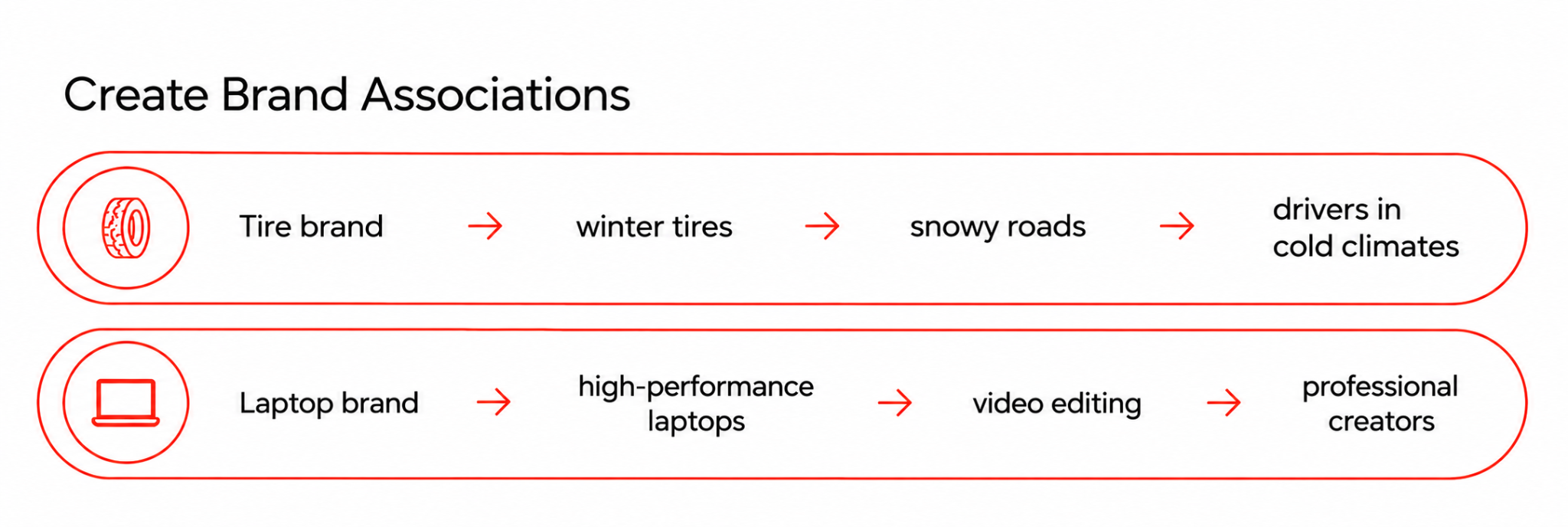
Build that chain across your site and content, not just on one product page. A tire brand targeting winter drivers should consistently cover winter performance, driving conditions, tire types, and buying considerations. A handful of general articles about tires won't build the association on their own.
Saying your product is “high-performing” or “the best choice” doesn't give AI much to work with. Be specific and provide verifiable information.
Compare (the specifics here are illustrative):
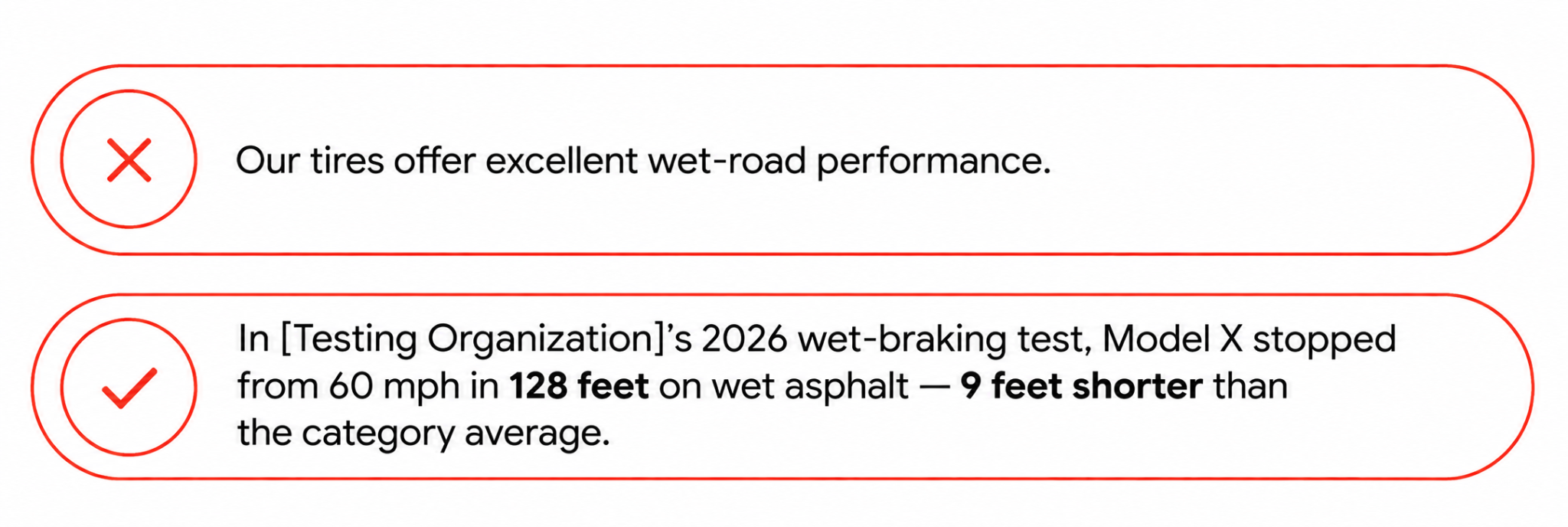
The second claim is easier to verify, compare, and reference.
Use evidence that fits your business, such as test results, benchmarks, certifications, original research, case studies, customer data, expert reviews, or independent studies.
You don't need statistics on every page. Focus on the claims that could actually influence a buying decision and give them enough evidence to support them.
Your website isn't the only place AI gets information about your brand. Reviews, media, comparison sites, retailers, industry publications, forums, and expert content can all shape how AI systems understand your brand.
That's why “getting more backlinks” is too narrow. What matters is being present in the sources people already use to research and compare products or services.
Start by looking at the questions you want your brand to appear for and run them across the AI platforms your customers use. Then look at the sources behind the answers. You may notice the same automotive publications, product review sites, retailers, comparison sites, or industry organizations appearing repeatedly.
These sources can influence how AI and customers understand your category. They can also provide information your website can't provide on its own, such as independent testing, real-world experience, or competitor comparisons.
Look at what these sources say about the brands they recommend:
For example, if AI repeatedly recommends several tire brands for winter driving, check which automotive publications, testing organizations, retailers, and review sites support those recommendations. That shows you what information and associations are helping competitors appear in those answers and where your brand has gaps.
This gives you a more useful starting point for SEO, digital PR, and content than looking at competitor backlinks alone.
As we already mentioned, AI doesn't look at your website in isolation. It can compare information from your site with reviews, publications, retailers, and other sources.
Look at how your brand is described across these sources. Are your positioning, product features, target audience, pricing, and key strengths consistent?
For example, your website might position a tire as a strong choice for winter driving, while reviews focus on dry-road performance and retailers highlight it mainly as a budget option. None of these statements has to be wrong, but together they make it harder to understand what the product is actually known for.
The same applies to basic product and company information. Keep names, specifications, locations, availability, and other important details accurate and consistent across your website and third-party sources.
A few GEO tactics are easy to overestimate.
Getting your brand into AI answers starts with the same thing as good SEO: making sure the right information is easy to find, understand, and trust. But it also means looking beyond your own website — building a presence on the sources AI relies on and making sure those sources support the same picture of your brand.
You can support your efforts with tools like Gelios to track your AI visibility. And if you need help, we can help you build an efficient GEO strategy.

Copywriter at Promodo
Over nearly three years as a copywriter, I’ve written for US and European startups and companies, including SE Ranking. I enjoy working with words—finding the right phrasing, organizing ideas, and turning them into clear and useful content that shows real value and helps businesses grow.
You may also like
Choose quality and trusted services to improve the presence of your company on the Internet, and feel free to contact our UK team if you have any questions.

Ukrainian entrepreneurs are actively exploring new markets and implementing digital solutions to optimize their processes.

Many searches don’t end with a click. This happens because Google can provide users with an answer directly at the top of the search results — zero-click search
.avif)
Our team has gathered practical AI use cases that help online stores sell more.
We at Promodo are ready to help you improve your performance across all digital marketing channels.
Get started



.png)

.svg)


