


Content



Marketing Specialist at Promodo
I have been working in marketing since 2012 with an emphasis on market research and analytics. I am experienced in the following niches: food wholesale, insurance, real estate, and software distribution. I have been responsible for Promodo's cases since 2021. Doing marketing research, I focus on causes and effects, as well as measurable results.

Almost everyone has been in a situation where they needed to convince someone of something — whether it’s asking for a promotion, defending a new idea, or proving that a chosen solution is the right one. And yet, even the strongest arguments don’t always work.
The same happens in marketing.
Even when data, forecasts, and calculations back a proposal, that is often not enough to secure leadership buy-in. Senior management doesn’t expect long explanations — they expect clarity: what is being proposed, why it matters for the business, and what result to expect.
Barbara Minto is a business consultant and the author of the Pyramid Principle, one of the most well-known tools for structured thinking and business communication. In the 1960s, she became the first female consultant at McKinsey & Company — an international consulting firm known for its approach to strategic thinking and executive decision-making.
It was during her work at McKinsey that she noticed a pattern: in presentations, most speakers started with data and facts, and only reached the main conclusion at the very end. As a result, the most important idea was often lost among details, and the audience quickly lost interest.
This led Minto to the conclusion that business communication follows different rules than storytelling. In a good story, the author builds suspense until the end, but in executive presentations, this is a disadvantage. The opposite approach works better — start with the main conclusion.
This is exactly what the Pyramid Principle is based on: first the answer or recommendation, and only then the arguments and facts that support it.
If you follow this principle, your presentation will take the shape of a pyramid:

This approach helps communicate ideas faster and keeps the audience’s attention. Today, it is used not only at McKinsey but also in many other companies where decision-making depends on how clearly a recommendation is formulated.
Starting with a recommendation is only part of Barbara Minto’s approach. Before presenting a recommendation, you need to establish context. Marketing budget presentations often fail not because of weak arguments, but because top management does not clearly understand what decision is being requested.
SCQA helps quickly set the context and guide the audience toward the key question even before the recommendation is presented.
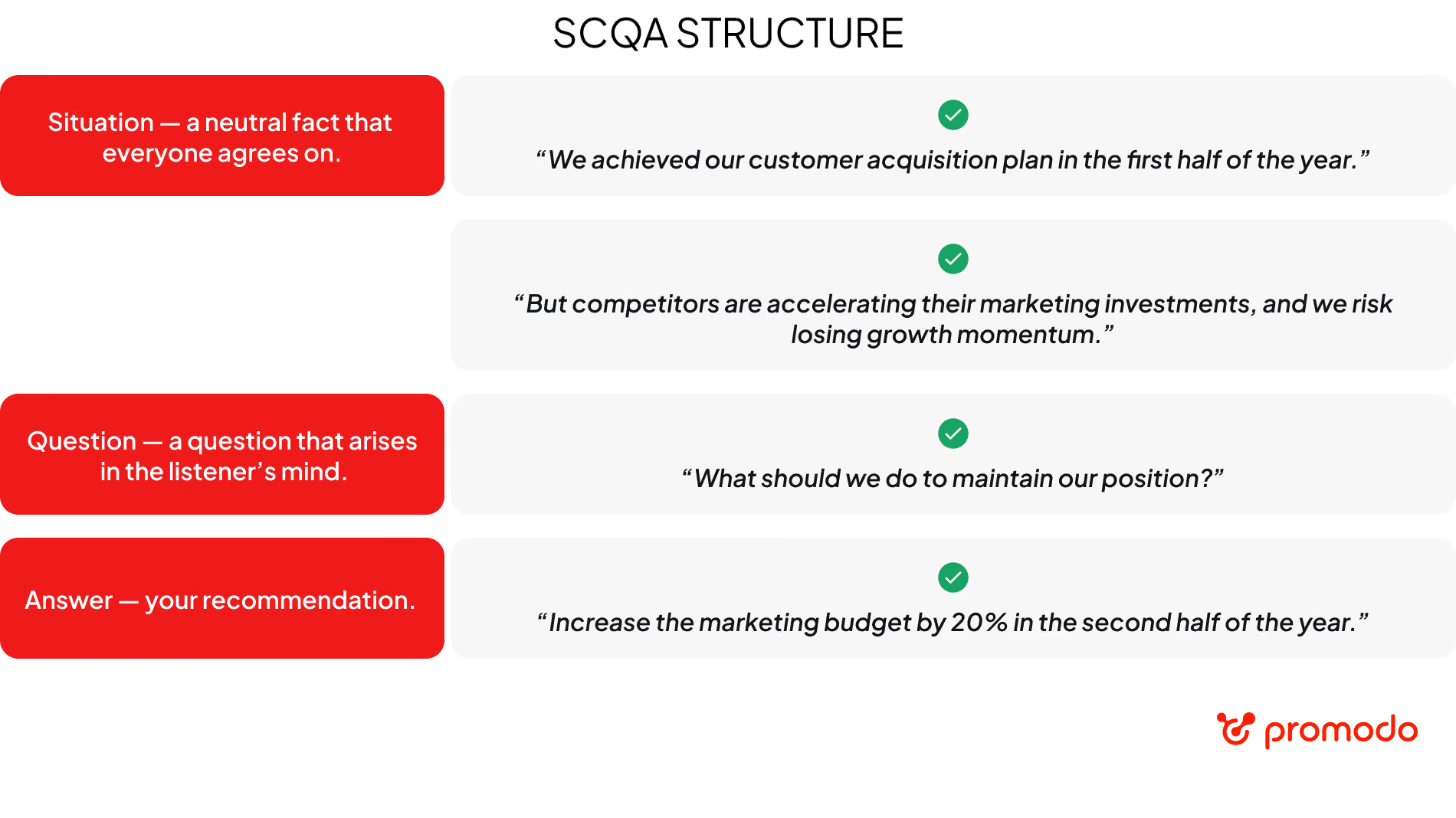
This is the sequence in which Minto recommends presenting a solution: first align on the context, then identify the complication, formulate the question, and only after that move to the answer.
Interestingly, marketers often use the SCQA method intuitively but in the wrong order. They start with the situation, explain the complication, present dozens of slides filled with data, and only at the end move to the question and answer.
In essence, SCQA shifts the focus of the conversation. Instead of discussing what has already happened, attention moves toward what the company should do next.
During marketing budget defense, the focus is often placed on data and marketing metrics. However, numbers alone do not always answer the key question: what decision is being proposed to the business — and this is the core problem.
Barbara Minto put it simply: “Think bottom-up, but present top-down.”
For CMOs, this means one thing: start with the recommendation, and only then explain why the business should support it. A budget defense is not a presentation of the marketing team’s performance results — it is a process of making an investment decision.”
“Over the years at Promodo, I’ve been on both sides of this process — defending marketing investments and evaluating them from a business perspective. That’s why I clearly understand that strong arguments alone are not enough. It is essential to help the other side quickly understand what value the proposed solution creates for the company, especially when it comes to resource allocation and investment in new projects”.
Valeria Lavska, CCO at Promodo
The faster management understands the recommendation and the underlying business logic, the higher the chances of a constructive discussion about resources. This is especially relevant in an environment of information overload.
Start with the main conclusion or recommendation. For example: “We propose increasing the marketing budget by 20% in the second half of the year to achieve the target sales growth.”
Then explain why this decision makes sense for the business.
When defending marketing budgets, three types of arguments work best:
Financial impact — expected growth in revenue, profit, or ROMI.
Risk of inaction — loss of market share, stronger competitors, increasing customer acquisition costs.
Strategic opportunities — entering new segments, launching new products, or building a foundation for long-term growth.
Each argument should be supported with facts and data: results of previous campaigns, investment payback forecasts, market analysis, or financial calculations.
In other words, data does not lead to the conclusion — it supports it. That is why the structure of argumentation takes the form of a pyramid: from the main conclusion to the evidence that confirms it.
“In the first half of the year, organic traffic grew by 35%, and paid channels accounted for 42% of all new customers. We also see increased demand in the category and growing competitor activity. Over the last three months, customer acquisition cost remained below plan, and ROMI exceeded target levels. We analyzed the potential for scaling campaigns and prepared a forecast for the second half of the year.
Therefore, we propose increasing the marketing budget by 20%.”
In this case, management first receives a large amount of information, but only at the very end do they understand what decision is expected from them.
We propose increasing the marketing budget by 20% in the second half of the year to ensure 25% sales growth.
Situation: In the first half of the year, we met our customer acquisition targets, and ROMI exceeded benchmark levels.
Complication: Competitors are actively increasing their marketing investments, which raises the risk of losing market share.
Question: How do we maintain growth momentum and competitive position?
Investment payback forecast, ROMI dynamics, and competitive analysis are included in the appendix.
In the second version, management immediately understands the proposal, why it matters for the business, and what it is based on. The difference is not in the arguments, but in the order in which they are presented.
In practice, few people build a presentation strictly according to the SCQA framework. Its value lies elsewhere — it helps understand how to guide the audience from the problem to the solution.
The Minto Pyramid does not guarantee automatic budget approval. However, it helps achieve the most important outcome — structuring the presentation and focusing the discussion on the decision itself.
If you still receive a rejection, it is not necessarily a bad result. On the contrary, such rejection is often much more informative. In this case, it becomes significantly easier to understand the reason: whether it was the financial forecast, risk assessment, strategic logic, or a lack of data needed for decision-making.
How to understand the reason for rejection? Key follow-up questions for top management:
The pyramid structure allows you to return precisely to a specific argument, rather than restarting the entire presentation from scratch.

Marketing Specialist at Promodo
I have been working in marketing since 2012 with an emphasis on market research and analytics. I am experienced in the following niches: food wholesale, insurance, real estate, and software distribution. I have been responsible for Promodo's cases since 2021. Doing marketing research, I focus on causes and effects, as well as measurable results.
You may also like
Choose quality and trusted services to improve the presence of your company on the Internet, and feel free to contact our UK team if you have any questions.

FOMO (Fear of Missing Out) is a feeling that a person gets when it seems that “something is passing by”.

60% of patients rely on online reviews when opting for a medical treatment facility.

Shopify is a service that provides tools to create your online store.
We at Promodo are ready to help you improve your performance across all digital marketing channels.
Get started





.svg)


