



Content



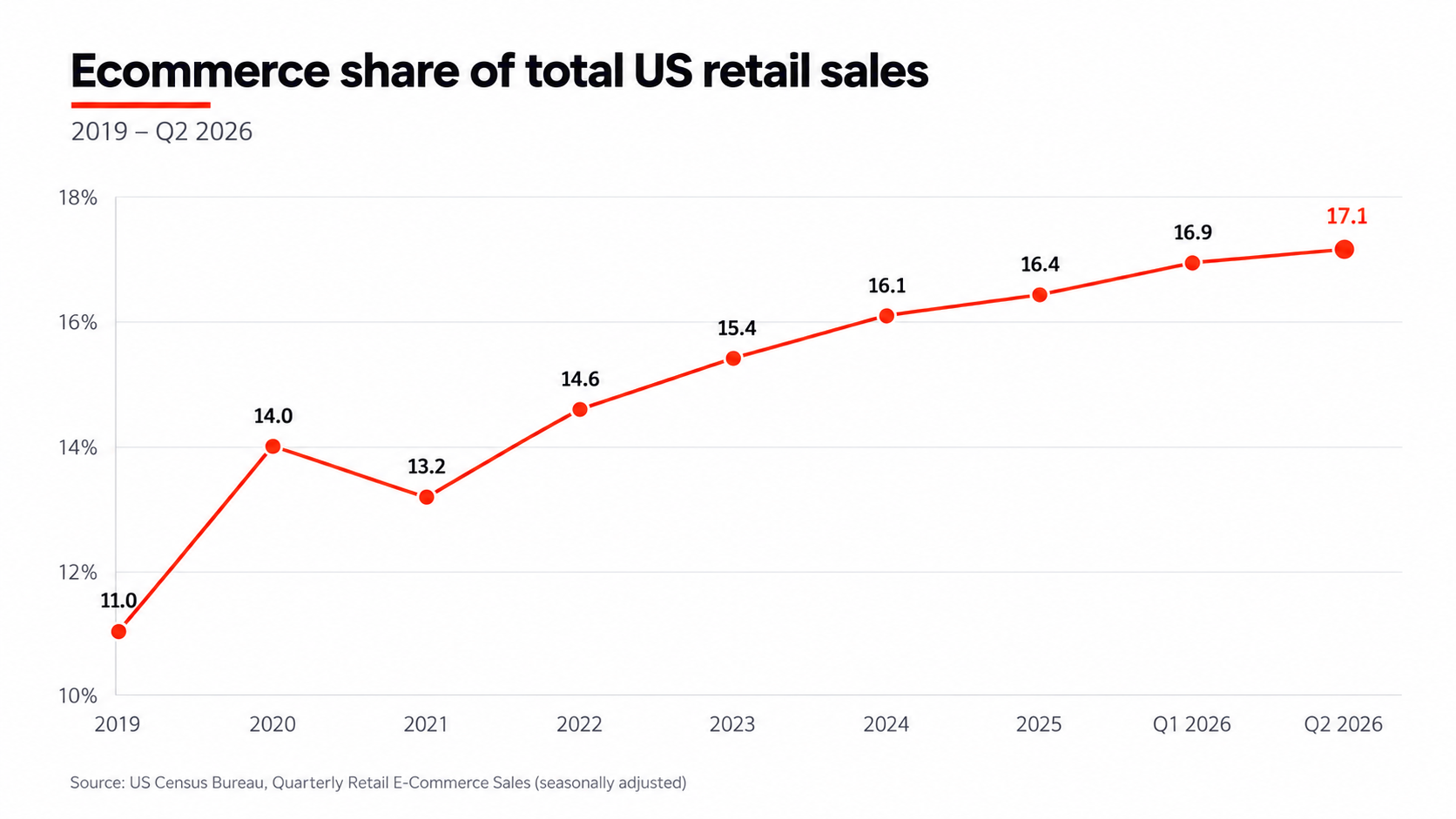
US retail ecommerce reached $340.2 billion in the second quarter of 2026, up 12.2% year over year, and now accounts for 17.1% of all retail sales, according to the Census Bureau. Total retail grew 6.7% over the same period, so online sales expanded at roughly twice the rate of retail overall. Growth like that attracts entrants faster than demand expands, and they all end up bidding in the same two auctions. Industry benchmark data published through 2026 puts Google Ads CPC up around 13% year over year and Meta CPMs up around 20% in competitive consumer categories, with median blended customer acquisition cost for DTC brands landing between $60 and $120. That combination — more competition, more expensive clicks — is what sends most retailers looking for a performance marketing agency in the first place.
Which turns hiring one from an operational decision into a margin decision: who do you trust to run acquisition when every point of efficiency now shows up directly in profit? The directories are no help here — sort by rating and you get companies that describe themselves in the same five words. What you actually need to know is narrower: who has run accounts at your catalog size, who works from your margin rather than platform ROAS, and who will still be useful when your growth comes from a channel you are not running yet. Below is our list of the best performance marketing agencies for ecommerce in 2026 — what each one is genuinely good at, and a framework for matching them to the situation you are in right now.
If you want the short version: Promodo fits mid-market online stores that need paid media, SEO, AI visibility and CRO run by one team rather than stitched together across three vendors. Tinuiti fits enterprise retail budgets. Darkroom fits brands where creative volume is the bottleneck. Common Thread Collective fits DTC brands scaling against contribution margin. Wpromote fits established retail with omnichannel media. Power Digital fits growth-stage brands that want analytics-led decisions. Inflow fits stores with large, complicated catalogs. Blue Wheel fits marketplace-first brands. Disruptive Advertising fits accounts that stopped performing and need a rebuild. NoGood fits early-stage DTC. Hawke Media fits smaller stores that want specific services rather than a full program.
The rest of this article explains the reasoning behind each, and gives you a way to narrow the list down to two or three names worth a call.
A performance marketing agency buys and optimizes media against a measurable commercial outcome — revenue, new customers, contribution margin — rather than against reach or awareness. For an online store that usually means paid search, Shopping and product feed management, paid social, marketplace advertising, retention through email and SMS, and the analytics layer that ties it all back to what the business actually earned. Our guides to ecommerce PPC and SEO for ecommerce go deeper into each side of that if you want the mechanics.
The line that separates a digital performance marketing agency from a brand agency is accountability to a number. A brand agency is judged on the work. A performance agency is judged on whether blended acquisition cost went down while volume went up.
The number that matters most here is MER, or marketing efficiency ratio: total revenue divided by total ad spend across every channel. Platform ROAS tells you what Meta or Google is willing to claim. MER tells you what the business kept. Any agency that cannot talk fluently about the difference between the two, and about where your gross margin sits, is going to optimize toward numbers that look good in a dashboard and do nothing for your P&L.
Let us be upfront: this article was written by Promodo, and we put ourselves at the top. Nearly every performance marketing agency rankings article you will find in 2026 was written by an agency that did the same thing. We would rather say so plainly than pretend otherwise and let you discover it in the footer.
Here is what we scored against, applied to ourselves as well:
We deliberately ignored two things. Award shelves, because they measure entry budgets. And headcount, because a 400-person agency can still put a junior on your account.
Promodo is one of the best e-commerce performance marketing agencies and has been working with online retailers for more than 20 years. The team runs paid search, Shopping and feed management, paid social, SEO, generative engine optimization, conversion rate optimization, email and the analytics behind all of it — which means the channel mix can shift as the business changes without you renegotiating with a new vendor each time. Our guide to growing an ecommerce business lays out how those pieces fit together.
Best for: mid-market online stores that have outgrown a single-channel agency, brands with large or complex catalogs, and retailers entering a new market. 175 companies in the United States have worked with Promodo, and the agency holds a 4.8 average rating on Clutch.
Not a fit if: you want one channel managed in isolation and nothing else.
Two examples of what that looks like in practice.
A Shopify brand in the US competing for organic visibility against Amazon, Etsy, eBay and Walmart — the hardest competitive set in American ecommerce. The work was technical: Core Web Vitals, a rebuilt HTML template, expanded site structure, catalog filter optimization, product markup for Merchant Center, thin content removal and link building. The share of tracked queries ranking in the top five went from 14% to 30% in six months. Read the full case.
A US automotive retailer where paid and organic ran as one program. Google Ads spend increased 60% while clicks grew 138% and cost per click dropped 33%. On Facebook, a 37% spend increase produced 105% more clicks at a 33% lower CPC. Completed forms rose 175%. Read the full case.
That second case is the point of the model: efficiency improving while volume grows, rather than results that only arrive when you spend more.
Not sure which channels have room left in them? Book a free strategy session. We will look at your current setup and tell you where the growth is, with no commitment on your side.
Tinuiti is one of the largest independent performance marketing firms in the United States and is built for budgets at the top of the market. The agency works across search, social, Amazon and the wider retail media landscape, with in-house measurement tooling and the staffing depth to run several large accounts for one brand at once. The strength is scale and platform relationships. If you are placing seven-figure monthly media and need a partner who can hold weight in conversations with the platforms themselves, that is the category Tinuiti operates in.
Best for: enterprise retailers and national brands with substantial, multi-platform media budgets and internal marketing teams to match.
Not a fit if: you are a smaller store that wants senior attention on a modest account. At the scale Tinuiti is designed for, a small program will not get the same gravity as the large ones running beside it.
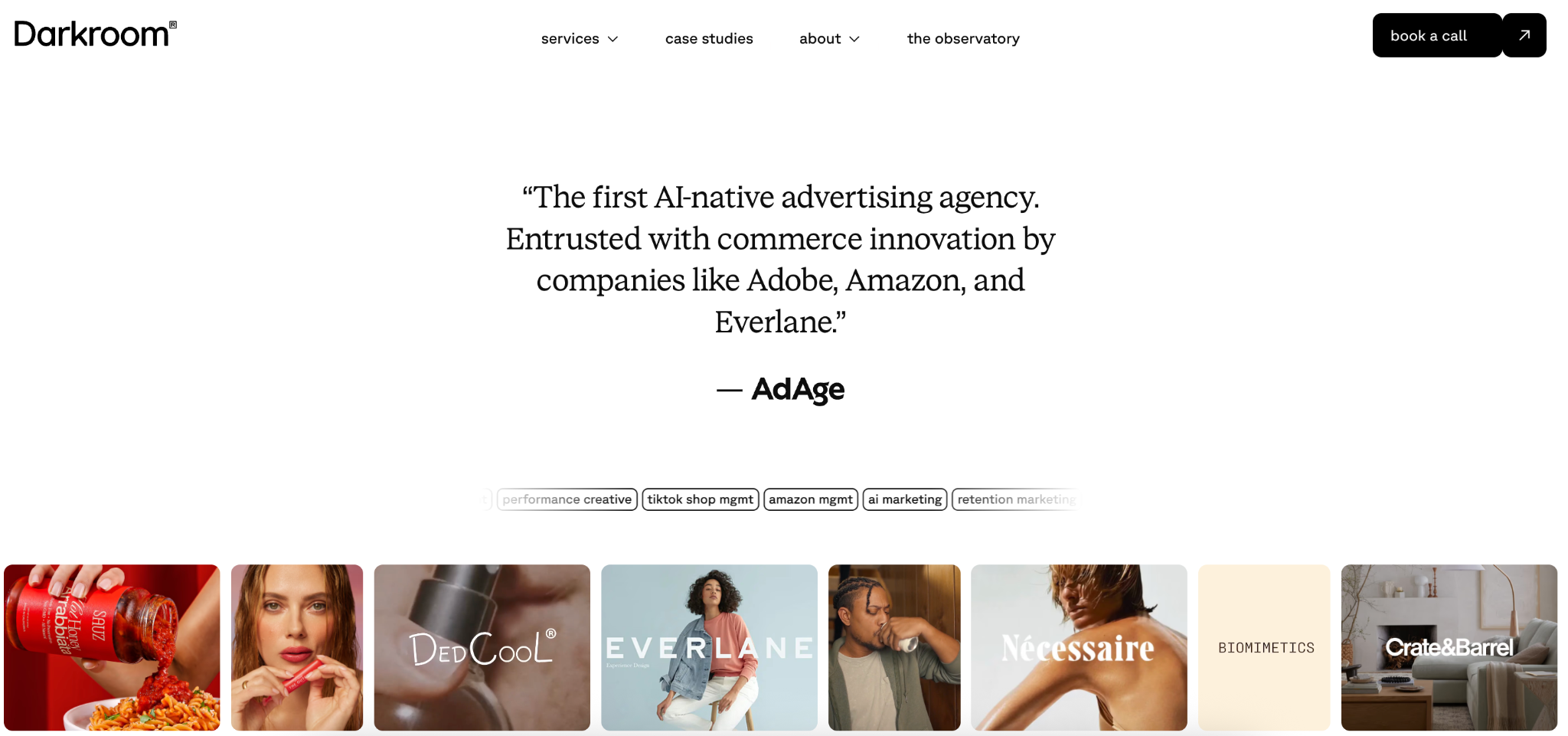
Darkroom built its model around a specific bottleneck: on Meta and TikTok, creative volume is now the main lever on performance, not bid strategy. The agency pairs paid media with high-output creative production and extends into commerce channels like Amazon and TikTok Shop. For consumer brands where the ad itself decides whether the campaign works, having the creative and the media buying in the same room removes the slowest part of the loop — waiting on assets from a separate studio before the next test can run.
Best for: DTC and omnichannel consumer brands that are creative-limited rather than budget-limited, especially in categories where the product is visual.
Not a fit if: your growth depends on search intent and catalog depth rather than discovery and creative. A large-catalog retailer buys on different mechanics.
Common Thread Collective is known for tying marketing investment to contribution margin rather than top-line revenue, and for a forecasting approach that starts from what the business can afford to spend before deciding what to spend it on. That framing matters for DTC brands that have hit the wall where revenue grows and profit does not. The agency works primarily on Shopify-based businesses and expects a level of financial openness that not every brand is ready for — you will be asked for your real numbers early.
Best for: DTC brands scaling on Shopify that want growth planning built on unit economics and are willing to share margin data.
Not a fit if: you want a media buying partner who executes against targets you set and does not question the model behind them. The planning layer is most of the value here.
Wpromote is one of the larger independent performance marketing agencies in the US, running media across Google, Meta, Amazon and programmatic for established retail and consumer brands. The agency combines media buying with creative and its own analytics stack, and is set up for brands that need several channels coordinated rather than one optimized. This is a performance based marketing agency in the fullest sense of the phrase — the work spans the funnel, with upper-funnel spend justified by its effect on what happens lower down.
Best for: established retailers with recognizable brands, multi-channel media and a performance marketing agency retail mandate that includes brand measurement alongside direct response.
Not a fit if: you are early-stage and need a partner who can move on weekly decisions without a process around them.
Power Digital positions itself as a digital marketing agency for ecommerce that leads with measurement. The agency pairs paid media, SEO, email and Amazon work with a proprietary analytics product, and the pitch is that channel decisions come out of the data layer rather than out of channel-team preference. For a brand at the stage where every channel looks like it is working according to its own platform report, that independent measurement view is worth something — it is usually the moment a business discovers it has been paying twice for the same customer.
Best for: growth-stage ecommerce brands running several channels at once that need a single view of what is actually driving incremental revenue.
Not a fit if: you are running one channel and your attribution question is simple. The analytics layer is the reason to hire them, and it is overkill for a single-channel account.
Inflow works exclusively with ecommerce businesses, which is rarer than it sounds. The focus is on established online stores with deep catalogs, where the hard part is not the campaign structure but keeping thousands of products correctly categorized, correctly fed and correctly surfaced. If your feed is the single point of failure in your paid program — and for most large-catalog retailers it is — that specialization is the argument for them.
Best for: established stores with large product catalogs where feed quality, category structure and Shopping performance are the main constraints on growth.
Not a fit if: you are a creative-led brand with twelve SKUs scaling on paid social. The depth here is in catalog mechanics, which is a different problem from making people want the product.
Blue Wheel concentrates on brands where the marketplace is the primary revenue line rather than a secondary channel. The work covers Amazon advertising, listing and content optimization, and the operational detail of running a brand presence inside someone else’s platform. Marketplace performance is its own discipline. The levers are different, the data is different, and a generalist agency running Amazon alongside everything else will usually leave money in it.
Best for: brands where Amazon or another marketplace generates most of the revenue, and where the DTC site is a supporting channel rather than the main one.
Not a fit if: your strategy is to pull customers off marketplaces and onto your own site. That is a different brief, and it needs a partner whose incentives point the same way.
Disruptive Advertising built its reputation on auditing and rebuilding paid accounts that have stopped delivering. The typical engagement starts with a diagnosis — what is structurally wrong with the account, what the previous team optimized toward, what the tracking is actually recording. A surprising share of underperforming accounts are not underperforming at all. They are measuring the wrong thing and have been optimized toward it faithfully for two years.
Best for: brands with an existing paid program where performance has degraded and nobody can explain why, and businesses switching agencies who want the account examined before anyone spends more.
Not a fit if: you are starting from nothing. The value is in forensic work on an existing account, and there is nothing to diagnose on day one.
NoGood works with consumer and DTC brands in the early scaling phase, assembling small cross-functional teams around a single account rather than routing the work through channel departments. The model suits companies that need to move quickly and do not yet have internal marketing structure to plug an agency into. The trade-off is that pod models depend heavily on who is in the pod. Ask who specifically will be on your account and what else they are working on.
Best for: early-stage and newly funded DTC brands that need acquisition moving fast and want a small, dedicated team rather than a process.
Not a fit if: you need deep specialization in one channel at scale, or you are at a size where governance and reporting rigor matter more than speed.
Hawke Media offers marketing services on an a la carte basis rather than as a single bundled program, which makes it a practical option for smaller online stores that need one or two things done well and are not ready to commit to a full retainer across every channel. This is a reasonable entry point for a business testing whether external help moves the needle before restructuring its marketing budget around it.
Best for: small and lower mid-market stores that want a specific service — paid social management, email, creative — without buying a complete program.
Not a fit if: you need a partner to own the whole growth number. Buying services separately means someone on your side still has to make them work together, and that someone is you.
The table below is the fastest way to narrow eleven names down to a shortlist. Engagement model matters more than most brands expect — it determines who you talk to weekly and how quickly decisions get made.
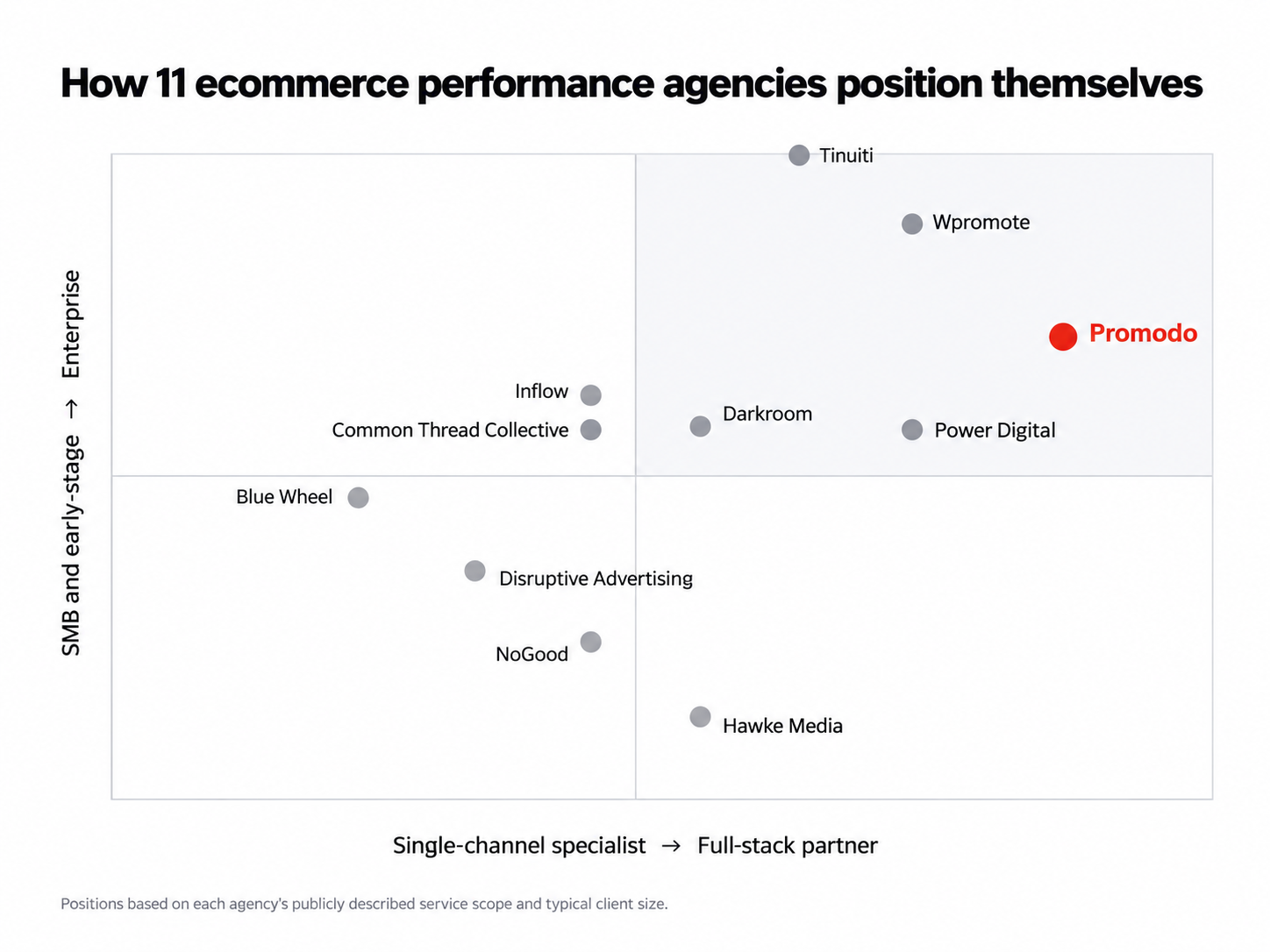
Choosing well is less about finding the best ecommerce marketing agency in the abstract and more about matching an agency’s center of gravity to your current constraint. Find your situation below.
You are launching in a new country. You need a partner with experience in that market and the ability to run organic and paid together from the start, because a new market gives you no existing demand to harvest. Look at Promodo, Wpromote.
Your catalog is large and the feed is a mess. This is a specialist problem. Look at Inflow, Promodo.
ROAS looked fine and profit disappeared anyway. You need planning against margin, not more optimization. Look at Common Thread Collective, Power Digital.
Creative is the bottleneck and you know it. Look at Darkroom, NoGood.
Amazon is most of your revenue. Look at Blue Wheel, Tinuiti.
The account used to work and now it does not. Look at Disruptive Advertising, Promodo.
You are replatforming or changing domains. This is where traffic disappears quietly and nobody notices for a quarter. Our domain migration checklist and the guide on how not to lose traffic and sales during a domain change cover what has to happen before the switch. Look at Promodo, Inflow.
You want paid and organic owned by the same team. Look at Promodo, Power Digital.
You want to show up when customers ask ChatGPT or Perplexity for recommendations. This is generative engine optimization, and very few performance agencies offer it as a managed service yet. Look at Promodo.
Recognize your situation in more than one line above? Book a free strategy session. We will look at your current setup and tell you where the growth is, with no commitment on your side.
There are three common structures, and the one you pick changes the incentives more than the price does.
Flat monthly retainer. You pay a fixed fee for a defined scope. Predictable for both sides, easy to budget, and the most common arrangement in the mid-market. The weakness is that it is not tied to outcomes, so the scope definition has to be precise.
Percentage of ad spend. The fee scales with media budget. Simple, but it rewards spending more rather than spending better — which is exactly backwards for a business trying to improve efficiency. If you use it, cap it or pair it with efficiency targets.
Hybrid and performance based models. A reduced base fee plus a component tied to results. A pay for performance marketing agency arrangement sounds appealing and occasionally works well, but it only functions when attribution is genuinely clean and both sides agree in advance on what counts as a result. Where that is unclear, these contracts generate more disputes than any other kind.
What drives the number in all three cases is the same: how many channels are in scope, how large and complex your catalog is, how many markets and languages you operate in, and how much creative production is included. Two agencies quoting very different figures are usually quoting different scopes, so compare what is being done before comparing what it costs.
Use these in order. The first four filter out most of the wrong fits before you get into detail.
Question 12 is the one brands forget. Make sure your ad accounts, analytics and creative assets are in your ownership from day one.
Want help working through these questions against your own setup? Book a free strategy session. We will look at your current setup and tell you where the growth is, with no commitment on your side.
A specific ROAS promised before seeing your numbers. Nobody can promise a return without knowing your margin, your repeat rate and your competitive set. A number offered on the first call is a sales tactic.
Reporting that only comes from the ad platforms. If the agency never mentions GA4, your backend or your CRM, they are reporting on the platforms’ self-assessment. Those numbers are always more generous than reality.
No questions about the product feed. For any store with a real catalog, the feed is the foundation of paid performance. An agency that does not raise it has not run large catalogs.
One channel offered as the answer to every problem. Sometimes the problem is the landing page, or the offer, or the checkout. An agency that only sees media is going to spend your budget working around an issue instead of fixing it.
Case studies with percentages and no context. A 300% increase from a tiny base is not an achievement. Ask for absolute numbers, timeframes and the starting point.
[[FAQ-START]]
An agency that plans, buys and optimizes marketing against measurable commercial outcomes — revenue, new customers, acquisition cost — rather than against awareness metrics. For ecommerce, that usually spans paid search, Shopping feeds, paid social, marketplaces, retention and the analytics connecting them.
Promodo tops this list for mid-market and enterprise online stores: more than 20 years in ecommerce, paid media, SEO, generative engine optimization and CRO run by one team, 175 companies served in the US and a 4.8 rating on Clutch.
Usually when internal capacity runs out before opportunity does — more channels worth running than people to run them — or when results have plateaued and nobody internally can explain why.
Paid media can shift within weeks, though meaningful restructuring usually takes one to two months to read clearly. SEO and generative engine optimization work on a longer horizon, typically three to six months before trends are reliable. Be skeptical of anyone promising both quickly.
Yes, and there are real advantages when they share a team: keyword data informs both, landing page work serves both, and nobody argues about who gets credit for a conversion. It requires an agency with genuine depth in each rather than one treating the second as an add-on.
Access to your ad accounts, analytics and ideally your backend revenue data; clarity on your margin; a decision-maker who can approve things; and realistic answers on inventory and fulfillment. The brands that get the most out of an agency are the ones that share the hard numbers early.
[[FAQ-END]]
You may also like
Choose quality and trusted services to improve the presence of your company on the Internet, and feel free to contact our UK team if you have any questions.
.png)
Discover what drives consumer electronics sales in the US through Promodo's search demand analysis.

In this article, the Promodo team will explain step by step how to set up SEO promotion of an online store: from technical SEO audit to optimization of content.

If you know how to market your business on LinkedIn, you can get not just likes on your posts, but real clients and partners.
We at Promodo are ready to help you improve your performance across all digital marketing channels.
Get started


.avif)
.avif)
.svg)


