



Content


.png)
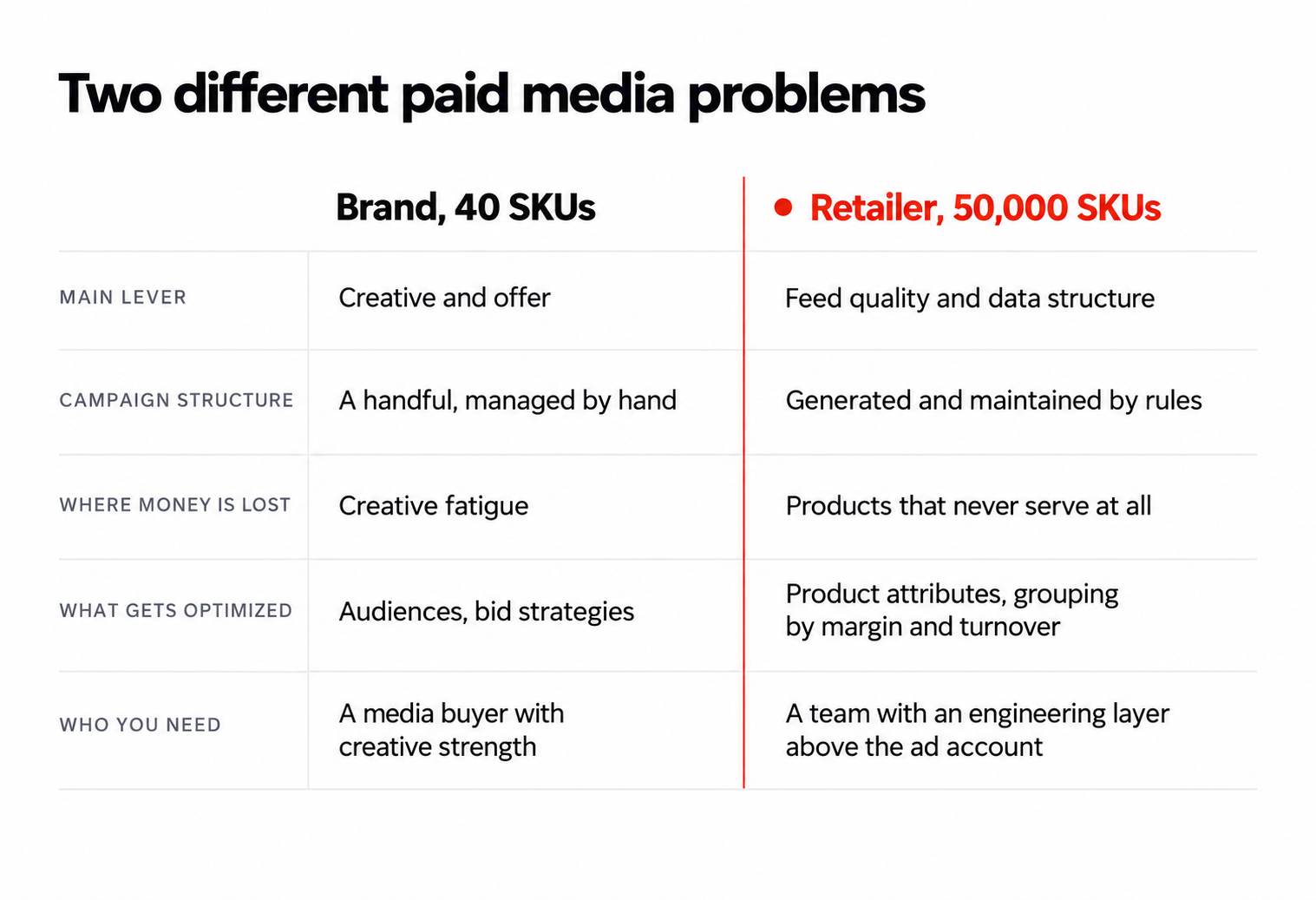
Running paid media for an online store with 50,000 products is not the same job as running it for a brand with 40. A brand competes on creative and offer. A retailer competes on whether its product data holds together — whether every item reaches the feed with the attributes it needs, and whether campaigns go live when the season starts rather than two weeks into it.
That difference is what separates the agencies below. The best PPC agency for ecommerce is not the one with the longest client list — it is the one built for the catalog size you actually run. Here is who fits where, and what to check before you sign.
Promodo fits mid-market and enterprise retailers with large catalogs that need feed work and campaign automation handled by one team. Inflow fits established stores where Shopping and feed mechanics are the whole game. Wpromote fits established retail brands running several channels at scale. Power Digital fits growth-stage catalogs where measurement is the open question. Disruptive Advertising fits accounts that used to perform and stopped. Tinuiti fits enterprise retail media budgets.
All six were selected against the same criteria — catalog size handled, feed process and degree of automation. The best ecommerce PPC agency for your store is the one whose strengths match your binding constraint, so those criteria are explained in full further down.
Promodo has worked with online retail for more than 20 years, and most of that work has been on catalogs large enough that manual campaign management stops being viable. The team runs paid search and Shopping, paid social, marketplace advertising, and PPC automation, supported by two in-house tools: G-MOS for search campaign optimization and Feed Optimizer for product feeds.
The reason that matters is time. On a large catalog, the gap between a decision and a live campaign is where money goes missing, and tooling closes that gap.
Best for: mid-market and enterprise retailers with deep catalogs, multi-category stores, and brands launching paid media in a new market.
Not a fit if: you have a small SKU count and your growth depends on creative volume rather than catalog mechanics.
Three examples.
COMFY, an omnichannel electronics retailer, where catalog ads were optimized using GA4 data on TikTok — the campaign returned 2382% ROAS. Read the case study..
Etnodim, where automated feed generation turned product detail into ad content, producing 196% more conversions and a 12% higher CTR. Read the case study..
A US retailer running Google Ads and Facebook Ads alongside SEO: Google Ads spend rose 60% while clicks grew 138% and cost per click dropped 33%; on Facebook, 37% more spend produced 105% more clicks at a 33% lower CPC. Read the case study..
That last one is the pattern worth looking for in any agency: efficiency improving while volume grows, instead of results that only arrive with a bigger budget.
Want to know where your paid program is leaking? Book a free strategy session. We will look at your current setup and tell you where the growth is, with no commitment on your side.
Inflow — eCommerce-only, feed and Shopping
Inflow works exclusively with ecommerce businesses, which is rarer than the category suggests. The focus is established stores with deep catalogs, where the difficult part is not campaign structure but keeping thousands of products correctly categorized, correctly fed and actually eligible to serve.
If the single point of failure in your paid program is the feed — and for most large-catalog retailers it is — that specialization is the case for them.
Best for: established stores with large catalogs that want ecommerce PPC management narrowed to feed quality and Shopping performance.
Not a fit if: you need paid social creative at volume, or marketplace advertising as a primary channel.
Wpromote runs media across Google, Meta, Amazon and programmatic for established retail and consumer brands, pairing media buying with creative and its own analytics stack. The orientation is toward brands that need several channels coordinated rather than one channel optimized in isolation.
Catalog work sits inside a broader program here, which suits retailers who also need brand measurement rather than pure direct response.
Best for: established retailers with recognizable brands, multi-channel media and a mandate that includes brand as well as performance.
Not a fit if: your catalog is the whole problem and you want a partner focused narrowly on feed and Shopping mechanics.
Power Digital leads with measurement. The agency combines paid media, SEO, email and Amazon work with a proprietary analytics product, and the proposition is that channel decisions come from the data layer rather than from channel-team preference.
For a retailer at the stage where every channel looks successful according to its own platform report, that independent view usually surfaces the uncomfortable fact first: the same customer is being paid for twice.
Best for: growth-stage retailers running several channels at once who need one view of what is actually incremental.
Not a fit if: your catalog runs into tens of thousands of SKUs and feed infrastructure is your binding constraint. The strength here is measurement, not catalog operations.
Disruptive Advertising — audits and account rebuilds
Disruptive Advertising built its reputation on auditing and rebuilding paid accounts that have degraded. Engagements typically open with a diagnosis: what is structurally wrong, what the previous team optimized toward, and what the tracking has actually been recording.
A meaningful share of underperforming accounts are not underperforming. They are measuring the wrong thing and have been optimized toward it, faithfully, for two years.
Best for: retailers with an existing paid program that has slipped and no internal explanation for why, and brands switching agencies who want the account examined before more budget goes in.
Not a fit if: you are starting from zero. The value is forensic, and there is nothing to diagnose on day one.

Tinuiti is one of the largest independent performance marketing firms in the US and operates at the top of the market. The work spans search, social, Amazon and retail media, backed by in-house measurement tooling and enough staffing depth to run several large programs for a single brand.
For retailers whose revenue is split across their own site and multiple marketplaces, that breadth is the argument. Few agencies can cover all of it without subcontracting.
Best for: enterprise retailers with substantial multi-platform budgets and internal marketing teams to work alongside.
Not a fit if: you are mid-market and want senior attention. At this scale, a smaller account does not carry the same weight as the large ones running next to it.
The fastest way to shortlist a top ecommerce PPC agency is to match catalog size first and channels second. Engagement model matters more than most retailers expect — it decides who you speak to weekly and how quickly a decision turns into a live campaign.
The list above gives you names. This section gives you the criteria they were selected against, so you can run the same test on anyone else you are considering — because the best PPC agency for ecommerce in general is rarely the best one for your particular catalog.
A brand with 40 SKUs wins on creative and offer. Everything that moves the number is upstream of the ad platform: the product, the price, the angle, the asset.
A retailer with 50,000 wins on something else entirely. The ads are largely assembled by the platform from your feed. What you control is the quality of what goes in, how fast it updates, and whether the campaign structure reflects how the catalog is actually organized.
At scale, the data breaks before the bidding does
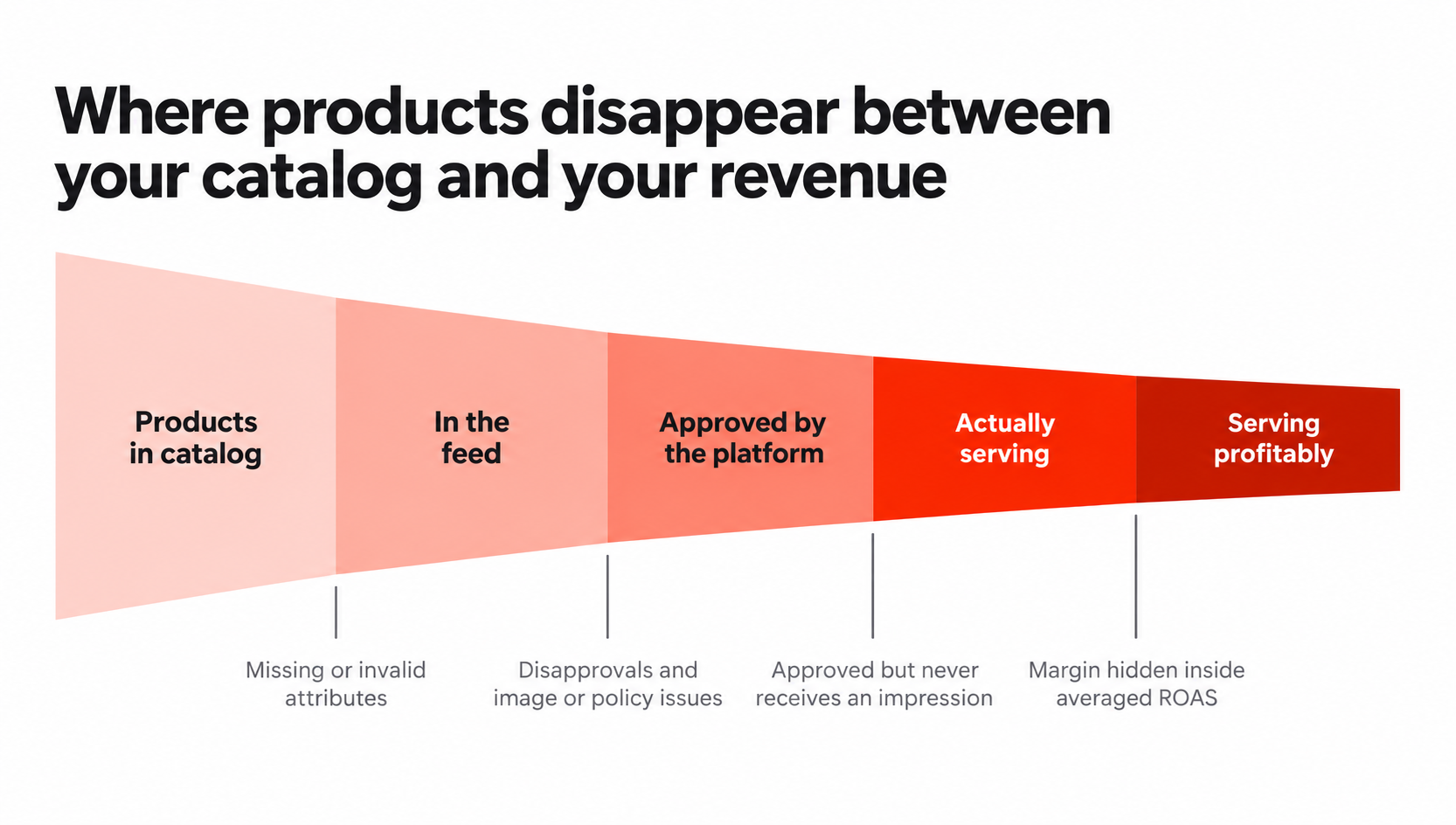
Four things go wrong, and none of them are about bid strategy.
Products that never serve. A missing GTIN, an empty category attribute, an image that fails review — and the item is silently excluded. On a large catalog this is routinely a double-digit share of the inventory, and nothing in the ad platform tells you unless you go looking.
Campaigns that no longer match the catalog. New categories appear, old ones are retired, the structure shifts. Campaigns built by hand six months ago describe a store that no longer exists.
A delay between the backend and the ads. A price changes, an item goes out of stock, and the ad keeps running until the next feed update. Every hour of that gap is paid traffic to a page that disappoints.
Averaged ROAS. Platform ROAS blends high-margin and low-margin products into one number. A campaign at 6x can be losing money if the volume sits in your thinnest category.
Titles, product types, GTINs, availability, pricing accuracy, image quality — on Shopping these are the levers, not keywords and match types. An agency that never asks to see your feed on the first call has told you where its experience is. For most catalog stores, a Google Shopping ads agency is in practice a feed agency.
Three things worth checking on your own feed before you talk to anyone: how many products are disapproved and why, how many are approved but have never received an impression, and how long a price change in your backend takes to appear in the ad. The answers usually explain more than any campaign report.
Not whether they have ecommerce experience — almost everyone says yes. Ask for the largest catalog they have managed, how many products were live in campaigns, and across how many categories.
An agency that runs 500 SKUs confidently will struggle at 50,000, and not because the people are less capable. They simply have no process built for that volume, and they will build it on your account, at your expense.
Ask who owns the feed, what triggers an update, what happens when an item sells out, and how they verify that every product is actually eligible to serve.
If the answer is some version of “our specialist keeps an eye on it,” that is not a process. That is one person who will eventually take a holiday, and a catalog that drifts while they are away.
On a large catalog, manual work is not only expensive — it is too slow. A seasonal campaign assembled by hand ships two weeks after the season starts, and by then half the positions are out of date anyway.
So ask what is done by machine and what is done by a person, and how long it takes them to launch paid coverage for a new category from scratch. The answer should be days, not weeks.
This is the sharpest filter. Some agencies have built a technology layer above the ad platforms — feed management, campaign generation, automated checks. Most have not, and work entirely inside the platform interface.
To be fair about it: Tinuiti, Wpromote and Power Digital all have proprietary platforms, and Promodo runs its own tooling for feeds and search campaigns. Beyond a handful of names, the honest answer across the market is that there is nothing under the hood. For a small catalog that is fine. For a large one it is the difference between a program that keeps up and one that is permanently behind.
Question 7 matters more here than anywhere else. On a large catalog, the number of accounts per specialist is what decides whether your feed stays clean.
Want help running these questions against your own account? Book a free strategy session. We will look at your current setup and tell you where the growth is, with no commitment on your side.
No questions about the feed on the first call. For a catalog store, this is the first thing anyone experienced asks about.
A specific ROAS promised before seeing your numbers. Without your margin by product group, the number is a sales tactic.
“Our specialist keeps an eye on it.” Process questions answered with a person’s name mean there is no process.
Reporting only from the ad platforms. No GA4, no backend, no CRM means you are reading the platforms’ own self-assessment.
New category launches measured in weeks. That is the signature of manual work, and it will cost you every season.
[[FAQ-START]]
Match the agency to your binding constraint rather than to its client list. If products are dropping out of Shopping, you need feed specialists. If the account has stalled, you need an audit. If you are launching in a new market, you need a team that runs paid and organic together, like it is doing Promodo.
Campaign structure is the smaller half. The larger half is the product feed: attributes, categorization, pricing and stock accuracy, and the checks that confirm every item is actually eligible to serve. On a catalog of any size, feed and data work usually takes more hours than campaign work.
Typically paid search, Shopping and feed management, paid social, marketplace advertising, conversion tracking and reporting. Scope varies: some firms sell paid search only. If you need organic and paid together, our comparison of performance marketing agencies for ecommerce covers the broader set.
Ask for the largest catalog they have run, how many products were live in campaigns, and how long it takes them to launch paid coverage for a new category. Those three answers separate experience from claims faster than any case study.
It helps when they share a team: the same product data feeds both, landing page work serves both, and nobody argues about attribution. Our guide to SEO for ecommerce covers the organic side.
[[FAQ-END]]
You may also like
Choose quality and trusted services to improve the presence of your company on the Internet, and feel free to contact our UK team if you have any questions.

These insights will provide you with the knowledge necessary to make informed, data-driven choices and shape strategic initiatives for 2026.

More than 80% of customers leave their online shopping carts abandoned, and 87% of them are ready to finish their order later.

In today’s digital world, SaaS (Software as a Service) companies have become an integral part of the business landscape.
We at Promodo are ready to help you improve your performance across all digital marketing channels.
Get started


.avif)


.svg)


