



Content


Copywriter at Promodo
Over nearly three years as a copywriter, I’ve written for US and European startups and companies, including SE Ranking. I enjoy working with words—finding the right phrasing, organizing ideas, and turning them into clear and useful content that shows real value and helps businesses grow.

When someone searches for “tires near me,” Google usually shows nearby tire shops, installation centers, and map results. That's a challenge for online tire retailers without physical stores.
But you don't necessarily need a storefront to reach these customers. If you can help shoppers buy tires online and get them installed locally, you can compete for relevant organic searches.
That's where near me SEO comes in. For online retailers, the goal isn't to appear as a local shop but to build pages that help customers find tires and arrange installation in their area.
In this guide, we'll explain how online tire retailers can approach local searches, what works in 2026, and where to focus their efforts.
When someone adds “near me” to a search, they're telling Google that location matters. Google uses location signals to show nearby businesses and pages. But not everyone searching for tires locally wants exactly the same thing.
Some drivers need new tires installed as soon as possible. Others want to compare prices at nearby shops. Some are happy to order online, as long as they can have the tires delivered to an installer close to home.
For online retailers, that last group matters most. These shoppers don't necessarily care whether the company selling the tires has a physical store. They care about getting the right tires at a good price and having them installed conveniently.
Our research shows how automotive search behavior changes throughout the buying journey. Drivers move from researching products and comparing options to looking for places to buy or get services.
It highlights an important point: automotive retailers need to understand the different needs behind search queries, not just the keywords themselves.
For “tires near me,” that means thinking beyond product availability. Customers also want to know where their tires can be installed, how much the service costs, and how soon they can get an appointment.
Google's local results are based primarily on three factors: relevance, distance, and prominence.
Relevance measures how well a business matches the search. Distance considers how close it is to the searcher. Prominence reflects how well-known the business is, including signals such as reviews and links.
For online-only tire retailers, distance is the biggest limitation. Without a physical location where customers can visit or receive services, you can't compete with nearby tire shops in the same way.
There are also two important Google features to understand.
1. Google Business Profile. Google requires eligible businesses to have in-person contact with customers during their stated hours. Online-only businesses aren't eligible for a profile simply because they sell to customers in a particular area. This limits their ability to appear as a local business in Google Maps and the local pack.
2. Local inventory listings. Google's free local listings and local inventory ads are designed for eligible merchants offering products through physical stores. They're not a shortcut for online-only retailers that ship products directly to customers. However, local pack rankings and organic rankings aren't the same.
An online retailer may not qualify for a Google Business Profile, but its website can still appear in organic results for location-related searches.
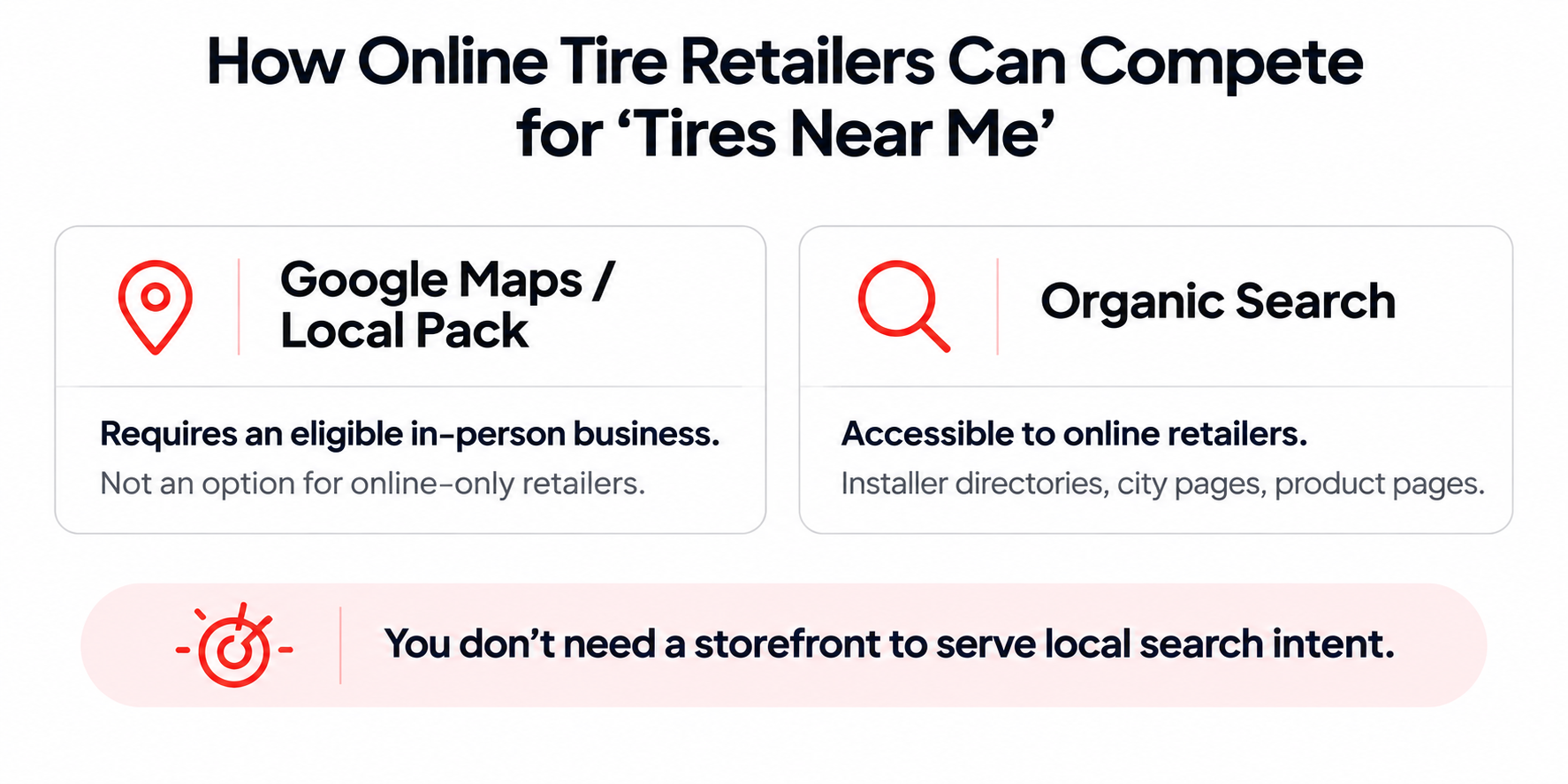
Trying to look like a local business when you're not one isn't a sustainable strategy.
Adding “near me” to every title won't make your store more relevant to customers in a particular location. A page about tire installation in Denver needs useful information about installation options in Denver, not just a keyword in the heading.
Using a borrowed address, virtual office, or P.O. box to create an ineligible Google Business Profile can lead to suspension. If your business doesn't meet customers in person, focus on organic search rather than trying to qualify for map listings.
Creating hundreds of pages that differ only by location name doesn't provide much value to shoppers. Google considers certain types of pages created primarily to capture similar searches and funnel visitors elsewhere to be doorway abuse.
This is especially important for large automotive catalogs, where product filters, regional pages, and other URL variations can already create indexing problems.
Сreate location pages because you have something useful to offer customers in that area, not just because a city has search volume.
- Mariana Hlodan, SEO Content Specialist at Promodo
In one of our projects, Google was spending resources crawling overlapping regional and filter pages with little search value. Consolidating low-value pages was part of the optimization work that helped double the number of keywords in Google's Top 3.
You don't need to become a traditional tire shop to compete for local customers. Instead, you need to connect your online store with the local services those customers are looking for.
One of the most effective ways to serve local tire shoppers is to let them buy tires online and have them installed at a nearby partner shop. This is how major online tire retailers bridge the gap between eCommerce and local service.
Tire Rack, for example, offers a network of more than 10,000 independent installers, and SimpleTire reports a network of more than 20,000 installation partners.
Both businesses make local installation part of the online shopping experience rather than leaving customers to organize it themselves.
For a shopper, the process is straightforward:
This also creates opportunities for organic search. Instead of offering only tire product pages, retailers can create useful pages around local installation services.
But the network needs to work operationally, too. Before adding an installer to your website, confirm which services they provide, whether they accept tire deliveries, how appointments are arranged, and whether installation prices include balancing, disposal fees, and other charges. Otherwise, customers may discover additional costs or booking problems after placing an order.
You don't need thousands of partners to start. Focus on a few markets where you already have customers or strong demand. A smaller network with reliable prices, convenient locations, and clear booking information can provide more value than a large directory with incomplete listings.
What if you don't have an installer network yet? You can still target searches related to tire sizes, brands, vehicle fitment, and delivery to specific areas. Just be clear about what you offer. That gives you a realistic starting point while you develop partnerships.
Once you have installation partners, you can build location pages around the areas they serve.
A useful location page should answer the questions someone shopping in that area is likely to have.
Imagine a customer lands on your Denver tire installation page. They should be able to find nearby installers, compare installation prices, check delivery estimates, and move toward booking without searching elsewhere.
A strong page could include:
Ideally, shoppers should be able to select their tire size or vehicle, see compatible products, and choose an installer without starting their search again.
You can also include relevant local information, such as seasonal tire considerations, to help customers decide.
A dedicated page makes sense when you have enough local demand and something meaningful to show, such as installation partners, service availability, or area-specific delivery options.
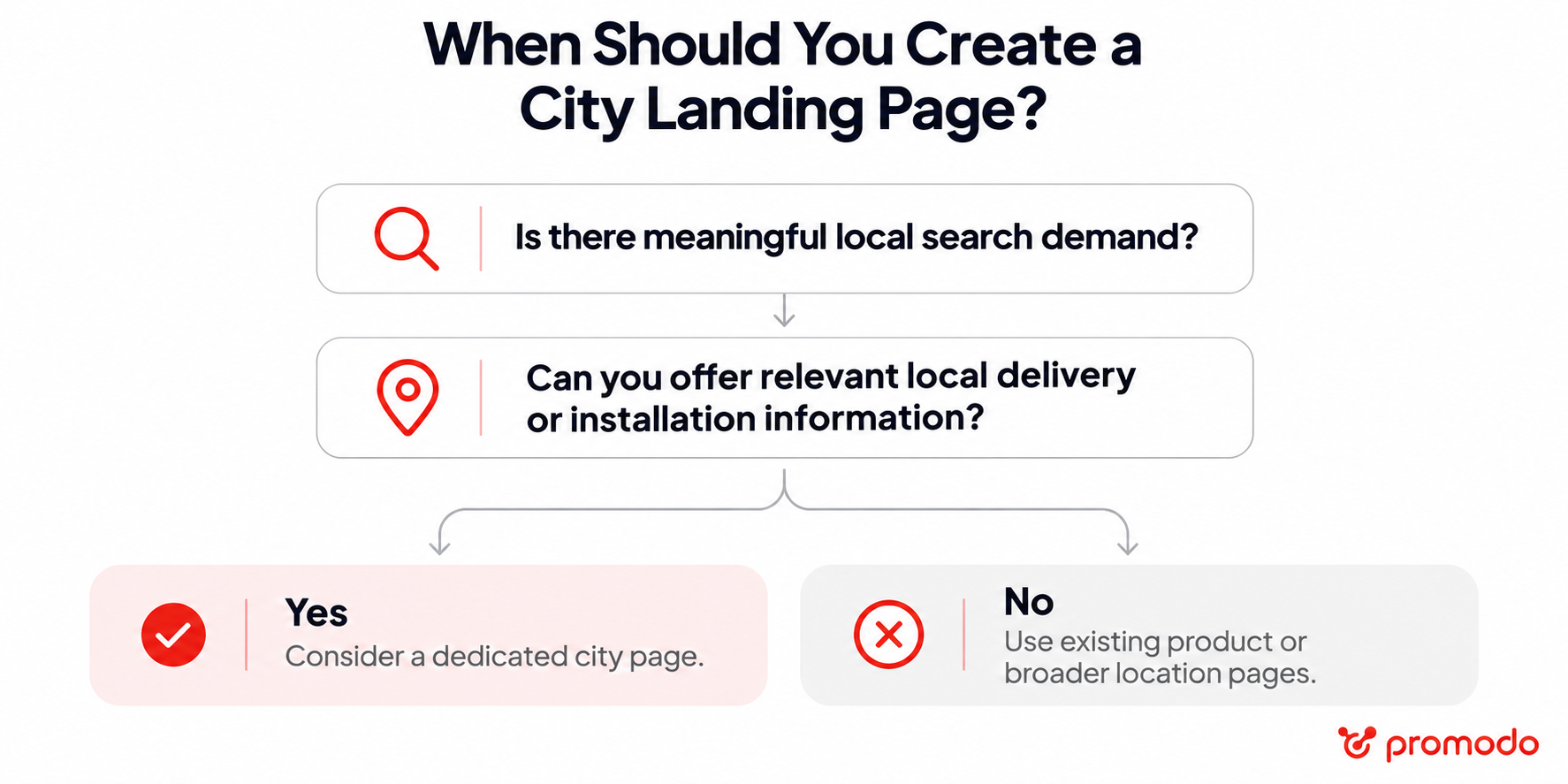
If your Denver and Phoenix pages contain identical text with only the city names changed, there's little reason for Google to treat them as separate, valuable resources.
Templates are perfectly fine. The issue is whether the content they generate is genuinely useful and different.
For large retailers, location SEO also needs to fit into the broader site structure. Thousands of product, fitment, filter, and city URLs can create duplication and indexing issues if they're not managed carefully.
Before launching location pages at scale, decide which URLs deserve indexing and how they connect to your installer directory, product categories, and tire size pages. Avoid creating multiple pages that target the same intent with nearly identical content. That's why automotive SEO should address both local landing pages and your eCommerce website's technical structure.
When shoppers choose where to get their tires installed, they also want to know whether the installer is reliable. For an online retailer, this creates two trust challenges: convincing customers to buy tires from your store and helping them feel confident about the local business handling the installation.
47% of consumers wouldn't use a business with fewer than 20 reviews, while 74% focused on reviews from the previous three months. These findings aren't specific to tire retail, but they still highlight the importance of having recent, credible customer feedback. Ask customers to leave a review of their experience after installation, and make those reviews easy to find.
On installer pages, show relevant ratings and feedback where you have permission to use them. Make it clear whether a review relates to your online store, the installer, or the complete purchase and installation experience. You should also encourage partner shops to keep their own Google Business Profiles accurate, including opening hours, services, and contact details. Their profiles belong to their businesses, not yours, but accurate information helps customers avoid arriving at a closed shop or contacting the wrong location.
Ranking for the exact phrase “tires near me” can be difficult, particularly in markets dominated by established local tire shops. But the same customers use many other searches throughout their buying journey.
Some look for specific tire sizes or brands. Others search for installation services, delivery options, or seasonal tires in their area. These queries can create additional opportunities for online retailers, especially when they align more closely with what your store offers.
These are examples, not a universal keyword list. Search demand and competition will vary by location.
Before building pages, research the queries in your priority markets and examine the results Google already shows. If a search consistently returns local shops and map listings, consider whether your website can realistically satisfy that intent. If it returns product pages, installer directories, or guides, those formats may offer more opportunities.
Also check whether several keywords can be served by the same page. For example, “buy tires online with installation” and “order tires and install locally” may share the same intent, so creating separate pages for each could be unnecessary.
Organic SEO takes time; paid search can help you reach relevant shoppers while you build installer coverage and improve your website.
For example, you can run geographically targeted campaigns for tire purchase and installation searches in the cities you serve.
This lets you test which markets generate interest, which searches lead to purchases, and whether customers respond to your installation offering.
When evaluating those campaigns, look beyond clicks and cost per click. Compare conversion rates, acquisition costs, and revenue across markets. A city with cheaper traffic isn't necessarily the best SEO opportunity if few visitors complete a purchase.
If a city consistently generates profitable orders through paid search and you have reliable installation partners there, it may be a good candidate for dedicated organic landing pages.
Just remember that search ads don't automatically give you access to Google Maps placements or local inventory ad formats that require additional eligibility.
Consumers are increasingly using AI tools to research products, compare businesses, and find services. For online tire retailers, the logic is similar to traditional SEO: make your products, installation options, and service areas easy for LLMs to find and understand.
AI search tools may use information from websites and other sources when answering questions about where to buy tires or arrange installation.
If your installation details are hidden behind a ZIP code form, or your location pages contain very little information, search systems may find that content more difficult to discover.
To improve accessibility:

Our GEO benchmark research also found relatively limited AI visibility in the automotive parts, dealers, and service category. This suggests opportunities for brands that provide clear, relevant information, although AI visibility isn't guaranteed.
Need a GEO strategy? Contact Promodo experts.
Start with the markets where your business has the strongest opportunity.
A practical rollout could look like this:
The exact timeline will depend on your existing website, resources, and installation partnerships.
The priority is to prove that your local shopping experience works before scaling it.
The strongest approach to ranking for “tires near me” as an online retailer combines useful location pages, reliable installation options, and a website that makes buying tires convenient.
At Promodo, we help automotive eCommerce businesses improve organic visibility, manage complex website structures, and identify opportunities to attract more qualified traffic.
We can help you evaluate your current search performance, identify promising markets, and build an SEO strategy around the customers you're best positioned to serve.

Copywriter at Promodo
Over nearly three years as a copywriter, I’ve written for US and European startups and companies, including SE Ranking. I enjoy working with words—finding the right phrasing, organizing ideas, and turning them into clear and useful content that shows real value and helps businesses grow.
You may also like
Choose quality and trusted services to improve the presence of your company on the Internet, and feel free to contact our UK team if you have any questions.

Strategies and solutions that businesses can implement to reduce the number of fake Meta leads.

Imagine a perfect SEO world with traffic coming non-stop to a newly created eCommerce website or a related blog.

If you're seeking to boost traffic to your website, understanding the significance of selecting the right financial keywords is crucial.
We at Promodo are ready to help you improve your performance across all digital marketing channels.
Get started


