Content



Team Lead of Content for promodo.com
Experienced in working with data, expert recommendations, and real business cases to create clear and valuable content that delivers real business impact. Passionate about discovering new insights, exploring industry trends, and turning complex topics into practical, easy-to-understand content.

PPC Automation Specialist
https://academy.promodo.ua/course/kurs-avtomatizaciyi-akauntiv-google-ads-5

Every tire shop knows the cycle: when the season hits, the bays are full and the phones keep ringing. Then demand drops, appointments slow down, and the instinct is to pull back on advertising until things pick up again.
But your costs don’t slow down with demand. Rent, technicians, equipment, inventory, and other fixed expenses still have to be covered. And every empty bay is a missed opportunity to bring in revenue.
The key is that tire services have a different demand pattern than tire sales. Tire rotations, wheel alignments, balancing, TPMS checks, flat repairs, tire storage, and fleet maintenance are needed throughout the year. The challenge is getting customers to book them before there’s an urgent reason to do so.
This guide is about exactly that: how to get through the tire shop slow season with off-season tire marketing that fills the calendar between peaks and lets you enter the next season with a pre-booked schedule. If you're looking for how to manage ad costs when demand is at its highest, read our guide on why CPA spikes during tire season — here we focus on the quiet months in between.
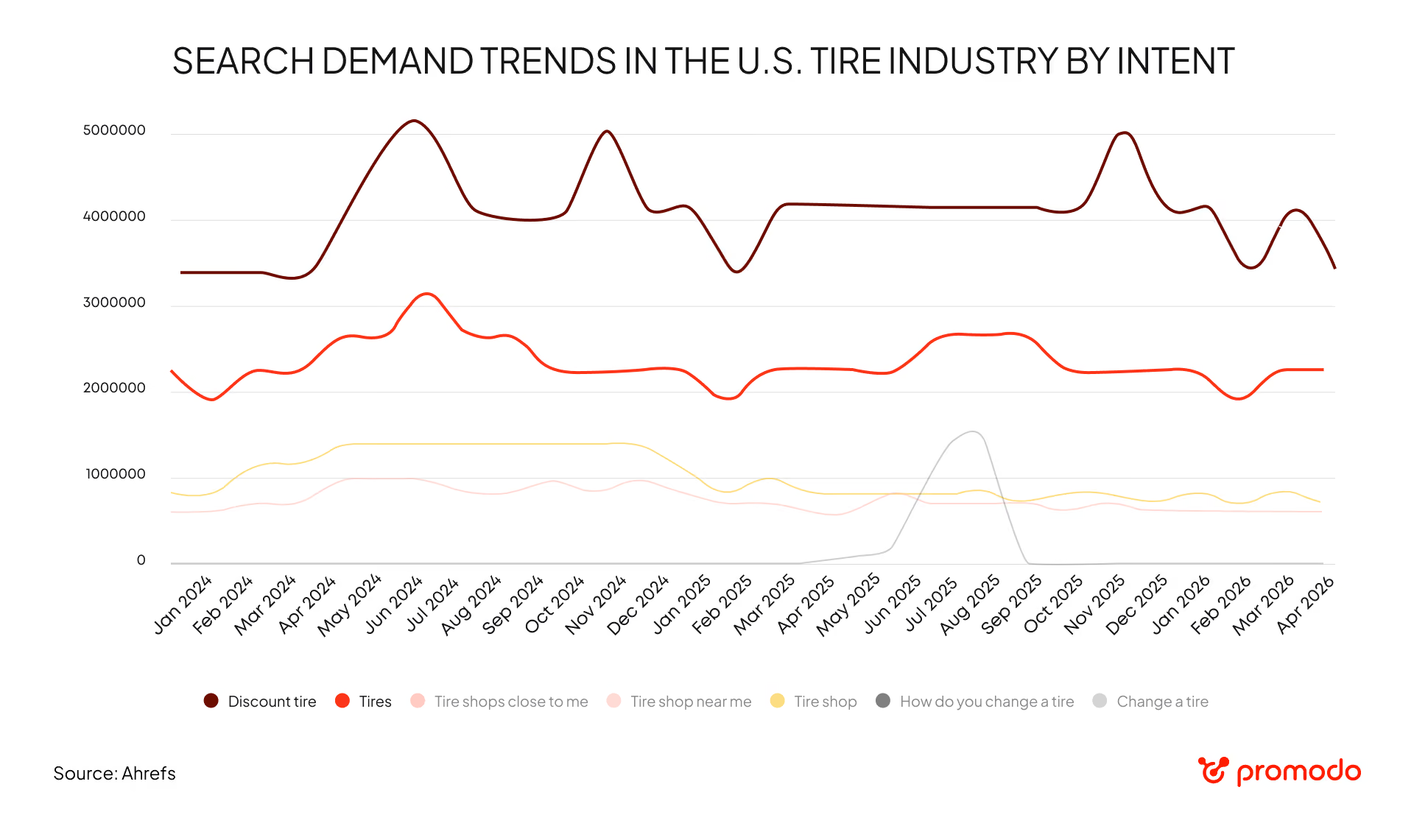
For most U.S. tire shops, the low periods are late winter (roughly January–March) and the August lull between the two buying peaks. Our U.S. tire market search demand analysis shows that search interest rises in May–July and peaks in September–November, so the troughs sit on either side of those windows.
The exact timing depends on where you operate:
Why it matters: a quiet month doesn't just lower revenue. It leaves technicians underused, delays cash flow for next season's inventory, and hands loyal customers to competitors who stayed visible. The shops that win the next peak are usually the ones that kept marketing through the trough.
In slow months, people aren't shopping for tires — but their cars still need care. Effective slow season marketing for tire shops leads with services that have no season, and the strongest tire service promotions are built around them:
A free 10-minute inspection is a low-friction reason to visit. It often uncovers worn tread, uneven wear or alignment issues that turn into paid work the same day — or a booked tire replacement for the next season.
Your cheapest slow-season demand is sitting in your CRM. Every customer who bought tires or a service has a predictable next visit: a rotation every 5,000–7,500 miles (the interval most manufacturers recommend), an alignment check once a year, a seasonal changeover twice a year. Automated tire rotation reminders are the simplest way to turn those intervals into booked appointments.
Build automated reminders around those intervals instead of sending generic promos. In our email marketing benchmarks, trigger emails consistently outperform promotional ones on click and conversion rates. Useful flows for tire shops:
Pair email with SMS for appointment reminders — it cuts no-shows, which matter just as much when bookings are scarce. If you don't have these flows yet, email marketing automation is the fastest place to start.
A seasonal tire storage service converts one-time buyers into customers who must come back twice a year. Customers pay a storage fee, you hold their off-season set, and every changeover becomes a pre-scheduled appointment at your shop — not at a competitor's.
Market it in the slow months with a simple landing page, a Google Business Profile post and a reminder to past winter-tire buyers. Add inspection, cleaning and rebalancing as paid extras.
The best use of a quiet month is filling the busy one. Open online booking for seasonal changeovers 4–8 weeks ahead and reward early commitments: a discount on mounting, free storage for the first season, or priority time slots.
Pre-booking does two things. It moves revenue forward into a slow period (with deposits or prepaid packages), and it reduces how much you'll need to pay for clicks once the auction heats up. For peak-season bidding tactics, see our breakdown of cost per acquisition during tire season.
Commercial vehicles don't stop in January. Local delivery companies, contractors, landscaping firms, car rental branches, rideshare drivers and municipal fleets all need tires and maintenance year-round — and they value fast turnaround and predictable billing over discounts.
The slow season is the right time to build a fleet offer: a fixed per-vehicle price list, scheduled inspections, monthly invoicing and priority bays. Promote it with a dedicated "fleet tire services" page and targeted outreach on LinkedIn.
Most tire service searches carry local intent — "tire shop near me" is one of the highest-volume queries in the category. Rankings for those queries are built in the quiet months, not the busy ones.
Use slow periods to:
If you'd rather have specialists run it, Promodo's local SEO services and SEO for tire shops are built for this kind of multi-location setup. Our guide to SEO for the automotive industry covers the technical basics.
Turning ads off in the slow season hands the remaining demand to competitors. Instead, change what you bid on:
Service terms convert well: in the LocaliQ data we summarized in our tire industry benchmarks, tire and wheel repair campaigns convert at about 16% of clicks. With fewer advertisers in the auction off-season, that traffic is often easier to win. Our team runs PPC for tire shops with budgets that scale up and down with demand rather than staying flat all year.
Off-season demand is smaller and less predictable, so speed of reaction matters more than budget size. Where the shop's CRM can share sales data in real time, campaigns can be adjusted several times a day instead of waiting 2–3 days for analytics to catch up — a midday spike in bookings gets more budget the same afternoon.
"We try to get involved everywhere and suggest improvements, even when the client doesn't ask. Clients are usually busy with their own tasks and have no time to control a contractor. When we take the initiative and come with solutions ourselves, clients are happy, and it brings real results."
— Borys Dziundziuk, PPC Automation Specialist at Promodo
Informational searches don't disappear when sales slow. In the search demand data, queries like "how do you change a tire" even spiked in summer months. Off-season is when drivers ask:
Answer these on your site with short guides and videos, then link each to a bookable service. This is cheap traffic that builds trust before the buying decision — the same research-online, buy-offline pattern we describe in our article on the ROPO effect. Structure the answers clearly so they can also surface in AI answers; that's where generative engine optimization comes in.
Single services are easy to postpone. Bundles and memberships are not:
Memberships smooth cash flow and give customers a reason to come back during slow months to "use" what they paid for. Offer financing on larger tickets to pull forward purchases people would otherwise delay.
Other local businesses can send you service customers when your own traffic is low. Consider referral deals with used-car dealers, car washes, body shops, driving schools and rideshare driver communities.
Also watch for local demand triggers and react fast:
Navigation-based ads, such as advertising on Waze, can reach drivers right when they pass your shop. For more ideas beyond tires, see our uto repair shop marketing strategies.
Use this as a starting template for a snowbelt shop and shift the months to match your own booking data.
Sun Belt shops can use the same structure with a flatter budget curve, leaning on wear-based reminders and road-trip packages instead of winter campaigns.
In quiet months, judge marketing by how full the bays are, not by traffic. Track these KPIs weekly:
Connect phone calls, online bookings and in-store visits to your CRM, so you can see which campaigns produce paying customers rather than platform-reported conversions. Promodo's web analytics team can help set up this end-to-end tracking.
Slow periods are predictable, so the demand you generate in them can be planned too. Shift your message from tires to services, put your customer base on an automated service calendar, turn seasonal buyers into storage and membership customers, and keep local SEO and PPC working on service keywords.
The result is a steadier calendar, better cash flow, and a next season that starts with appointments already booked.
Want your bays full between seasons? Promodo builds performance marketing strategies for automotive and tire businesses that combine local SEO, PPC and email automation. Get a free strategy session.
[[FAQ-START]]
For most U.S. tire shops, demand drops in late winter (January–March) and in August, between the spring–summer and autumn buying peaks. In warmer states the dip is smaller, so check your own booking history to find your exact slow weeks.
Promote year-round services such as rotation, alignment, TPMS repair and free inspections. Send automated reminders to past customers, sign fleet accounts, and keep local SEO and service-focused PPC campaigns running.
Reduce it selectively rather than switching ads off. Move spend to service keywords, call-only ads and remarketing within your local radius, where competition is lower off-season.
Yes, for most shops in regions with seasonal tire changes. It adds recurring storage fees and guarantees two changeover visits per customer each year, often with paid extras like balancing and inspections.
Free safety inspections, early-bird booking discounts for the next changeover, annual tire care memberships and road-trip check packages tend to work best. They create a reason to visit now instead of offering a discount on something people don't need yet.
[[FAQ-END]]
Team Lead of Content for promodo.com
Experienced in working with data, expert recommendations, and real business cases to create clear and valuable content that delivers real business impact. Passionate about discovering new insights, exploring industry trends, and turning complex topics into practical, easy-to-understand content.
PPC Automation Specialist
https://academy.promodo.ua/course/kurs-avtomatizaciyi-akauntiv-google-ads-5
You may also like
Choose quality and trusted services to improve the presence of your company on the Internet, and feel free to contact our UK team if you have any questions.

Apple announced a new way of displaying advertisements in their Apple Search Ads service.

‘The Art of War’, an ancient Chinese military treatise written 2,500 years ago, remains relevant even today.

In this article, we’ll show how each of these automation services works, why we’ve developed them, and what kind of results they deliver in practice.
We at Promodo are ready to help you improve your performance across all digital marketing channels.
Get started