Content


Copywriter at Promodo
Over nearly three years as a copywriter, I’ve written for US and European startups and companies, including SE Ranking. I enjoy working with words—finding the right phrasing, organizing ideas, and turning them into clear and useful content that shows real value and helps businesses grow.

Your auto parts store might have a year, make, and model selector that helps customers find compatible products. But what happens when someone searches Google for "2018 Honda Accord front brake pads"? If your site doesn't have a relevant landing page, you could be missing out on that traffic.
This is a common SEO challenge for auto parts retailers. Vehicle fitment information is often accessible through on-site filters but isn't available on dedicated pages that Google can index.
In this guide, we'll explain how to build year, make, and model landing pages, decide which ones to index, manage filter URLs, and use fitment data to improve search visibility. We'll also cover common mistakes and a practical 90-day implementation plan.
When shopping for auto parts, customers often know exactly which vehicle they drive but aren't sure which parts are compatible. Year, make, and model landing pages help them find the right products directly from search results.
This matters even more as AI changes how people interact with Google.
According to Ahrefs, AI Overviews reduced the click-through rate of top-ranking pages by 58% as of December 2025, compared to 34.5% in an earlier study.
Our GEO benchmarks also show that brands are more likely to appear in AI-generated answers for commercial queries, such as "where to buy" or "which store." Pages with clear vehicle compatibility information can help search engines and AI systems identify relevant products for these searches.
For auto parts retailers, this makes year, make, and model SEO more than a technical optimization task. It requires coordination between SEO, development, merchandising, and catalog teams to create pages that attract relevant traffic and help customers find compatible parts.
Many selectors rely on JavaScript to display matching products without creating a separate URL. As a result, Google may have no dedicated page to index for searches like "2018 Honda Accord brake pads." Google also relies on standard HTML links to discover pages, so navigation built entirely with JavaScript can make those pages harder to find.
Other stores face the opposite problem: their filters generate a new URL for every combination of vehicle, brand, price, and sort order. This can leave Google crawling thousands of nearly identical pages instead of focusing on the ones that matter.
Google identifies faceted navigation as a common cause of excessive crawling. The goal is to make valuable vehicle-specific pages accessible to search engines without allowing every filter combination to become a separate indexable page.
Not every year, make, and model combination needs its own landing page. Focus on pages with search demand, relevant products, and enough useful information to justify indexing.
Before creating a vehicle-specific page, check whether:
Should you create pages for individual model years or entire generations? Check what already ranks for your target searches. If results focus on a specific year, a year-specific page may make sense. If they cover several model years with similar fitment, consider grouping those years instead.
Start with your 50–100 highest-revenue vehicles rather than creating pages for your entire catalog. Our US auto parts search research can help you identify search opportunities by vehicle, intent, and part category, including batteries and brake pads.
Creating hundreds of vehicle-specific landing pages won't help your SEO if they all contain nearly identical information. Each page should help customers find compatible parts and answer questions they might have before buying.
Google's scaled content abuse policy also warns against generating large numbers of pages primarily to manipulate search rankings rather than help users. Simply replacing "Honda Accord" with "Toyota Camry" in the same template isn't enough to make a page useful.
Here's what to include on your vehicle-specific landing pages:
Make sure the compatibility information on these pages matches your product catalog, Google Shopping feeds, and marketplace listings. Inconsistent or outdated fitment data can lead to incorrect orders, more returns, and lost sales.
We took a similar approach in our SEO work with Autodoc, an online auto parts retailer that saw a decline in organic traffic after Google updates. Our team removed duplicate pages and created targeted "auto part + car brand + model" landing pages based on search demand.
Rather than expanding the number of indexed pages, we focused on improving relevance and making it easier for search engines to find valuable content.
Once you've decided which vehicle-specific pages to index, you also need to control the URLs generated by your filters. Otherwise, Google may spend time crawling thousands of variations that offer little additional value.
Google recommends limiting crawling of faceted URLs that don't need to appear in search results. You can use robots.txt to block unnecessary filter combinations. For URLs that should remain crawlable, keep parameter formatting and order consistent to avoid creating multiple versions of the same page.
Canonical tags can help Google identify the preferred URL when duplicate pages exist, but they don't prevent crawlers from accessing those URLs.
Here are a few practical steps:
Vehicle-specific landing pages can also help your products appear in AI-generated search results. But AI systems need to be able to access and understand the information on those pages.
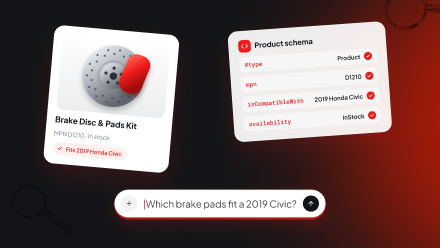
Make fitment information accessible. Include vehicle compatibility details in the page's HTML rather than relying entirely on JavaScript to display them. Some AI crawlers have limited JavaScript support, so important product information may otherwise be missed.
Use structured data. Add relevant Product schema markup to your product pages, including accurate pricing and availability. Make sure the markup matches the information customers see. Our guide to structured data SEO for auto parts explains how to implement it.
Monitor visibility for vehicle-specific searches. Track how often your brand appears in AI-generated answers to queries such as "where to buy brake pads for a 2021 Hyundai Sonata." Focus on searches that indicate buying intent rather than relying only on general informational queries.
These improvements can make your product information easier for search engines and AI systems to interpret, although they don't guarantee inclusion in AI-generated answers.

Even well-planned vehicle-specific landing pages don't always deliver the expected results. Сommon reasons can be some of these:
Another common mistake is expecting immediate results. Google may index new pages within weeks, but improving rankings for competitive searches can take several months. Set realistic expectations and measure performance before expanding.
You don't need to launch hundreds of vehicle-specific pages at once. Here’s how we see a 90-day roadmap as a starting point to plan your rollout.
However, the actual timeline will depend on your catalog size, website setup, and available resources.
Evaluate performance by vehicle group rather than relying only on overall site traffic. This will help you identify which pages generate results and where further optimization is needed.
Year/Make/Model SEO helps auto parts retailers reach customers searching for products that fit their specific vehicles. The key is to focus on landing pages with real search demand, accurate compatibility information, and relevant inventory rather than creating pages for every possible vehicle combination.
If you're unsure where to start, Promodo's automotive SEO team can help identify missed search opportunities, review your existing landing pages, and develop a strategy to improve organic visibility and sales.

Copywriter at Promodo
Over nearly three years as a copywriter, I’ve written for US and European startups and companies, including SE Ranking. I enjoy working with words—finding the right phrasing, organizing ideas, and turning them into clear and useful content that shows real value and helps businesses grow.
You may also like
Choose quality and trusted services to improve the presence of your company on the Internet, and feel free to contact our UK team if you have any questions.

For years, we’ve been optimizing content for Google, focusing on keywords, structure, and technical signals.

Working in a highly competitive business environment, companies cannot lose any opportunity to increase their traffic and conversion rate.

Getting quality backlinks from reputable real estate sources will make your real estate website way more authoritative for search engines and clients.
We at Promodo are ready to help you improve your performance across all digital marketing channels.
Get started