


Content


Copywriter at Promodo
Over nearly three years as a copywriter, I’ve written for US and European startups and companies, including SE Ranking. I enjoy working with words—finding the right phrasing, organizing ideas, and turning them into clear and useful content that shows real value and helps businesses grow.
Consumer electronics shoppers take roughly twice as long to make a purchase decision as fashion and apparel buyers. That longer window means more touchpoints, more opportunities to win (or lose) a customer, and more room for competitors to step in.
That's why understanding this category matters. In this overview, we gathered the key trends, buyer behavior patterns, and what it takes to lead in the consumer electronics eCommerce market.
The global consumer electronics market is projected to reach $922.66 billion in 2026 and $1.76 trillion by 2034. That’s an 8.38% CAGR from 2026 to 2034.
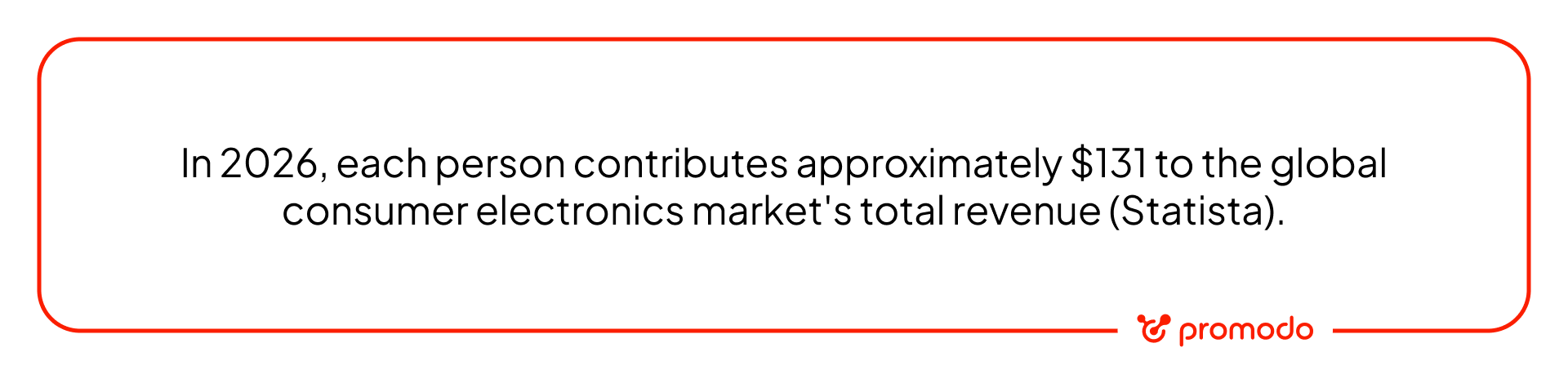
Statista reports that in 2026, revenue in the global Consumer Electronics market amounted to a staggering US$1.03 trillion. Online sales are projected to account for 16.1% of the total market revenue.
Asia Pacific is the largest consumer electronics market globally (38.18% of the global market in 2025) because it produces a large share of the world’s electronics and demand continues to grow.
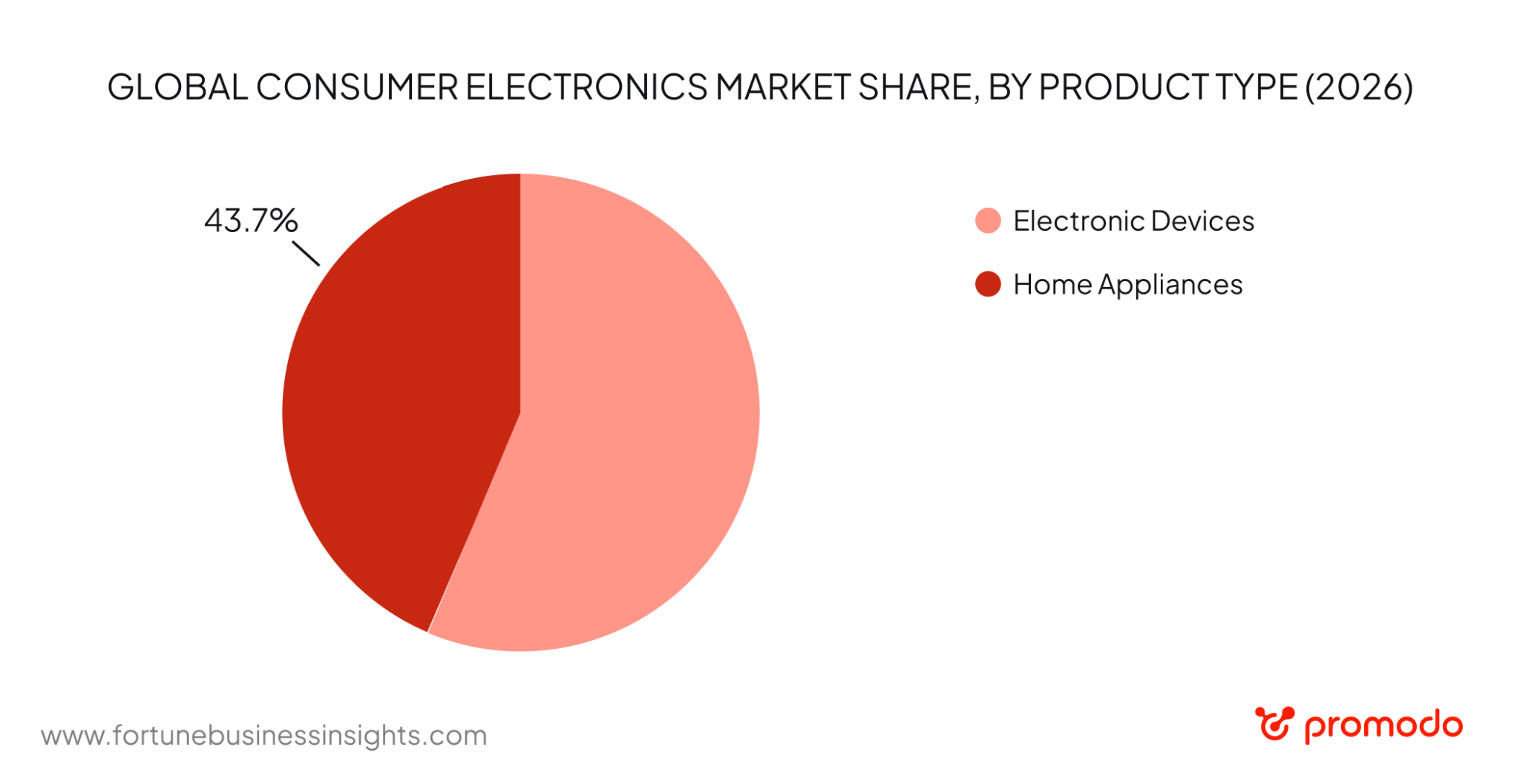
Electronic devices make up the largest product segment (58.33%) in the consumer electronics market, including TVs, computers, digital cameras, and camcorders.
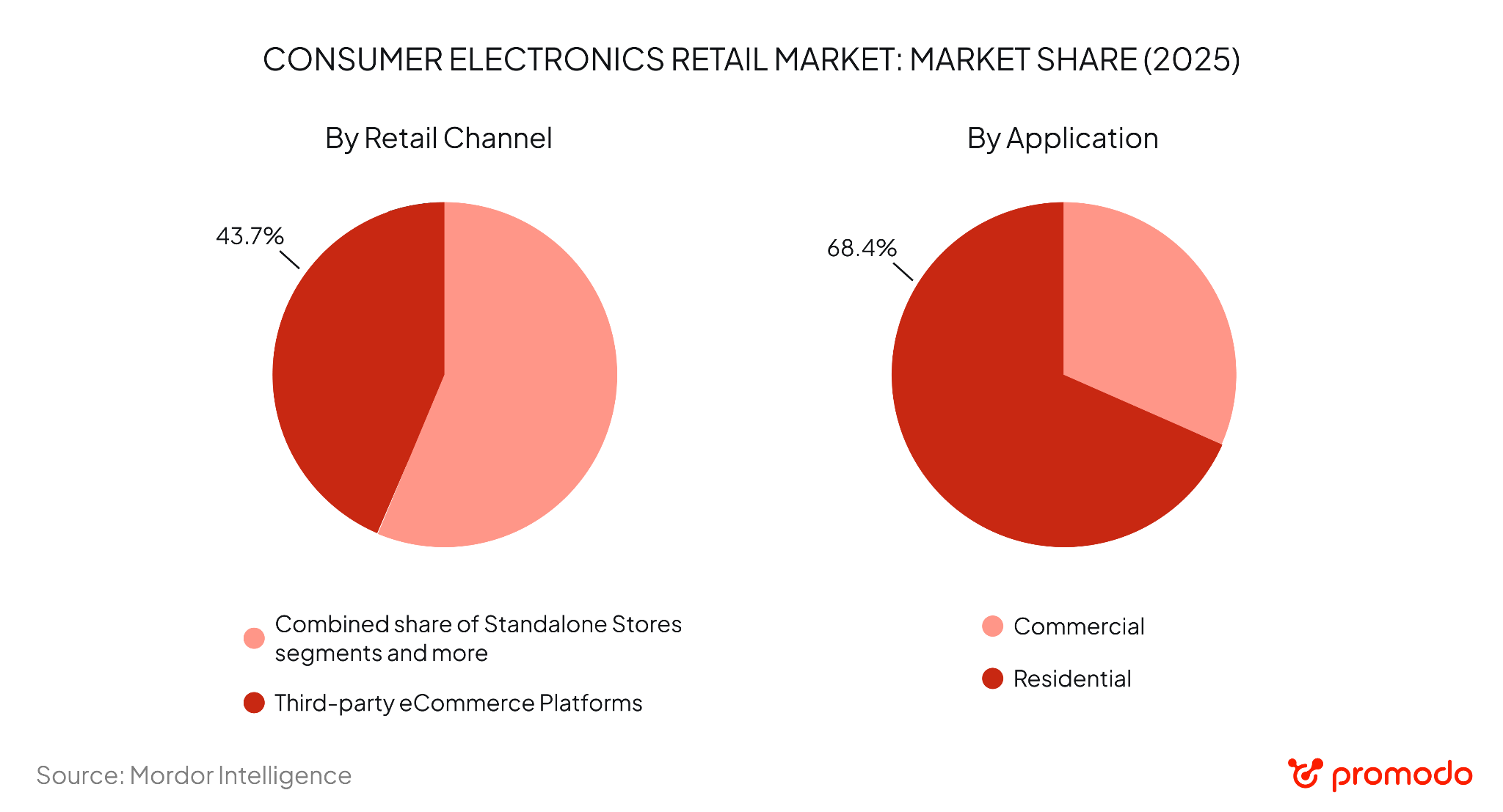
Third-party eCommerce platforms dominate the market, holding 43.72%. Brand-owned websites are expected to grow by 9.92% per year through 2031, compared with 3.22% for standalone stores.
Looking at market share by application, 68.43% of the market in 2025 came from electronics purchased for personal or household use. The remaining share came from business and commercial purchases.
Criteo research found that 52% of consumer electronics purchases happen online. While 58% of home appliance purchases happen in offline stores.
According to Statista, Amazon led the U.S. electronics market, generating more than $163.4 billion in online sales. Walmart and Apple took the second and third spots.
.png)
According to global statistics, in 2025, JD.com was the top online retailer for consumer electronics, generating over $140 billion in sales. Amazon followed with more than $128 billion in annual revenue.
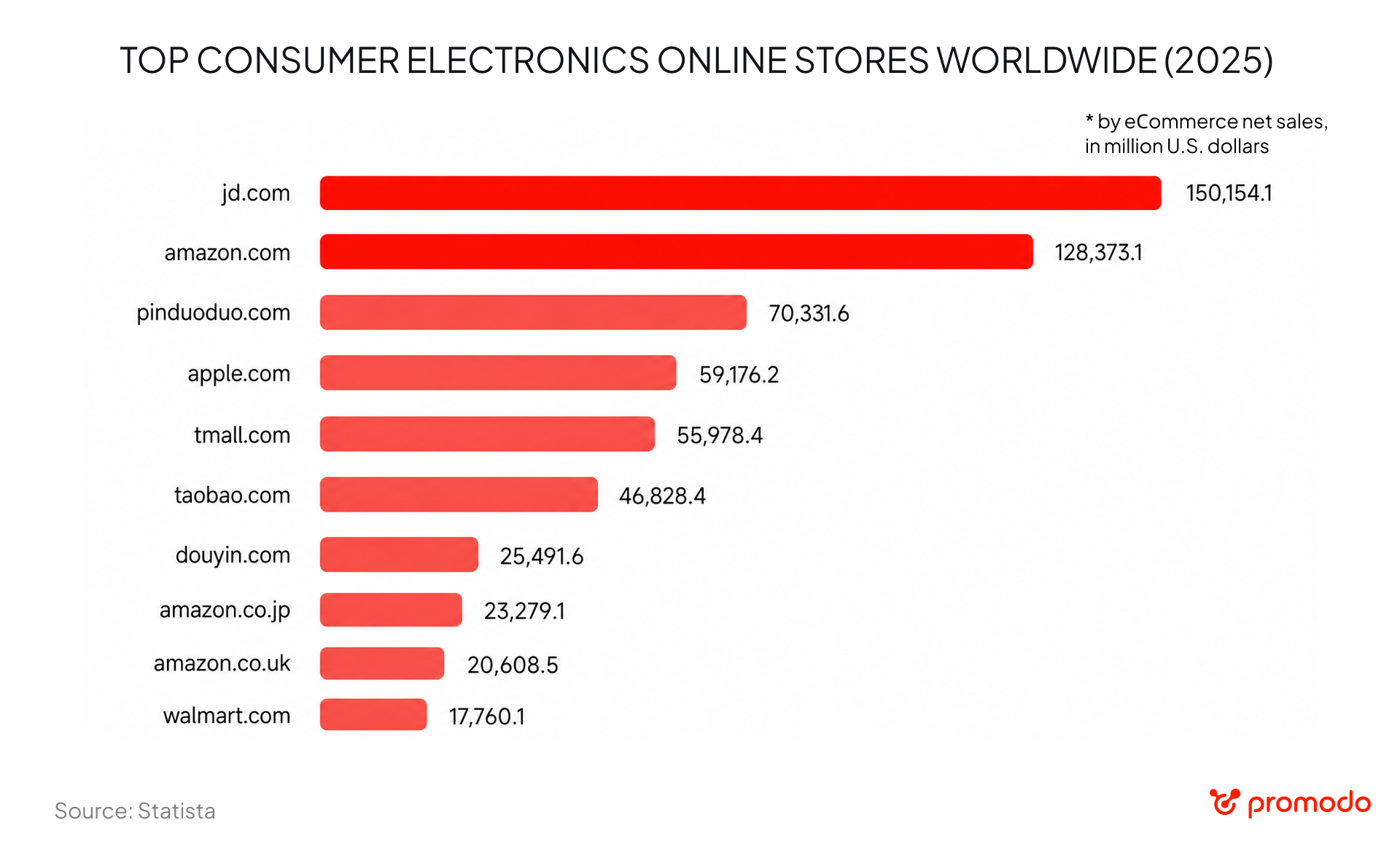
Mordor Intelligence also provides its top players list, and some of the same players are on it (they are not sorted in any particular order).
The same source reports that the five biggest retailers account for just under 40% of global sales. It means regional players have plenty of room to compete and grow.
OpenBrand shared research on the computing market share, and it says that Apple Stores convert 81% of the shoppers they attract. It’s the highest rate among the retailers analyzed. Overall, Apple draws 12% of shoppers.
Also, they found that Apple was the most frequently considered brand when consumers were shopping for desktops, monitors, notebooks, tablets, wireless routers, and similar devices — 28% of respondents chose it. HP (23%) and Dell (22%) followed. People considered Samsung (12%), Lenovo (10%), and Kindle (4%) less often.
As for dollar-share winners in the computing sector, Best Buy (49.8%), Amazon (34%), and Walmart (16%) lead the market.
We conducted our own research and analyzed the traffic sources of the most popular consumer electronics retailers in the US using Similarweb.
Our analysis showed that direct traffic (38.25%) and organic search (29.92%) are the main traffic sources for leading US consumer electronics retailers.
Paid search accounts for 9.03%, followed by referrals (6.7%), display (4.7%), organic social (4.02%), affiliates (3.6%), email (2.6%), Gen AI (0.66%), and paid social (0.48%).
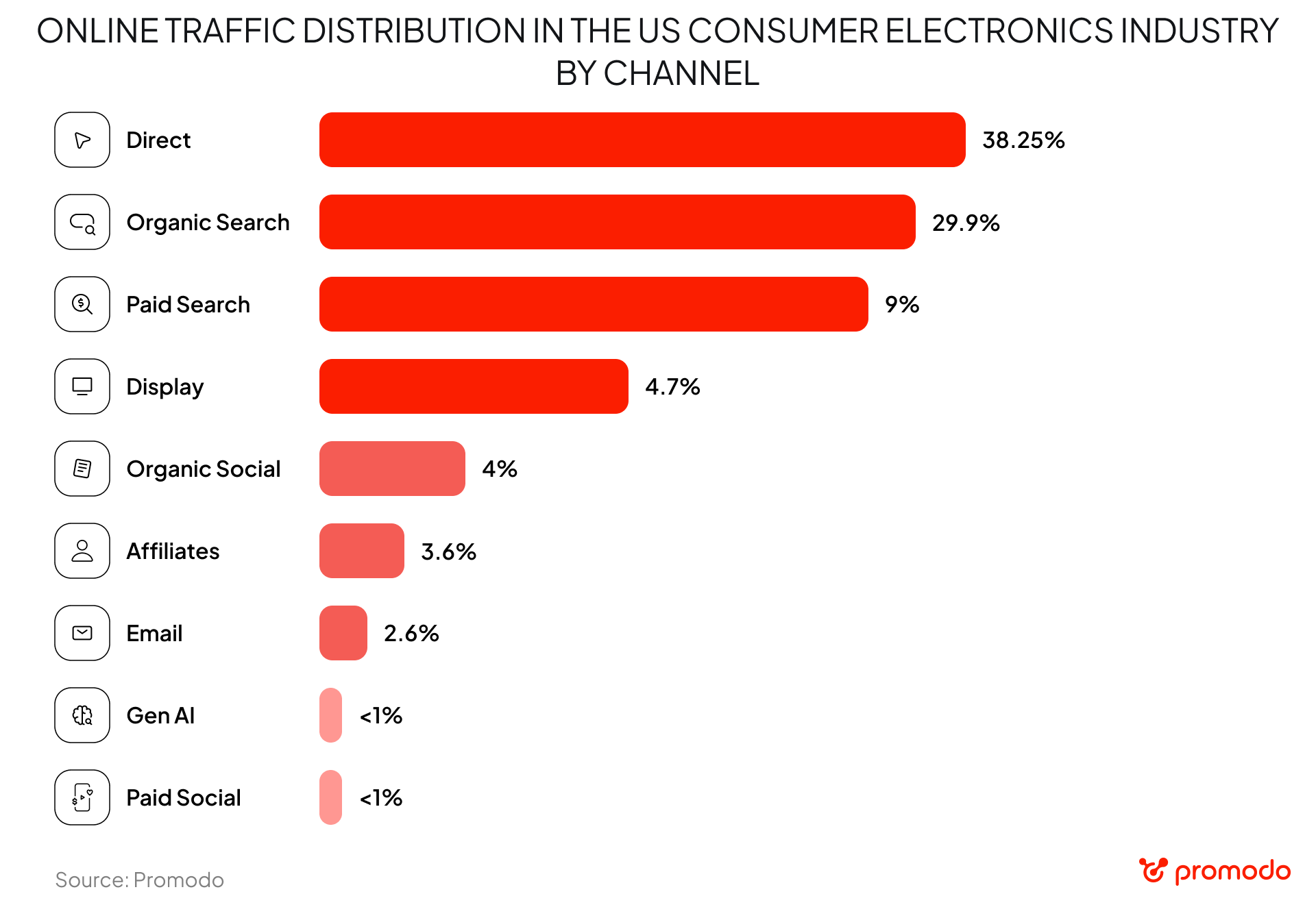
Disclaimer: We do not disclose specific brand names, and the brands analyzed may not match the top players mentioned above.
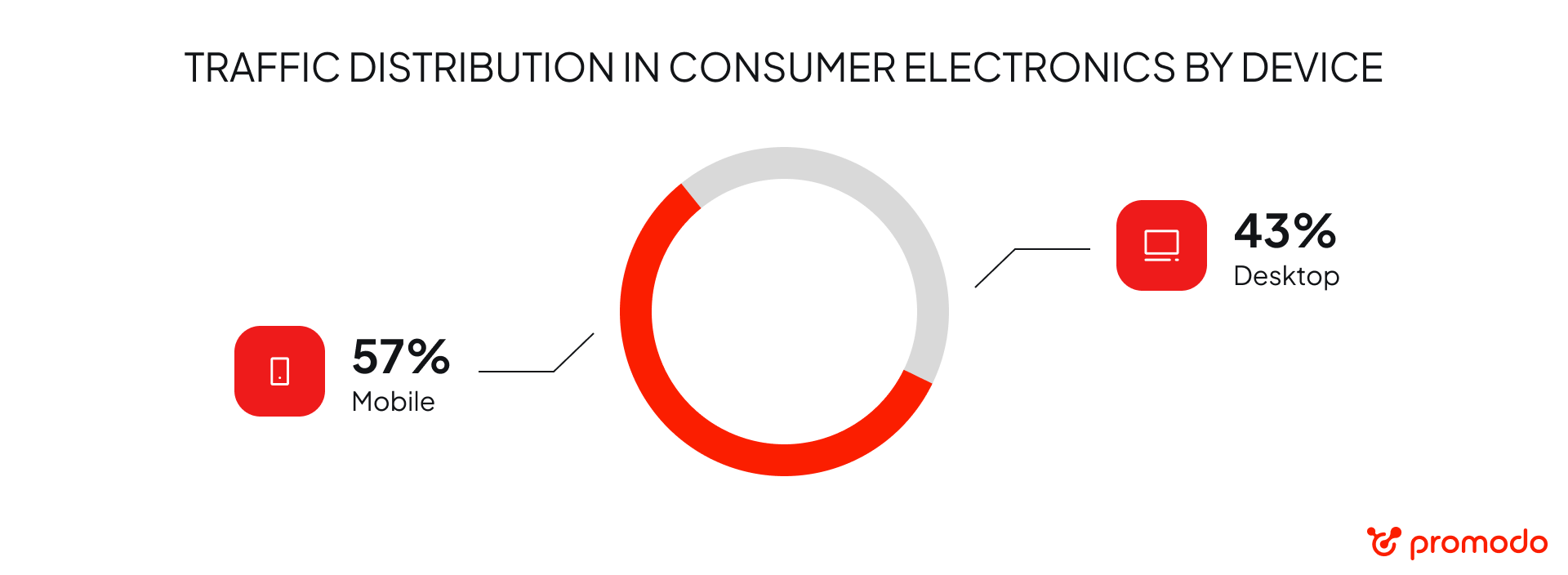
We checked the device distribution across the most popular retailers on Similarweb. The proportion is nearly even, but the majority is still mobile.
In fact, desktop accounts for 43% of traffic, while mobile accounts for 57%.
We’ve gathered key behavioral trends among consumer electronics buyers from several sources, including our own research.
Lately, we conducted our own research and found that U.S. consumers tend to actively research consumer electronics before making a purchase, but the buying journey differs by category.
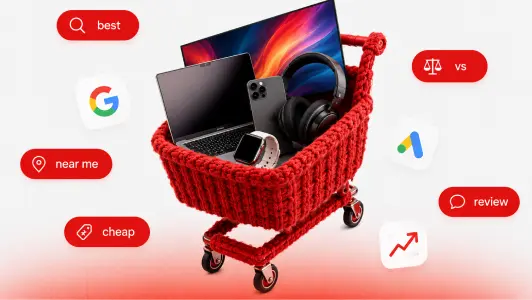
Promodo’s analysis of U.S. search behavior found that “best” was the leading search modifier across five categories.
It means there’s a strong focus on finding the right product rather than simply looking for a specific brand.
There are two distinct types of purchase behavior. TVs, headphones, and smartwatches are more research-driven. Consumers spend more time exploring products, comparing options, and seeking information. There’s a stronger purchase intent for smartphones and laptops. Searches in these categories are more often focused on price, local availability, and where to buy.
It all means different products need different approaches. TVs, headphones, and smartwatches may need more educational content and product comparisons. At the same time, smartphones and laptops may need a stronger focus on price, availability, and making it easy to buy.
This is only an overview of the purchase drivers. Read the article to find more details on consumer electronics purchase behavior.
Let’s see what other sources tell us about consumer behavior.
Criteo reports that 35% of shoppers consult four or more sources before buying, and only 12% rely on a single source. Also, 44% of consumer electronics shoppers usually spend a long time researching and comparing brands before choosing a product.
For 39% of CE shoppers, the purchase window lasts from two weeks to one month (Criteo).
AI recommendations can also directly influence electronics purchases. Globally, 61% of consumer electronics shoppers who use AI assistants say product recommendations in AI responses would influence their purchase decisions. In the U.S., the figure is even higher at 66%.
In an OpenBrand study on computing, 54% of people choose computing retailers for competitive prices, 31% for a good selection of products, 27% because of previous experience with the store, and 16% for a convenient location.
Criteo analyzed 5 categories of consumer electronics items; 29%–34% of global shoppers purchased from a brand they had not previously bought from. In the U.S., the share ranged from 24% to 35%.
Most people still shop for electronics through online marketplaces (60%) and in-store specialists (58%) — these are the two biggest channels overall (Criteo).
Gen X sticks to these the most: 66% shop marketplaces, 62% shop in-store specialists.
Gen Z is different. They use marketplaces less (50%) and instead appear more on brand websites (40%), brand stores (25%), and department stores (21%) than other generations.
So while older shoppers stick to a couple of go-to channels, Gen Z spreads their shopping across more places, including going straight to the brand itself.
Gartner found that 28% of shoppers are open to using AI to help choose personal electronics.
What’s more, Shopify found that AI-referred shoppers convert nearly 50% better and have 14% higher average order values than those coming from organic search.
eMarketer also predicts that the share of AI-driven ecommerce sales will increase from 3.2% of total US retail eCommerce in 2026 to 15.8% in 2030.
AI, in fact, is already sending shoppers closer to the purchase. Criteo found that ChatGPT drove nearly twice as many product-page landings as search did, on average, from January to June 2026.
Globally, 48% of consumer electronics shoppers use AI assistants for at least some purchases, rising to 50% in the U.S. (Criteo)
Now eCommerce websites are adding their own AI assistants to help customers find products, answer questions, and make decisions. At the same time, you can ask ChatGPT to shortlist smartphones within a certain budget. The next step is agentic commerce, where AI can choose a product and buy it for the shopper.
72% of Americans use BNPL services, and electronics is the most popular category to buy with BNPL (65%). Also, according to Fortune Business Insights, consumer electronics is estimated to make up more than 30.% of the global BNPL market in 2026. It’s the largest share among all categories.
This trend is largely driven by the growing number of people buying smartphones, smart TVs, and gaming consoles online. Since electronic devices are often costly, BNPL helps consumers split a purchase into smaller, more manageable amounts.
38% of consumers look for energy-efficient or eco-rated appliances when shopping for home electronics (Criteo). Also, the report notes that 37% are willing to pay more for better performance or quality.
15% of consumers buy appliances from sustainability-focused brands. At the same time, consumers expect brands to do more: 75% say businesses need to take greater action on sustainability, while 63% want more transparency from brands (Sustainable Jungle).
In 2026, a lot of brands already support the sustainability trend:
Consumer electronics is the category where people often research things online but in the end, buy offline.
Consumers can research products online, visit a store to try them, and choose the most convenient way to receive their purchase. Best Buy, for example, offers several ways to get a product: shipping, same-day delivery, in-store pickup, and curbside pickup. And it’s just one example among many retailers that offer similar services.
Physical stores are also becoming more focused on product experiences. In 2026, the same Best Buy expanded Meta Lab at Best Buy to more than 50 stores. Customers can try Meta’s AI glasses and VR headsets before buying.
For electronics retailers, the goal is to make the online and in-store experience work together, rather than treating them as separate channels.
Since more people turn to AI for shopping, we recommend investing in GEO to improve visibility in AI-generated recommendations.
Make your content detailed, well-structured, and easy to summarize, with clear product information, comparisons, pricing, and answers to common questions. At the same time, make sure your site has a solid technical foundation and demonstrates real expertise and trust through strong E-E-A-T signals, credible sources, reviews, and up-to-date information.
For consumer electronics brands, this is especially important because shoppers often compare multiple products before buying. The more complete and trustworthy the information on your site, the easier it is for AI systems to understand your products and use them in their recommendations.
.webp)
Shoppers who browse multiple retailers see more brands than those who stick to one retailer. In the U.S., they see an average of 2.5 brands across multiple retailers, compared with 1.7 brands when shopping at a single retailer. It gives brands more reason to stay visible across various shopping platforms (Criteo).
Mobile accounts for the majority of traffic, so the mobile shopping journey must be as complete and frictionless as the desktop one. Optimize site speed, product-page readability, navigation, filtering, comparison functionality, checkout, and payment options for smaller screens.
Mobile users should be able to compare products, check stock, understand delivery options, and complete a purchase without switching devices.
Offline channels remain important for products customers want to see, test, or discuss before purchasing. If your brand is available in physical retail, unify online and in-store inventory, local availability, pickup, delivery, returns, and service information.
Strengthen local SEO with optimized location pages and Google Business Profiles where relevant, and actively collect and respond to customer reviews. It will help you appear when shoppers search for consumer electronics stores or specific products nearby.
Promodo helps consumer electronics brands get found when shoppers research, compare, and decide where to buy. Our team can strengthen SEO and AI search visibility, improve product pages and mobile journeys, and connect digital demand with marketplace- and store-level availability.

Copywriter at Promodo
Over nearly three years as a copywriter, I’ve written for US and European startups and companies, including SE Ranking. I enjoy working with words—finding the right phrasing, organizing ideas, and turning them into clear and useful content that shows real value and helps businesses grow.
You may also like
Choose quality and trusted services to improve the presence of your company on the Internet, and feel free to contact our UK team if you have any questions.

Find out the key content marketing trends for 2026 that deserve a spot in your content marketing strategy.
.png)
Ukraine's eCommerce market kept growing in the first half of 2026 despite the country's most severe wartime energy crisis to date.

Are you thinking of changing your domain name but worrying about losing traffic and sales? No need to, let us explain why.
We at Promodo are ready to help you improve your performance across all digital marketing channels.
Get started


.png)
.svg)


