Content



Team Lead of Content for promodo.com
Experienced in working with data, expert recommendations, and real business cases to create clear and valuable content that delivers real business impact. Passionate about discovering new insights, exploring industry trends, and turning complex topics into practical, easy-to-understand content.
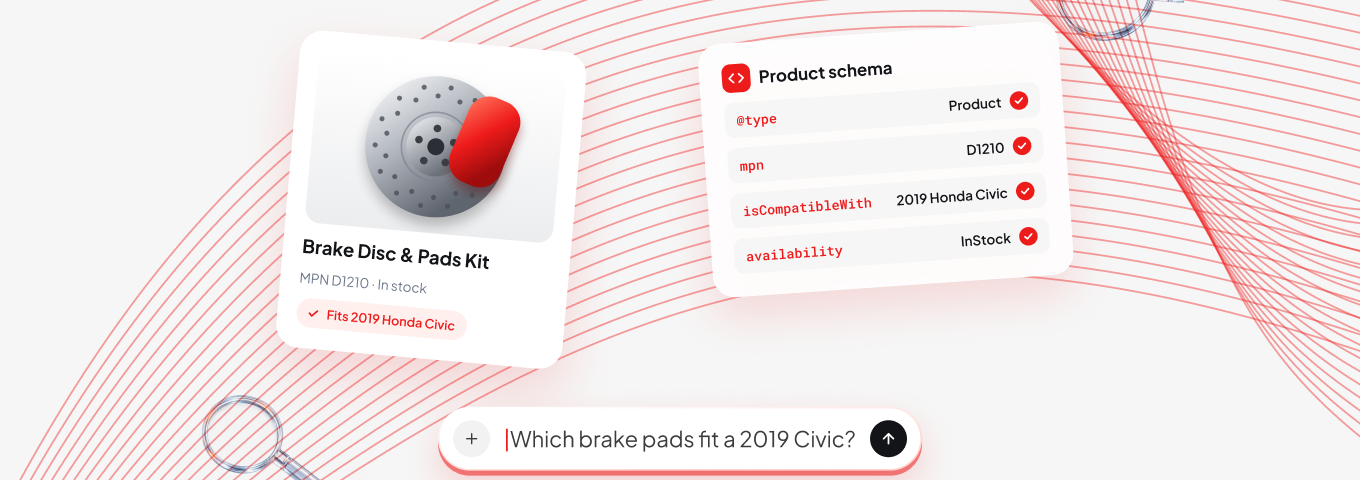
Ask ChatGPT for "front brake pads for a 2019 Toyota RAV4 hybrid" and you may get a confident answer with the wrong part number, a pad for the non-hybrid trim, or a store that no longer stocks it. The model is not careless. It is guessing, because most auto parts stores publish fitment, part numbers and stock in a form people can read but machines cannot. Structured data SEO is how you stop the guessing: you describe each part, its identifiers, its price, its reviews and the vehicles it fits in machine-readable markup that Google, Bing and AI assistants can parse without inference.
This guide explains why large language models misread auto parts catalogs, which schema types fix it, and what happened when Promodo applied the same approach to a product-led eCommerce site: +351% traffic from AI assistants and +551% revenue from that traffic in three months (case study).
Auto parts are the hardest product category for an AI assistant to answer correctly. A single brake pad SKU can fit 40 vehicle configurations and miss the 41st by one engine code. When the facts that separate those configurations are not machine-readable, the model fills the gap with probability.
Most parts stores show compatibility through a year/make/model selector, a JavaScript widget or a "Fits these vehicles" tab loaded on click. A shopper sees it. A crawler often sees an empty container. AI assistants build answers from content they can fetch and render, so a page without visible fitment is, to them, a page about a generic brake pad.
The same physical part can carry an OEM number, an aftermarket MPN, a supersession number and a retailer SKU. Without mpn, gtin and brand declared explicitly, a model cannot tell whether "D1210" is a part number, a model name or a dimension, and it may merge two different products.
Tabs such as ?tab=specs or ?tab=reviews, filtered category pages and marketplace listings create several versions of one product. Each version may show a different price, stock status or rating. A model that sees conflicting signals either averages them or picks the most frequently cited source, which is often not your store.
Ratings and review counts often render client-side or sit in a widget without markup. Then an assistant has no evidence that buyers confirmed the part fits, and it has a reason to recommend a competitor whose rating is declared in aggregateRating.
ChatGPT does not keep its own clean parts catalog. OpenAI documents that OAI-SearchBot indexes sites for ChatGPT search, and sites that block it are not shown in search answers (OpenAI crawler docs). Independent research by Peec AI, summarized by Precis, found that products in ChatGPT shopping carousels could be traced to Google Shopping's top organic results for the matching query. Either way, the inputs are search indexes and product data, and both run on structured data.
Demand makes the problem urgent. Promodo's 2026 analysis of US auto parts searches found 30.1M average monthly searches, with 10.9% of demand focused on finding the right part. Those fitment and part questions are exactly the ones shoppers now ask AI assistants.
Structured data SEO is the practice of describing a page's entities and facts in a standard machine-readable vocabulary, usually Schema.org in JSON-LD, so search engines and AI systems can understand, verify and reuse them. For an auto parts store, those facts are the part, its manufacturer, its identifiers, its price and stock, its reviews and the vehicles it fits.
Google defines structured data as a standardized format for classifying page content, and Product markup makes pages eligible for merchant listings, product snippets and the shopping knowledge panel (Google Search Central). Google also states that its AI features rely on the same core SEO principles as Search, with no extra technical requirements to appear in AI Overviews or AI Mode (Google: AI features and your website).
That last point matters. There is no secret "LLM schema". Structured data helps AI search in three indirect but powerful ways:
In short, structured data SEO does not replace content. It makes the content you already have unambiguous. Promodo's broader guide on how to get ChatGPT and AI search to recommend your brand covers the content and mention side; this article focuses on the data layer.
Promodo's GEO case for an eCommerce manufacturer is the clearest public proof that structured, renderable product data changes what AI assistants cite. The client sells power tools and electronics, not auto parts, but the catalog problem is the same one parts retailers face: rich specs, manuals, videos and reviews that bots could not see.
The client is a mono-brand manufacturer with its own online store and an offline retail network (name under NDA). The site already had detailed specifications, reviews and videos for each product. AI assistant traffic was minimal and flat through 2025.
The SEO audit showed the problem was not missing content but inaccessible content:
The team built a backlog of 16 technical items and gave top priority to the product page:
Compared with January 2025, AI traffic grew by more than 3,200%. The break from a year-long flat range coincides with the February 2026 release, and most AI visits in May 2026 landed directly on product pages.
Replace "specifications tab" with "fitment tab" and you have the typical parts store. The lesson transfers directly: an AI assistant can only recommend a part for a 2019 RAV4 hybrid if the page it renders says, in text and in markup, that the part fits a 2019 RAV4 hybrid. Promodo's Autodoc case shows the same principle on a large parts catalog, where server-side rendering made product data accessible to crawlers and organic traffic recovered by 47%.
A parts product page needs five layers of markup. The first three are what Google uses for merchant listings; the last two are what make the page unambiguous for AI answers.
Two honest caveats. First, Google's rich results do not currently use fitment properties, so isAccessoryOrSparePartFor will not change how a snippet looks. It is still the official Schema.org property for this relationship, and it gives any parser an explicit statement instead of a guess. Second, Google says a wrong identifier is worse than none: if you do not know a part's GTIN, leave it out and rely on mpn + brand (Merchant Center product data specification).
In North America, fitment is exchanged through ACES (Aftermarket Catalog Exchange Standard) and part attributes through PIES (Product Information Exchange Standard), both maintained by the Auto Care Association. The current versions, ACES 5.0 and PIES 8.0, were released in April 2026 (announcement). If your suppliers send ACES/PIES files, your structured data should be generated from them, so the markup, the visible fitment table and your feed all say the same thing.
The order matters. Steps 1 and 2 decide whether AI crawlers can see your facts at all; markup added before them describes content no one can render.
For seasonal catalogs, finish this before peak demand. Promodo's Black Friday SEO checklist explains why pages must be crawled, indexed and marked up weeks before a sale.
Measure two things separately: whether AI assistants mention and cite you, and whether that exposure brings revenue.
Give changes time. Promodo measured from the February 2026 release to May 2026, three months, and compared the result against a full year of flat AI traffic to rule out seasonality.
Most of these show up in a single technical review. If you are not sure where your catalog stands, start with an SEO audit focused on product templates.
AI assistants already answer the fitment questions your customers used to type into Google. The stores they cite are the ones whose product pages state the part, the vehicle, the price and the proof in a form machines can read. Promodo's GEO team anв automotive SEO specialists can audit your product templates, fix fitment rendering and build structured data from your ACES/PIES files. Get a GEO consultation.
[[FAQ-START]]
Structured data SEO is adding standardized, machine-readable markup, usually Schema.org in JSON-LD, that describes a page's entities and facts. For eCommerce it covers products, offers, identifiers, reviews and breadcrumbs. It helps search engines and AI systems understand a page without guessing, and it makes products eligible for merchant listings and rich results.
There is no public confirmation that ChatGPT parses JSON-LD directly at answer time. Structured data still shapes its answers indirectly: ChatGPT search relies on crawled pages and search indexes, and shopping results draw on product data that search engines build from markup and feeds. Clean markup plus visible content is the reliable path.
Usually because fitment, part numbers or stock are hidden in JavaScript, tabs or PDFs, or because the same part shows conflicting data on several URLs. The model then infers compatibility from incomplete text. Putting fitment in server-rendered HTML and in isAccessoryOrSparePartFor markup removes most of that ambiguity.
Schema.org's isAccessoryOrSparePartFor property links a Product to the Car or Vehicle it fits, with properties such as brand, model, vehicleModelDate and vehicleEngine. Google does not show it in rich results today, so pair it with a visible fitment table and accurate mpn, brand and Offer data.
In Promodo's eCommerce case, changes went live in February 2026 and AI assistant traffic was up 351% by May 2026, about three months later. Timing depends on crawl frequency, so allow search crawlers, keep sitemaps current and use IndexNow to speed up re-indexing in Bing.
Yes, ideally both. Google can show merchant listings from on-page Product markup alone, but it recommends combining markup with a Merchant Center feed so it can cross-check price, availability and identifiers. Consistency between the two also reduces the risk of AI tools quoting outdated prices.
[[FAQ-END]]
Team Lead of Content for promodo.com
Experienced in working with data, expert recommendations, and real business cases to create clear and valuable content that delivers real business impact. Passionate about discovering new insights, exploring industry trends, and turning complex topics into practical, easy-to-understand content.
You may also like
Choose quality and trusted services to improve the presence of your company on the Internet, and feel free to contact our UK team if you have any questions.

Google is the absolute leader among search engines. That's a fact. However, ignoring SEO Bing means losing potential customers.

Ukrainian entrepreneurs are actively exploring new markets and implementing digital solutions to optimize their processes.

While the primary goal of SEO is to generate organic traffic, it takes on added significance in safeguarding the reputation of a bank.
We at Promodo are ready to help you improve your performance across all digital marketing channels.
Get started