



Content



Organic traffic is up, and revenue is flat. It is the most common complaint in eСommerce SEO, and the hardest one to act on from the inside: the reports look healthy, the positions keep improving, and revenue from organic sits where it was — not only against last month, but against the same month a year ago.
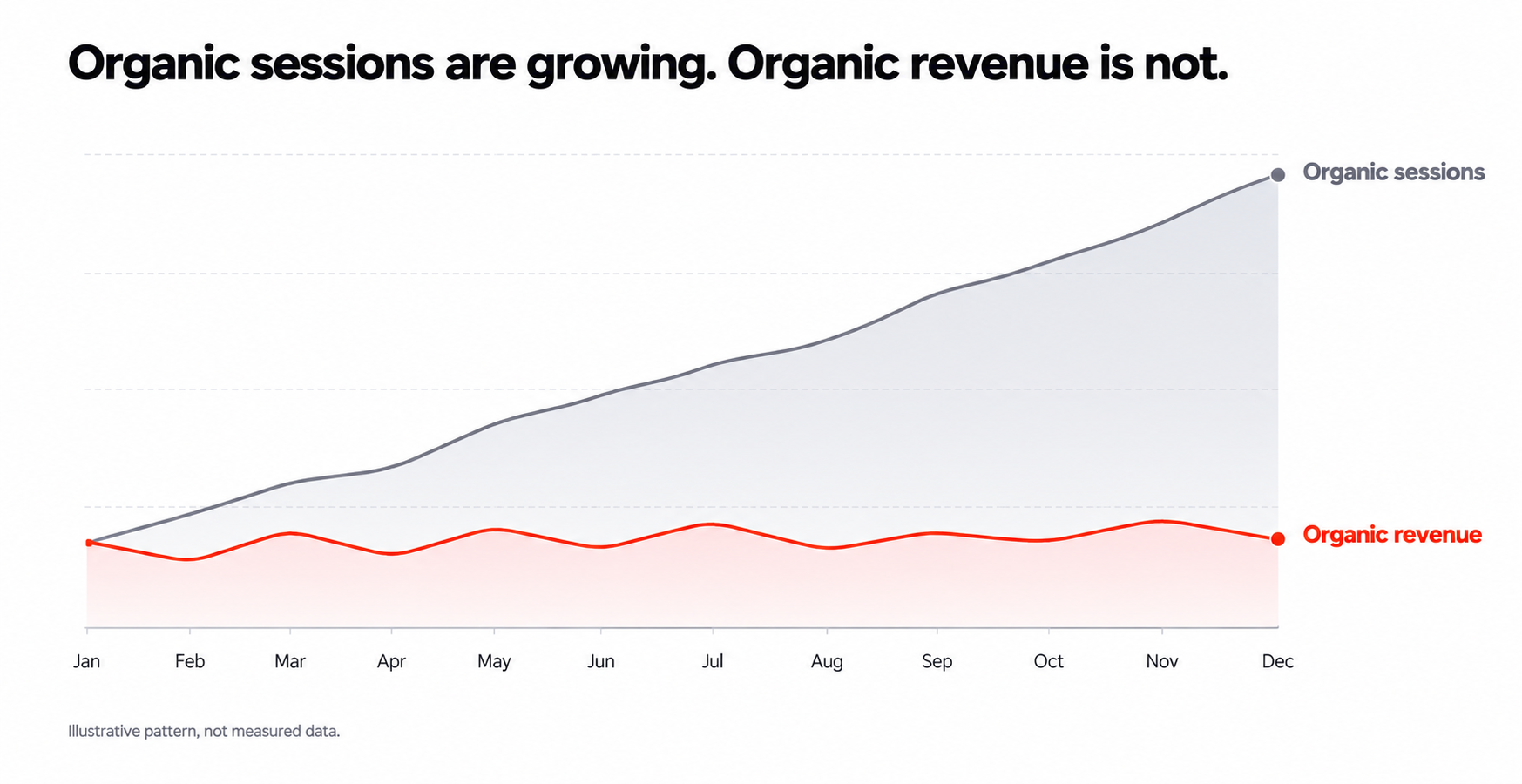
The reason is rarely one broken thing. It is usually several small ones stacked on top of each other, and from inside a single store they are almost impossible to separate: every metric has an explanation, every explanation sounds plausible, and none of them changes the number. What it takes is someone who has seen the same pattern across dozens of catalogs — and who can not only name the root cause but fix it and show movement within the next few months, not at the end of a 12-month contract.

Below are the best eCommerce SEO companies working on revenue rather than sessions, and what each one is best at.
Promodo fits retailers who want organic measured in revenue and AI visibility handled alongside classic SEO. OuterBox fits high-SKU catalogs. Coalition Technologies fits stores rebuilding or replatforming. Victorious fits brands that want a pure SEO specialist and nothing else. Siege Media fits categories where content and links decide the ranking. Searchbloom fits mid-market stores running SEO and paid from one budget. Seer Interactive fits enterprise retailers with complicated measurement.
Every one of the best eCommerce SEO companies on this list was assessed on the same thing: what they put in the monthly report. That criterion, and five others, are explained after the list.
Promodo has worked with online retail for more than 20 years across 20+ markets, and runs SEO alongside paid media, generative engine optimization and analytics in one team. The practical effect is that organic is reported against revenue and margin rather than sessions, because the same team sees what paid is doing and what the backend records.
Best for: mid-market and enterprise retailers whose organic traffic grows faster than organic revenue, multi-market stores, and brands that want AI visibility measured rather than assumed. 175 companies in the United States have worked with Promodo, which holds a 4.8 average rating on Clutch.
Not a fit if: you want a single technical audit delivered and nothing after it.
Two examples. A Shopify brand in the US competing for organic visibility against Amazon, Etsy, eBay and Walmart — technical work, catalog filters, Merchant Center markup, thin content removal — moved its share of tracked queries in the top five from 14% to 30% in six months.

An eCommerce brand working on visibility inside AI assistants grew traffic from those sources by 351% and revenue attributable to that traffic by 551%.
OuterBox has been working on eCommerce exclusively for over two decades and describes a team of more than 240 specialists, which puts it among the largest eCommerce-only SEO companies in the US. The work centers on catalog and product-page SEO for stores on Shopify, BigCommerce and Magento, and extends into design and development when the architecture itself is the constraint.
Scale is the argument. A catalog with tens of thousands of SKUs needs people who have done the same work at that volume, and few agencies can staff it without subcontracting.
Best for: large retailers where category structure, product-page templates and internal linking across thousands of URLs decide the result.
Not a fit if: you have a small catalog and need creative content more than catalog mechanics.
Coalition Technologies combines SEO with design and development, and specializes in rebuilding underperforming stores with search requirements built into the architecture rather than retrofitted after launch. The platform focus is Shopify and WooCommerce.
That matters because a replatform is where most organic revenue quietly disappears. URLs change, internal links break, templates lose markup, and the drop is usually noticed a quarter later. Our domain migration checklist covers what has to be agreed before the switch, whoever runs it.
Best for: stores mid-rebuild, mid-migration, or planning one in the next six months.
Not a fit if: your site is stable and the problem is purely organic performance on an existing platform.
Victorious does one thing. No paid media, no design, no social — SEO only, which means the engagement is judged on a single channel and nothing else subsidizes the result.
For a brand that already has paid and creative handled and wants a specialist rather than another full-service partner, the narrow scope is the point. It also makes accountability simple: there is no second channel to attribute the growth to.
Best for: stores with in-house marketing or existing agencies for other channels, who need deep SEO work plugged into what already exists.
Not a fit if: you need one partner to own acquisition as a whole, or your organic problem is actually a product-page or pricing problem.
Siege Media built its reputation on content-led organic growth and on earning links through digital PR rather than acquiring them. For eCommerce categories where buyers research before they choose — furniture, tools, equipment, anything considered — that upper-funnel layer is often what separates two otherwise identical stores.
The caveat is timeline. Content programs compound, and they rarely move commercial category rankings in the first quarter.
Best for: stores in considered-purchase categories that need topical authority and links, with the patience for a program measured over quarters.
Not a fit if: your categories are already ranking and the blockage is technical or structural.
Searchbloom works across SEO, local search and paid media, and positions itself around running organic and paid as one acquisition program rather than two. It is a Google Premier Partner and reports a 4.9 rating on Clutch across more than 100 reviews.
The case for a combined setup is practical: keyword data from paid tells you which organic rankings are worth chasing, and paid can hold position on commercial terms while organic catches up.
Best for: mid-market retailers running both channels who want one team and one view of acquisition cost.
Not a fit if: you have a large in-house paid team and want an organic specialist to work alongside it.
Seer Interactive is known for an analytics-first approach to search, with a strong emphasis on data engineering behind the SEO work. For large retailers whose attribution spans several systems, that layer often surfaces the real problem before any optimization starts.
This is the agency for the situation where nobody can agree on what the numbers mean. The downside is that the engagement starts slower, because the measurement has to be sorted out first.
Best for: enterprise retailers with complex data, several markets, and internal disagreement about what organic is actually contributing.
Not a fit if: you want execution to start in week one and your analytics are already clean.
The fastest way to narrow the top eCommerce SEO companies down to a shortlist is to compare what they report on, not how many clients they have. A store that needs revenue to move cannot afford a partner whose definition of progress stops at rankings.
The list gives you names. This section gives you the test, so you can apply it to anyone else on your shortlist — because the best eCommerce SEO company in general is rarely the best eCommerce SEO company for your particular store.
Ask what the monthly report leads with. If the first slide is positions and sessions, the engagement is optimized toward positions and sessions, and you can get both while revenue stays flat.
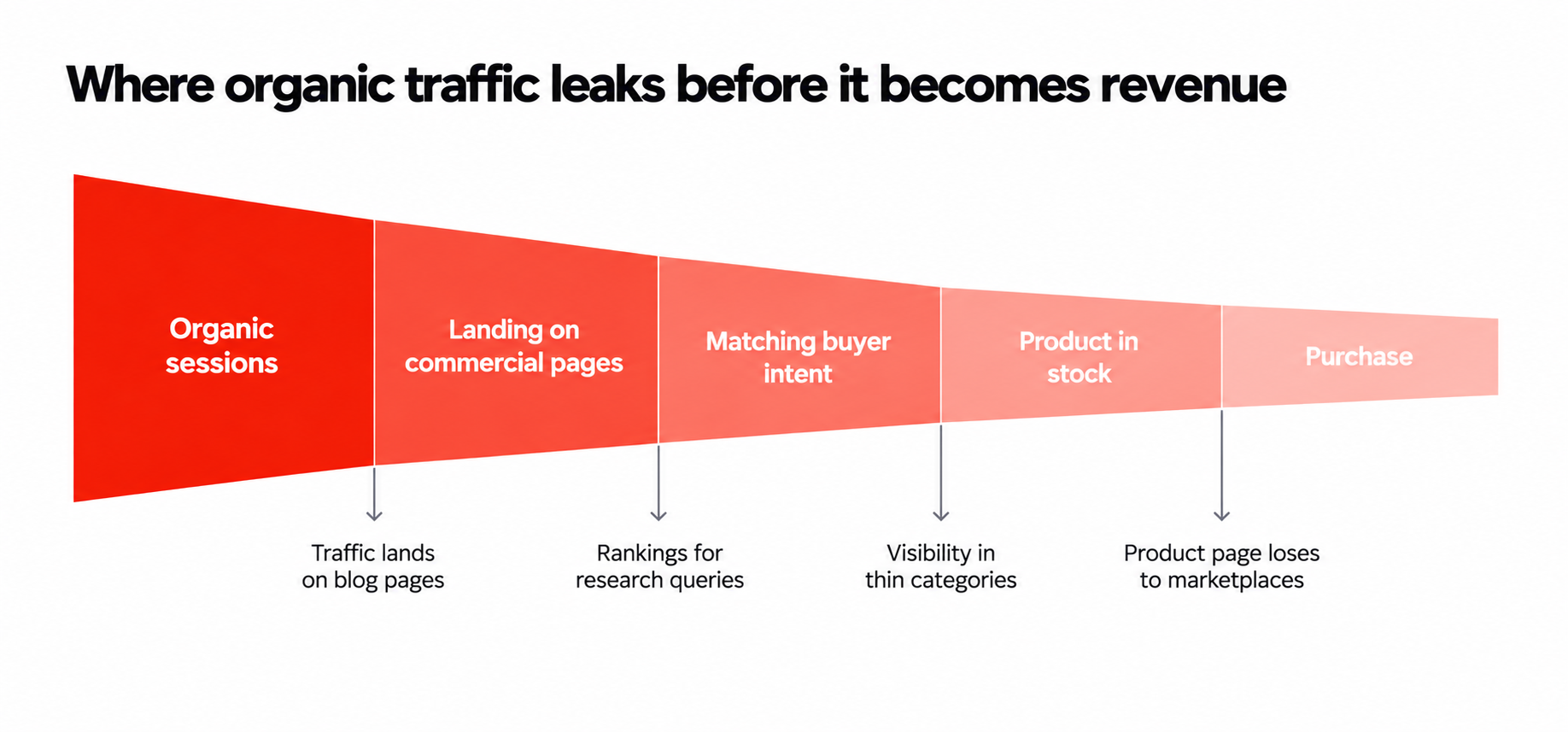
That happens in three ordinary ways. Growth lands on blog pages rather than commercial categories. Rankings arrive for queries with the wrong intent — readers instead of buyers. Or visibility appears in categories where half the products are out of stock, so the traffic bounces. None of these looks like a failure in a traffic chart.
A capable eCommerce SEO agency reports organic revenue by category, and can say which categories moved and why. If the agency cannot access your backend numbers, ask who is stopping that from happening.
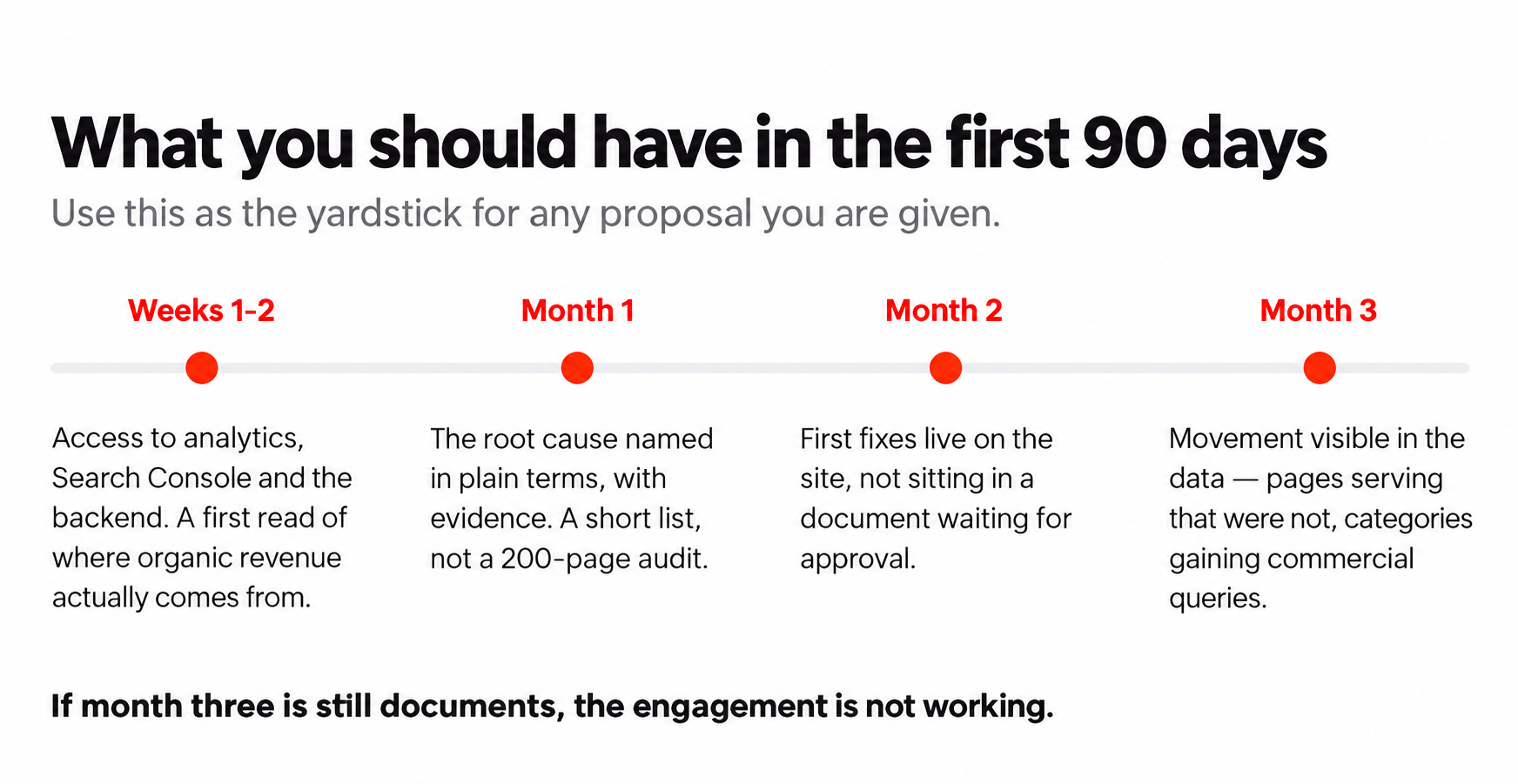
A good partner will tell you within the first month or two what is holding revenue back, in plain terms, with evidence. Not a 200-page audit with every issue weighted equally — a short list with the one or two things that actually matter for your store.
Ask what they would look at first and why. The answer tells you whether they have seen your situation before or are about to run a generic checklist on your site.
Platform decides which problems you will have. A Shopify SEO agency deals with collection and tag URLs multiplying, limited control over robots directives and app-injected scripts. On Magento and custom builds the issues are layered navigation, faceted URLs and crawl budget disappearing into filter combinations.
Ask which platforms the team works on most, and what the recurring issue is on yours. Anyone with real experience will answer in one sentence.
Category pages get most of the attention because they rank for the bigger terms. But SEO for eCommerce product pages is where the transaction happens, and it is usually the weakest part of the site: duplicated manufacturer descriptions, no reviews, missing or incorrect markup, variants splitting signals across near-identical URLs.
Ask whether product-page work is in scope or whether the agency considers it the client’s job. Both answers are legitimate, but you need to know which one you are buying.
For many brands, Amazon and Walmart outrank the manufacturer on searches for the manufacturer’s own products. That is not a ranking problem in the usual sense — it is a question of what your product page offers that a marketplace listing does not.
Ask how the agency approaches it. Agencies with real eCommerce experience have a position on this. Those without one will treat it as an unavoidable fact.
A growing share of research now ends inside an AI answer. Impressions hold, positions hold, clicks fall — and in Search Console it looks like a CTR decline with no obvious cause.
Ask how the agency measures visibility in AI answers and what it reports on. The honest answer in 2026 is that few have a method; the ones who do will show you the tracking rather than describe it.
Want someone to run this test against your current setup? Book a free strategy session. We will look at your current setup and tell you where the growth is, with no commitment on your side.
Use these on the first call. The best eCommerce SEO companies answer all ten without hesitating, because they have been asked before.
Question 1 does most of the filtering. Agencies that report on sessions will show you a sample report full of sessions.
These are the signals that separate the top eCommerce SEO companies from the ones that will keep you busy for a year.
A traffic forecast without a revenue forecast. Traffic projections are easy and mean nothing on their own. Ask what revenue that traffic is expected to produce.
No questions about margin or stock. An agency that never asks which categories make money will happily grow the ones that do not.
Deliverables counted in volume. Twenty articles a month and fifty links is an activity report, not a strategy.
Nothing to show before month six. Technical fixes and page-level work produce measurable movement earlier than that. A six-month silence usually means the first quarter went into documents.
Rankings reported without impressions or clicks. Position improvements in queries nobody searches are easy to generate and easy to spot.
Shortlisting the best eCommerce SEO companies is less about ranking them and more about matching one to the reason your organic revenue stopped moving. If you do not yet know that reason, that is the first thing to find out — and it is a shorter conversation than most agencies make it.
[[FAQ-START]]
There is no single answer, and anyone giving you one is selling. The best eCommerce SEO company for a 200-SKU Shopify brand is not the one for a 50,000-SKU retailer mid-replatform. Match the agency to the reason your revenue is flat: catalog structure, product pages, content authority, platform, or measurement.
In a healthy engagement: technical fixes, category and product-page work, content, internal linking, markup, and reporting against commercial outcomes. The split shifts over time — heavier technical work early, more content and authority work later.
Technical fixes on indexation and templates can move within weeks because pages start being served that previously were not. Category rankings typically read clearly in three to six months. Content programs compound over longer periods.
It depends on catalog size, platform, number of markets and how much content production is included. Two quotes that differ sharply are usually quoting different scopes, so compare the work before the number.
Look at organic revenue by category year over year, not sessions month over month. If sessions grow and category revenue does not, the work is landing on the wrong pages.
Our guide to SEO for eCommerce walks through the fundamentals, so you can judge a proposal on its merits.
[[FAQ-END]]

You may also like
Choose quality and trusted services to improve the presence of your company on the Internet, and feel free to contact our UK team if you have any questions.

Having a healthy brand means that your efforts are recognized and valued by your audiences.

The recent crisis years have vividly illuminated the value of working in Internet marketing.

We're here to alleviate your struggle with simple, effective tips that have helped many of our clients to get more traffic and leads.
We at Promodo are ready to help you improve your performance across all digital marketing channels.
Get started


.png)

.svg)


