Content


Copywriter at Promodo
Over nearly three years as a copywriter, I’ve written for US and European startups and companies, including SE Ranking. I enjoy working with words—finding the right phrasing, organizing ideas, and turning them into clear and useful content that shows real value and helps businesses grow.
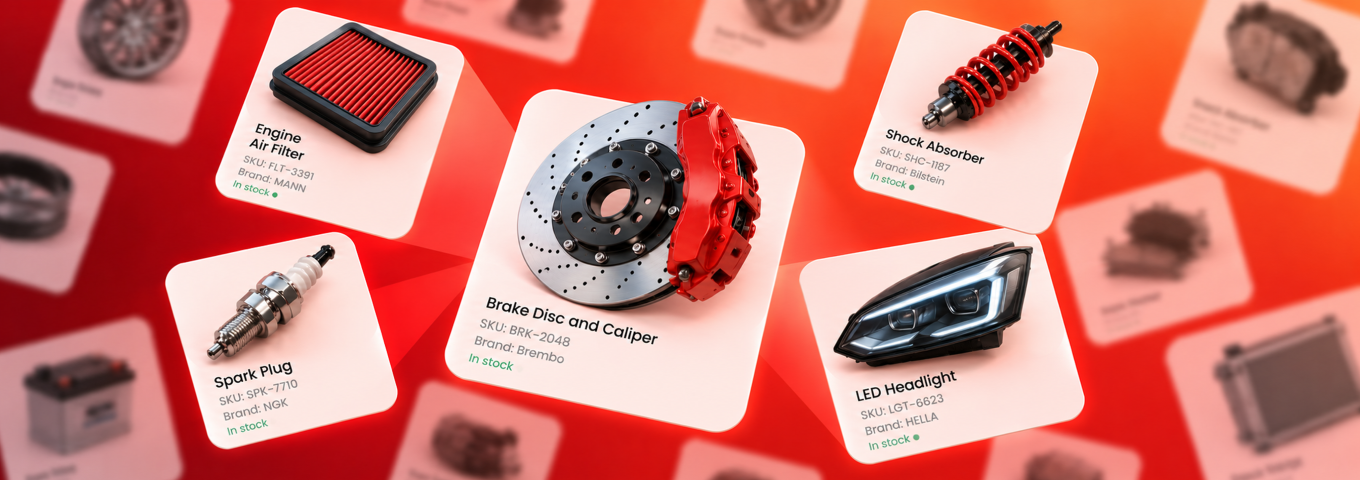
When you're managing 100,000+ auto parts, it's easy to lose track of what's actually happening across your Google Shopping campaigns. You're investing in ads, but thousands of products may never get shown to potential buyers. Campaigns become harder to manage, product information gets outdated, and increasing your budget doesn't always bring better results.
But you don't necessarily need to spend more to get better results. With the right Google Shopping feed optimization approach, you can improve product visibility, use your ad budget better, and manage a large catalog without adding manual work.
In this article, we'll explain where to focus your efforts and share how Promodo PPC team has helped automotive retailers improve their PPC performance.
In Google Shopping and Performance Max (Google's automated campaign type), you don't choose keywords. Google uses your product feed to decide which searches to show your products for. This means your product data quality directly affects which potential buyers see your ads.
For example, Google uses the product title to match your product to a customer's search.
Auto parts put that system under unusual pressure:
Many retailers create separate campaigns for each product category. But with large catalogs, this leaves each campaign with too little conversion data for Google's automation to work effectively. As a result, even increasing budgets may not improve revenue or profitability.
Google uses product identifiers to recognize what you're selling.
For most products, that's a barcode. For auto parts, it's often the brand and manufacturer's part number. Without these details, your products may get less visibility. You can check which products are affected in Google Merchant Center.
Start by checking how many products in your catalog have both a brand and a manufacturer's part number. This simple audit will show where information is missing and which products need attention.
Follow Google's guidelines: don't use made-up identifiers or internal codes to fill gaps, as this can lead to product disapprovals. Include barcodes where available, and consider adding original (OEM) part numbers to product descriptions, since buyers often search for those exact numbers.
Titles do most of the work in Google Shopping feed optimization. Google allows up to 150 characters, but shoppers usually see only the first 70. So, put the most relevant information first.
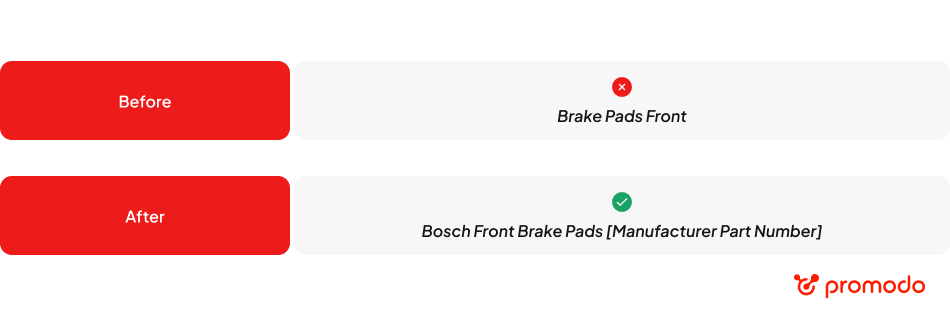
For auto parts, a good title includes the brand, part type, part number, and key details like size or vehicle compatibility. Avoid prices, promotional phrases, store names, and unnecessary capitalization, as Google doesn't allow these in titles.
Keep in mind that one part may fit hundreds of vehicles, so you can't list them all in the title. Instead, focus on clearly identifying the part. For searches that include a specific vehicle, use search ads that lead buyers to the relevant filtered page on your website.
With 100,000+ products, writing titles manually isn't practical. Instead, you can generate them automatically using your existing product data. If you use generative AI to write titles, make sure your feed follows Google's requirements for AI-generated titles, including the structured_title attribute.
For example, here's how a more descriptive title could look:
People search for auto parts in different ways, and not every type of ad works equally well for each search.
Based on Promodo's analysis, auto parts searches generally fall into three groups: product category, category with car make, and category with make and model. Tire retailers also see searches for exact products.
Here's one way to match your ads to different searches. The best approach will depend on your products, campaign performance, and how much control you need.
You can use your existing product data, including categories, vehicle makes and models, and website filters, to automatically create relevant search ads.
While Performance Max can also reach these searches, dedicated Search campaigns give you more control over keywords, ad copy, and landing pages. This is especially useful when buyers are looking for a specific part or vehicle.
Google's automation works better when campaigns have enough conversion data to learn from. If you split a large catalog into too many product-category campaigns, each may get too few conversions to perform well.
One approach we've used at Promodo is to group products by price rather than category or brand. This makes campaigns easier to manage and helps direct more budget toward products that generate revenue. However, consider profit margins before choosing this approach.
Price isn't the only option. You can also group products by profit margin, sales volume, or seasonality. Google Merchant Center supports this through custom labels, which let you organize products using rules based on your product data.
Choose an approach that fits your business goals. For example, if profitability matters more than revenue growth, grouping products by margin may be more useful than grouping them by price. Keep campaigns consolidated where possible so Google's automation has enough data to optimize performance.
In large catalogs, many products receive little or no attention from Google Ads. These are often called zombie SKUs: products that get few or no impressions, clicks, or sales.
The problem can be bigger than you think. In some large retail accounts we've worked with, up to 80% of products received little or no ad exposure. Even similar products can perform very differently, with some selling well while others get almost no visibility.
Identify these products and test them in separate campaigns with more flexible performance targets. Based on the results, decide which products to keep advertising, improve, or exclude.
Promodo has used this approach in more than 40 projects. In one case, previously overlooked products went on to generate up to 20% of the store's total revenue.
You can start by checking product-level reports in Google Ads to find products with little or no visibility. Review the first group manually to understand why they're underperforming. Then use what you've learned to automate the process.
For large catalogs, tools like Promodo's AdsHub can help monitor these products and keep the groups updated.
For large auto parts catalogs, keeping search ads updated manually is difficult. One of our automotive clients faced this problem: outdated prices, missing product details, incorrect keywords, and products that weren't advertised at all.
The solution is to automate search campaigns using your product feed. For example, Promodo's G-MOS tool generates ad groups, keywords, and ads from approved templates. It also updates ads when prices or stock levels change, as often as once an hour. This helps keep ads accurate without constant manual work.
However, your team still needs to decide which searches to target, how to group products, and which ones to exclude. The goal is to reduce manual work while keeping control over your advertising strategy.
In many cases, revenue is lost due to overlooked technical gaps.
- Borys Dziundziuk, PPC Automation Specialist at Promodo
Make sure someone on your team checks product approvals, feed errors, and products that aren't getting impressions. This helps catch problems before they affect your advertising results.
There are also two important Google updates to prepare for:
1. Google is replacing the Content API with the Merchant API.
Google retired the Content API for Shopping on August 18, 2026, with a full shutdown planned for early 2027. If your eCommerce platform manages your feed, your provider should handle the transition. But if you use a custom integration or an older tool, check with your vendor that it supports the new Merchant API.
2. Dynamic Search Ads are moving to AI Max.
Google plans to automatically upgrade campaigns using Dynamic Search Ads to AI Max starting in February 2027. One important consideration is that AI Max can automatically choose which pages your ads lead to. For auto parts retailers, this matters because customers searching for a specific part need to land on the right product page.
If you're currently using Dynamic Search Ads, test AI Max before the transition, check your landing page settings, and compare sales results rather than just clicks.
Read more about AI Max in our article:

Exist is a large auto parts retailer with over 1 million products and physical stores in 21 cities. Each product is linked to specific vehicle makes, models, and modifications.
The goal was to increase revenue while maintaining the target return on ad spend (ROAS).
Here's what we changed:
The changes delivered strong results: we increased transactions by 318%, revenue by 430%, and ROAS by 11%.
Read the full Exist case study for more details on the approach and results.

Managing Google Shopping for 100,000+ products doesn't have to mean bigger budgets or more manual work. Start by reviewing your product feed, identifying products with little or no ad visibility, and checking whether your campaign structure supports your business goals.
Not sure where your Google Shopping campaigns could perform better? At Promodo, we help auto parts retailers optimize product feeds, automate campaigns, and make better use of their ad budgets.

Copywriter at Promodo
Over nearly three years as a copywriter, I’ve written for US and European startups and companies, including SE Ranking. I enjoy working with words—finding the right phrasing, organizing ideas, and turning them into clear and useful content that shows real value and helps businesses grow.
You may also like
Choose quality and trusted services to improve the presence of your company on the Internet, and feel free to contact our UK team if you have any questions.

In this article, we’ll explain what Google Lens is, why it’s becoming critical for eCommerce, and how to make sure your products are bought through images.

What fintech apps pay for installs, how many users stay after day 1, and how US and European markets compare. Fresh 2026 benchmarks.

While paid ads generate $2 in return for every dollar spent, real estate businesses consider a pay-per-click (PPC) strategy as a sustainable option.
We at Promodo are ready to help you improve your performance across all digital marketing channels.
Get started